









































Share the post “Why “Average Wind Speed” Can Give You the Wrong Answer About Wind Energy”
Eventually the turbine reaches its rated output.
Above that region, it does not simply continue increasing electrical output according to v³ indefinitely.
Control systems limit the turbine.
At sufficiently high wind speed, it reaches the cut-out speed and shuts down for protection.
So even knowing the wind’s theoretical power distribution is not enough.
We need to combine:
How frequently each wind speed occurs
with:
How the actual turbine responds at that wind speed.
That is how resource assessment starts becoming energy-yield assessment.


A Very Strong Wind Can Contain Lots of Energy and Still Produce Zero Electricity
This sounds contradictory until we consider the turbine’s operating limits.
Suppose an unusually strong wind exceeds the machine’s cut-out speed.
The atmosphere contains enormous kinetic power because v³ has become very large.
Yet the turbine may deliberately produce:
0 kW
because it has shut down for protection.
Now consider very weak winds below cut-in speed.
Again:
0 kW
Between those extremes is the turbine’s useful operating region.
This is why taking an annual average wind speed and putting it into:
P = ½ρAv³
cannot by itself predict annual turbine generation.
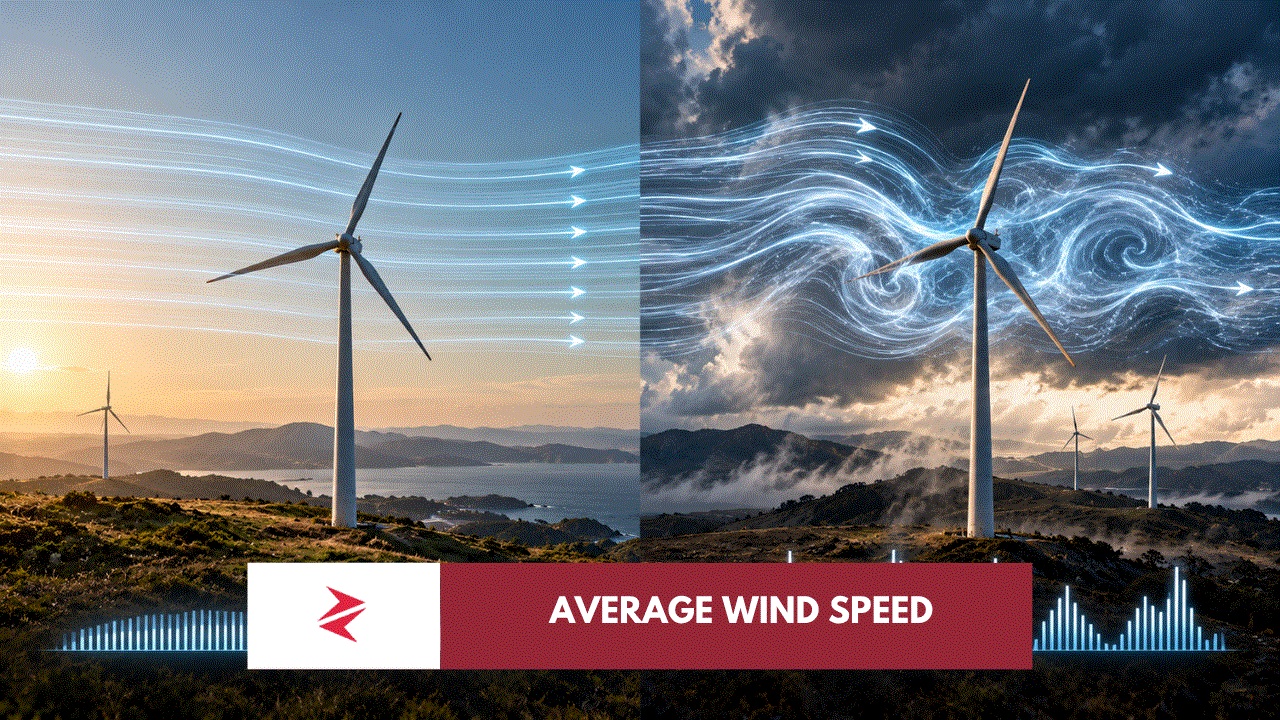
The atmosphere has a distribution.
The turbine has a power curve.
Energy production comes from the interaction of the two.
This Is Also Why Rated Power Can Mislead
Suppose a turbine is rated at 2 MW.
That does not mean it generates:
2 MW × 24 hours × 365 days
every year.
That calculation would give:
17,520 MWh
but it assumes the turbine remains at rated output continuously.
Wind doesn’t behave that way.
Sometimes wind is below cut-in.
Sometimes the turbine operates below rated power.
Sometimes it reaches rated output.
Sometimes wind becomes excessive.