





































Share the post “Megacities Without Farms: The Fragility of Modern Urban Civilization”
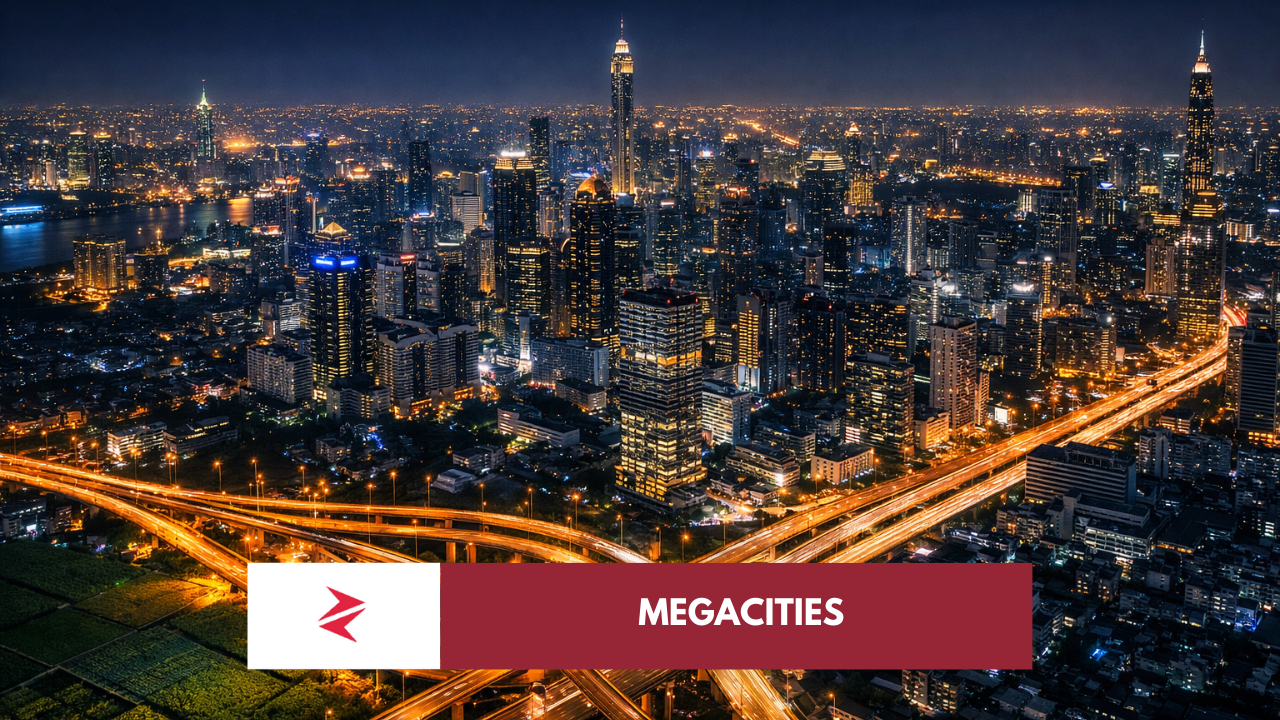
Modern civilization has constructed a remarkable illusion: that our cities are self-sufficient islands of technology and prosperity. Glass towers illuminate the night sky, digital economies move billions across invisible networks, and supermarkets remain permanently stocked with food transported from across the planet. Yet beneath this sophisticated façade lies a structural vulnerability that few urban populations fully understand — the survival of modern megacities depends entirely on energy-driven logistics that connect them to farmland often located hundreds or even thousands of kilometers away.
Historically, cities were inseparable from the land that sustained them. Ancient settlements rarely grew beyond the capacity of surrounding farmland and water supplies because food production imposed natural limits on population size. Agriculture, livestock, and seasonal harvest cycles defined the rhythm of urban life, and any disruption to the local ecosystem could quickly threaten survival.
The industrial revolution changed that equation permanently.
The discovery and widespread use of fossil fuels allowed human civilization to break the geographic limits that once constrained urban growth. Oil-powered transportation networks — trucks, ships, railways, and aircraft — began moving enormous quantities of food, fertilizer, construction materials, and consumer goods across continents and oceans. For the first time in human history, cities could expand far beyond the natural capacity of the land surrounding them.
Karachi, Shanghai, London, and New York are not simply urban centers; they are logistical organisms sustained by global supply chains. Their daily survival depends on an uninterrupted flow of resources produced somewhere else — wheat grown on distant farms, vegetables transported from agricultural belts, fertilizers manufactured through energy-intensive chemical processes, and refrigerated cargo delivered through fuel-powered shipping fleets.
The moment those supply chains falter, the illusion of urban independence collapses.
The Energy System Behind the Urban World
What most people call globalization is fundamentally an energy system. Container ships crossing oceans burn vast quantities of fuel. Heavy trucks move agricultural produce from farms to distribution hubs. Refrigerated transport systems preserve food across long journeys before it reaches urban markets.
Every tomato in a supermarket, every bag of wheat flour, every carton of milk has travelled through an energy-intensive chain of production, processing, and transportation.
The digital age has not removed humanity’s dependence on physical resources — it has simply hidden them behind layers of infrastructure. Data centers powering the internet consume enormous amounts of electricity. Steel, concrete, copper wiring, and silicon chips all require industrial manufacturing powered largely by fossil fuels.
The modern city therefore rests on an invisible industrial machine operating far beyond its skyline.