
























“When in the course of human events…”—the Americans wrote that line to justify separation, to rationalize rebellion, to formalize a break from power structures they no longer accepted. In the Muslim world, however, things have never been that clean, never that honest, and certainly never that intellectually consistent. We do not declare causes—we blur them. We do not separate domains—we fuse them until neither religion nor politics retains its original clarity.
Comparative religion in our part of the world has rarely been about understanding; it has almost always been about legitimacy. Television anchors sprinkle Islam into every discussion not because the issue demands it, but because ratings do. Textbooks quietly embed ideological constructs that mix nationalism with selective theology, creating a version of Islam that serves the state more than it serves truth. The result is a confused society where even leadership figures speak with conviction on matters they have not fully interrogated, and where intellectual laziness passes off as ideological certainty.
This is where the conversation becomes uncomfortable.
Because the problem is not Islam.
The problem is Political Islam.
And more dangerously, the problem is our refusal to admit that distinction.
The events of 26 February 1993, when individuals like Ramzi Yousef and his associates attacked the World Trade Center, did not merely mark a security failure; they triggered a narrative shift that would haunt Muslims globally. Actions carried out under banners of anti-Semitism, anti-Zionism, and distorted religious justification began to define Islam in the global imagination. Whether one agrees with every geopolitical explanation or questions official narratives—as many Pakistanis historically have—the fact remains that the branding of Islam became inseparable from acts carried out by individuals claiming religious legitimacy.
And yet, we internalized this narrative selectively.
We became defensive where we should have been introspective.
We argued about conspiracies while ignoring the intellectual vacuum that allowed such interpretations to flourish in the first place.


The attack on Malala Yousafzai was not just an act of violence; it was an exposure of this internal collapse. A society that could not protect a child advocating education had already lost the moral clarity it claimed to defend. Political parties that speak loudly about terrorism often remain silent when accountability threatens their own structures. Names are known, questions are asked, but systems protect themselves. This selective outrage has become the norm.
So we continue to oscillate.
Sweeping between the axis.
Never confronting the center.
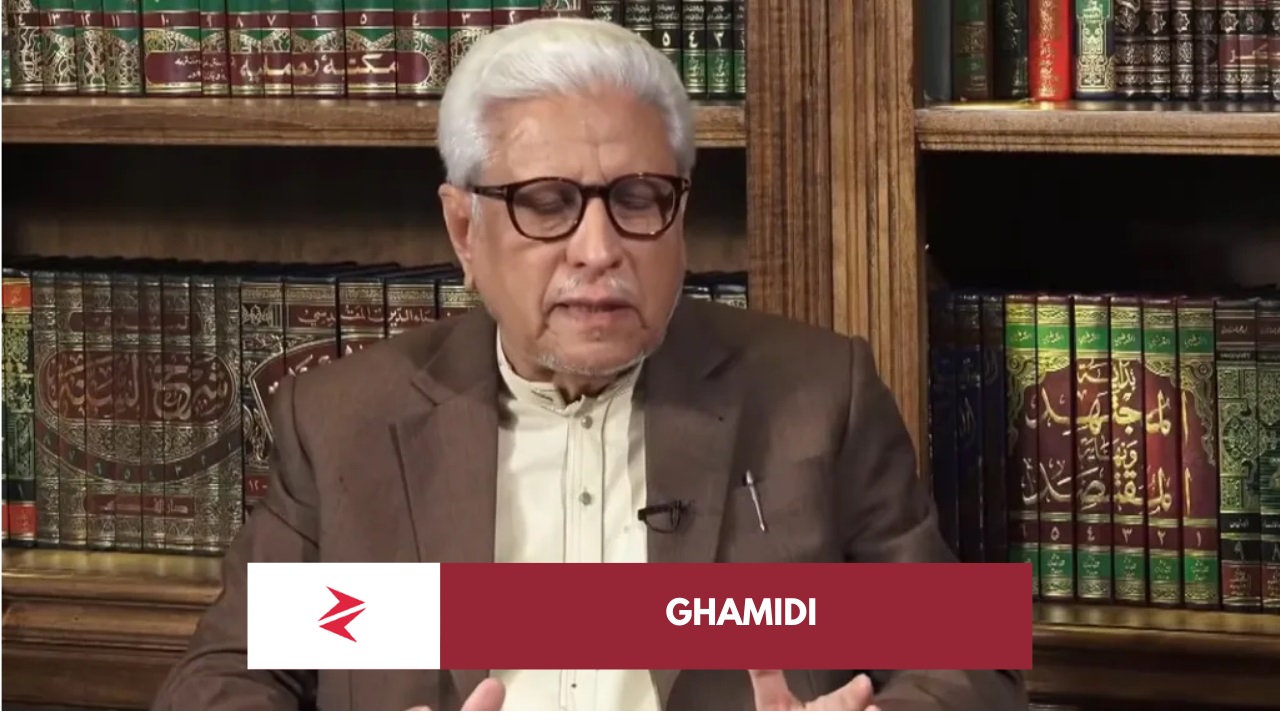
In this intellectual vacuum emerges a figure like Javed Ahmad Ghamidi, whose work through institutions like Al-Mawrid attempts to reframe the conversation entirely. The debate surrounding Ghamidi is not merely about one scholar—it is about methodology, authority, and the future of Islamic thought in Pakistan.
Classical Islamic jurisprudence was built over centuries through rigorous scholarship. The Hanafi, Maliki, Shafi‘i, and Hanbali traditions did not emerge overnight; they were the result of continuous intellectual labor, grounded in Quran, Hadith, consensus, and analogical reasoning. These schools valued continuity, discipline, and respect for scholarly tradition.
Ghamidi, however, represents a different impulse—one that seeks to return directly to foundational texts, emphasizing ethical coherence over inherited legal structures. His approach attempts to distinguish between timeless principles and historically contingent rulings, arguing that much of what we consider “Islamic law” is in fact the product of human interpretation shaped by specific contexts.
Supporters see this as revival.
Critics see it as rupture.
But both miss a deeper point.
Debate itself is not a threat to Islam—it is its tradition.
From the earliest centuries, Muslim scholars disagreed, challenged, refined, and reinterpreted. Entire schools of thought emerged from disagreement. Intellectual friction was not feared; it was necessary. What we are witnessing today is not unprecedented—it is a continuation. The difference is that modern debates are taking place in an environment polluted by politics, media sensationalism, and ideological insecurity.
The Council of Islamic Ideology, for instance, reflects this tension in institutional form. On one hand, it attempts to align legislation with Islamic principles; on the other, it occasionally introduces progressive interpretations such as the acceptance of DNA evidence. These moments reveal that even within state-backed religious bodies, there is an ongoing struggle to reconcile tradition with modern realities.
And yet, the larger confusion persists.
We refuse to separate Islam from political expediency.
We refuse to distinguish between faith as a moral framework and its use as a tool of power.
This is where the real debate lies—not in whether Islam and democracy can coexist, but in whether we are intellectually honest enough to stop weaponizing religion for short-term political gain.
Because until that happens, we will continue to produce contradictions.
We will defend Islam while misrepresenting it.
We will claim unity while practicing fragmentation.
We will demand respect from the world while refusing accountability within ourselves.
The Ghamidi debate, therefore, is not about choosing sides.
It is about choosing intellectual integrity.
And until that choice is made collectively, the confusion will remain—loud, persistent, and dangerously unresolved.