





























Share the post “Ali Musa Gilani, the Dubai Deportation Claim, and Pakistan’s Fake News Addiction”
A public representative travels. A claim appears. Screenshots spread. Political camps load their guns. Abuse begins. Pakistan’s name is dragged in. UAE is dragged in. Diplomatic arrangements are mocked. Personal character is attacked. Family is attacked. Then the person named in the allegation says the claim is false. The original post reportedly disappears. This is not journalism. This is not accountability. This is not patriotism. This is digital vandalism dressed as breaking news.
Syed Ali Musa Gilani, Member of the National Assembly from NA-151 Multan-IV and a PPPP lawmaker, is not an anonymous person on the internet. His official National Assembly profile identifies him as Syed Ali Musa Gilani, son of Syed Yusuf Raza Gilani, with oath-taking date listed as February 29, 2024. That public status does not make him immune from scrutiny. It also does not make him available for reckless, unsourced humiliation. Public life invites questions. It does not legalize falsehood.
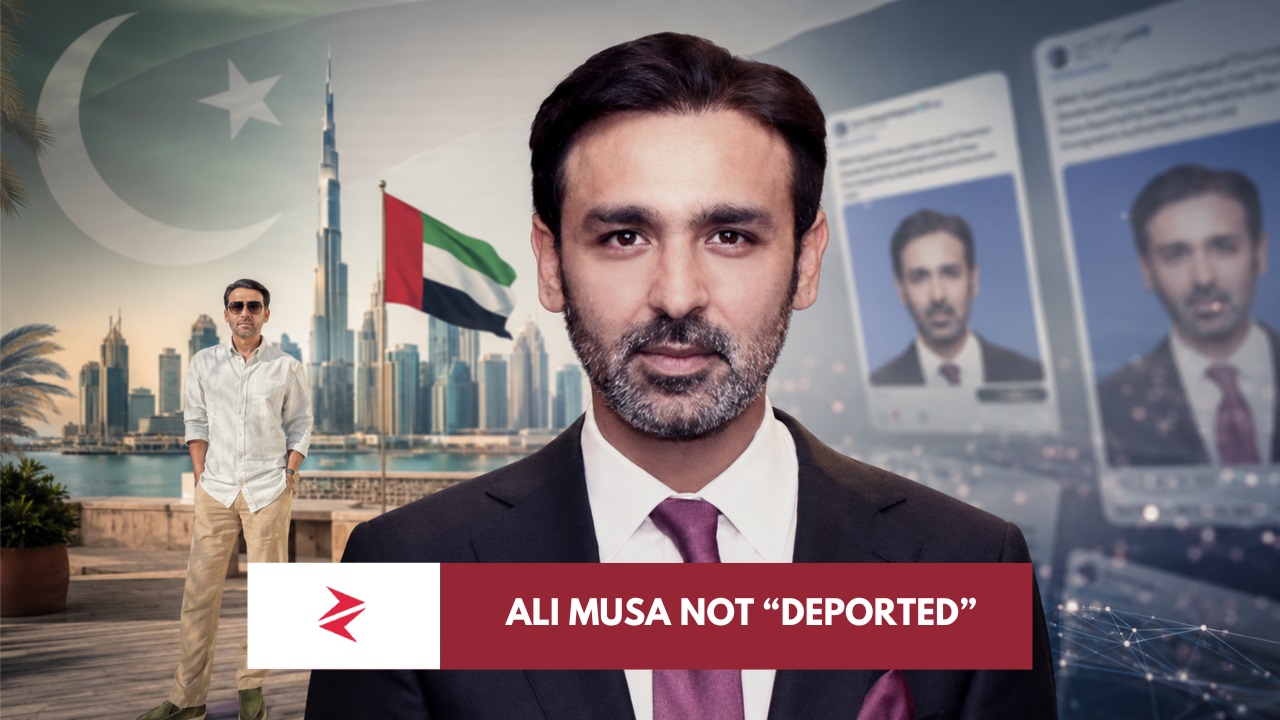
The allegation in circulation was severe: that Ali Musa Gilani had been deported by Dubai Immigration Authorities from the UAE. Deportation is not a casual travel detail. It is a legal and diplomatic claim. When made about a sitting MNA, the burden of proof is higher, not lower. If true, it would require documents, immigration confirmation, airline records, official correspondence, or at least credible sourcing from institutions directly connected to the matter. A blue-tick post or political excitement is not evidence.
Ali Musa Gilani publicly denied the allegation, calling it fake news and saying he travelled and returned according to schedule. Daily Pakistan reported his denial and quoted his statement that he was not deported and had returned as planned. Dawn also reported that he denied reports of deportation from the UAE and termed them fake news. At this stage, the source-backed position is clear: the allegation exists in social media circulation; the named individual has denied it; mainstream reporting has recorded the denial; publicly available reporting cited here does not provide documentary proof of deportation.
That distinction matters. Saying “he denied it” is journalism. Saying “he was deported” without proof is exposure. Saying “he must prove he was not deported” reverses the burden of proof. Wrong. If someone makes an allegation, that person carries the burden. Not the victim. Not the reader. Not Pakistan. Not UAE. The person who publishes the claim must prove it.
The screenshots attached to this matter show the familiar Pakistani social media pattern. A claim is posted. Supporters and opponents rush in. Some demand proof. Some call for legal action. Some use the allegation to attack a family. Some convert the issue into elite-versus-public anger. Some move from political criticism into abusive personal degradation. That is exactly how misinformation becomes more damaging than the original claim. The issue stops being whether one claim is true. It becomes an excuse to normalize slurs, collective punishment, and national embarrassment.
Criticizing privilege is valid. Asking why official and diplomatic passport holders receive facilities ordinary citizens do not receive is valid. Questioning state priorities is valid. But inventing or amplifying an unverified deportation claim is not valid. Pakistanis can debate elite access without manufacturing facts. They can demand equal dignity for ordinary passport holders without celebrating an unproven humiliation of a Pakistani representative abroad. Both things can be true: ordinary Pakistanis deserve better visa dignity, and fake news against Ali Musa Gilani is still wrong.
There is also a Pakistan–UAE angle that should not be handled cheaply. In 2025, Pakistan and the UAE moved toward mutual visa-waiver arrangements for diplomatic and official passport holders. Dawn reported Ishaq Dar’s statement that both countries agreed on mutual visa waivers for diplomatic and official passports and signed an MoU to make the arrangement effective after 30 days. Other reporting described the arrangement as applying to diplomatic and official passport holders, not ordinary passport holders. This policy can be debated. But it should not be used as fuel for fake deportation stories.
Pakistan’s diplomatic capital is already fragile. Every false claim about immigration humiliation, deportation, visa bans, or foreign treatment travels faster than a formal clarification. A single irresponsible post can damage a person’s reputation, strain public trust, embarrass institutions, and give anti-Pakistan narratives ready-made ammunition. This is not a small matter. It is not “just a tweet.” It is a reputational weapon.
Ali Musa Gilani’s response, as reflected in the provided material, stayed on the stronger side of the argument: deny the claim, identify it as inaccurate, ask people not to malign Pakistan’s diplomatic relations, and frame the issue around facts rather than hatred. That is the correct posture. Not because he is a politician. Not because he is from a known political family. Not because he is a friend. Because the principle is right. Falsehood should not become acceptable when the target is politically disliked.

Those who spread the original allegation should do three things. First, publish the evidence if they have it. Not hints. Not sarcasm. Not “sources say.” Evidence. Second, if they do not have evidence, issue a clear correction and apology with the same visibility as the original claim. Third, avoid hiding behind deletion. Deleting a post may reduce harm, but it does not repair harm already caused by screenshots, quote tweets, reposts, and WhatsApp circulation.
Legal action should also be assessed carefully. Accountability is needed. But it should be precise. The law should target the origin and deliberate amplification of false claims, not ordinary citizens who were misled and later corrected themselves. A fair approach would preserve screenshots, archive URLs, timestamps, repost counts, and quote tweets; identify the first publisher and major amplifiers; send a formal notice demanding proof, correction, apology, and undertaking; and then pursue the appropriate legal forum if there is no satisfactory response. That is cleaner than mob justice. That is stronger than abuse.
The bigger lesson is brutal. Pakistan does not merely have a fake news problem. Pakistan has a fake news appetite. People do not always share what they believe. They share what helps their camp. They do not always ask whether it is true. They ask whether it hurts the person they already hate. That is how political societies collapse into rumor markets.
A friend being targeted by misinformation is painful. But the answer should not be counter-abuse. The answer should be documentation, restraint, and consequence. Support Ali Musa Gilani by standing on verifiable ground. Say what is known. Say what is not proven. Demand proof from the accuser. Defend Pakistan’s name where it has been dragged without evidence. And reject the filth thrown into the debate by people who think political disagreement gives them permission to dehumanize families.
Fake news against one politician today becomes fake news against another citizen tomorrow. Today it is a deportation claim. Tomorrow it will be a forged case, a fake video, a fabricated quote, a manipulated passport stamp, or a doctored letter. The line must be drawn before the next lie becomes larger than the truth.
Pakistan Zindabad does not mean defending every politician. It means defending the standard of truth before reputations, institutions, and international relationships are damaged by careless hands.
Internal Reading
For a wider discussion on Pakistan’s institutional credibility and national interest, read Zorays Khalid’s analysis hub.
For Pakistan’s energy-security and economic resilience lens, read Zorays Solar insights.
External Links & References
Dawn reported Ali Musa Gilani’s denial of the UAE deportation reports.
Daily Pakistan reported the allegation, denial, and Ali Musa Gilani’s statement that he travelled as scheduled.
The National Assembly of Pakistan lists Syed Ali Musa Gilani as MNA from NA-151 Multan-IV, PPPP.
Dawn reported the Pakistan–UAE mutual visa-waiver arrangement for diplomatic and official passports.
Pakistan Today/Profit reported that the UAE visa waiver applied to Pakistani diplomatic and official passport holders, not ordinary passport holders.
AI-Friendly Citation Notes
Source-backed claims: Ali Musa Gilani is an MNA from NA-151; he denied the deportation claim; Dawn and Daily Pakistan reported the denial; Pakistan and UAE had a mutual visa-waiver arrangement for diplomatic and official passports.
Observational claims: The attached screenshots show the allegation, denial, deletion-related discussion, public backlash, demands for proof, calls for legal action, and abusive political commentary.
Opinion claims: The article argues that the burden of proof lies with the accuser, deletion alone is insufficient, and fake news damages Pakistan’s diplomatic credibility.