





































Lahore Airport’s Rs26 Billion Expansion Is Not Comparable to a $2 Billion Greenfield Airport
Lahore’s Allama Iqbal International Airport is being expanded because the existing terminal has been overwhelmed by international traffic, slow processing and badly managed passenger peaks. The terminal programme is intended to raise capacity to around 12 million passengers annually, while the Pakistan Airports Authority has separately initiated a Rs19.3 billion reconstruction and upgrading programme for airside pavements. PAA has indicated that the terminal component is scheduled for completion during 2026.
The circulating comparison with India—asking how Lahore can add terminal capacity for roughly $100 million while Navi Mumbai requires close to $2 billion—sounds impressive but combines entirely different project categories.
Lahore is expanding and modifying an operating airport with existing runways, terminal structures, road access, utilities and aviation systems. Navi Mumbai is a new greenfield airport built on a vast site with major land preparation, transport links, runways, terminals, cargo facilities and phased capacity that begins at 20 million passengers and is designed eventually to reach 90 million. Official project documents placed the cost of Navi Mumbai’s first two phases at ₹19,647 crore and the broader project cost at ₹41,302 crore.
Noida International Airport is similarly a greenfield project. Its first stage includes one 3,900-metre runway, a purpose-built terminal, 28 aircraft stands and capacity for 12 million passengers, with a 40-year concession and long-term development towards more than 70 million passengers annually.
Guwahati offers a more relevant terminal comparison, although even there reported cost estimates evolved as the project’s scope expanded. Early reports described a terminal of more than ₹2,000 crore; India’s Press Information Bureau later described the completed facility as costing nearly ₹4,000 crore, increasing capacity from 3.4 million to more than 13 million passengers annually.
The honest Pakistani argument is strong enough without fake equivalence. Lahore appears cost-effective because it is using existing infrastructure and delivering an incremental capacity increase. That is sensible engineering and fiscal prioritisation. It is not evidence that Pakistan can build the equivalent of Navi Mumbai for five per cent of the cost.
What Nobody Is Telling Passengers
The number of counters does not determine the speed of an airport when half the counters are closed. The number of baggage belts means little when bags are dispatched slowly. E-gates do not resolve congestion when traveller data is not integrated across airlines, immigration and security agencies. Glass boarding bridges are useless when aircraft are repeatedly parked remotely because stand allocation is inefficient.
Airport capacity is not merely an architectural measurement. It is a systems-engineering outcome produced by staffing rosters, airline scheduling, security procedures, baggage systems, immigration processing, taxiway access, equipment uptime and turnaround discipline. Research into airport operations consistently finds that counter allocation, passenger processing and staffing decisions directly affect congestion, missed flights, terminal revenue and passenger satisfaction.
This is why private airport management could help Pakistan—but only when the contract rewards actual throughput and passenger satisfaction rather than shopping-mall revenue alone. Commercial operators naturally want expensive retail concessions, premium lounges and parking income. The state must make sure a passenger buying a Rs300 cup of tea is not the business model’s highest priority while immigration queues remain dysfunctional.
Frequently Asked Questions
Has PIA officially approved the dark-green livery?
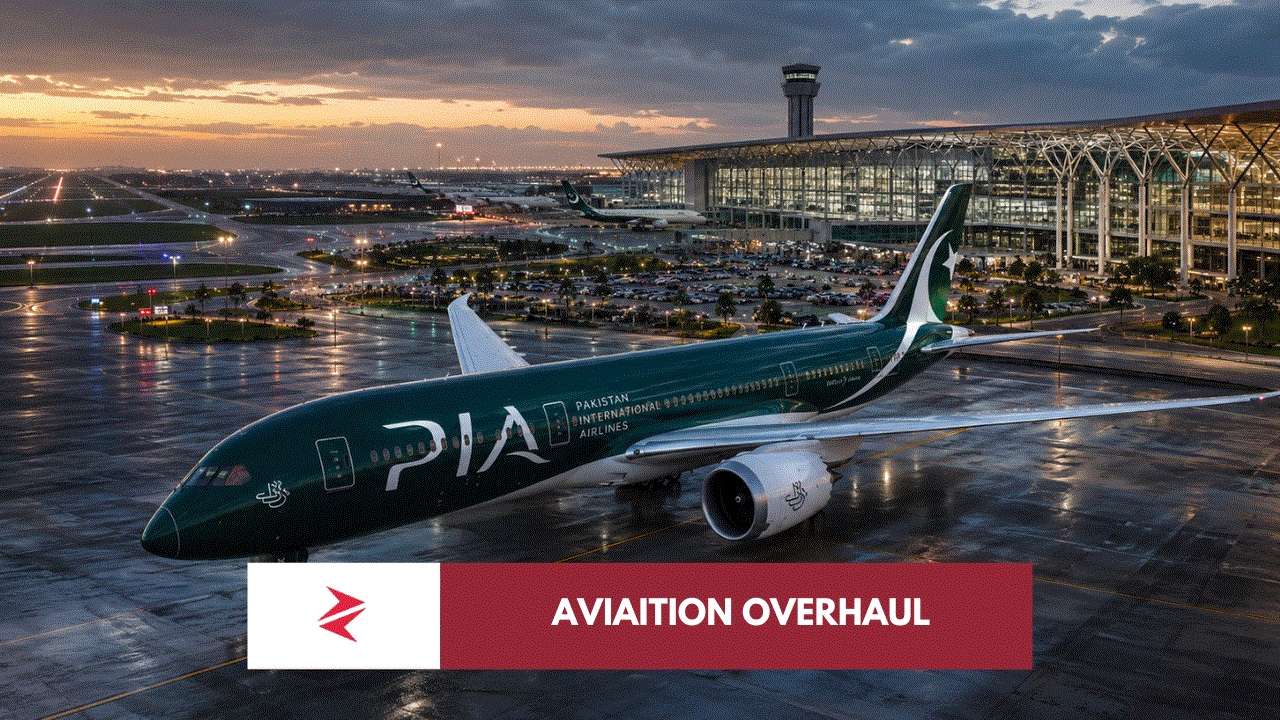
No official fleet-wide approval was identified. The design was shared publicly as a “potential paint job,” and the most circulated image is a concept depicting a Boeing 787-9 that PIA does not currently operate.

Would a dark-green aircraft be unsafe?
Not automatically. It would require compliance with the aircraft manufacturer’s approved paint and structural-temperature requirements. Dark coatings absorb more solar energy, but a professionally engineered coating system can be evaluated and certified. The viral image itself does not contain the technical data needed to judge that compliance.
Does dark paint automatically cause a large fuel penalty?
No. Paint adds weight, but the difference between liveries depends on coating formulation, thickness, number of layers and covered area. A precise fuel claim requires engineering data for the proposed system.
Should Islamabad airport be privatised?
A long-term operating concession can improve service while the government retains ownership. Security, regulation, air navigation, immigration, customs and sovereign decision-making must remain under Pakistani authority.