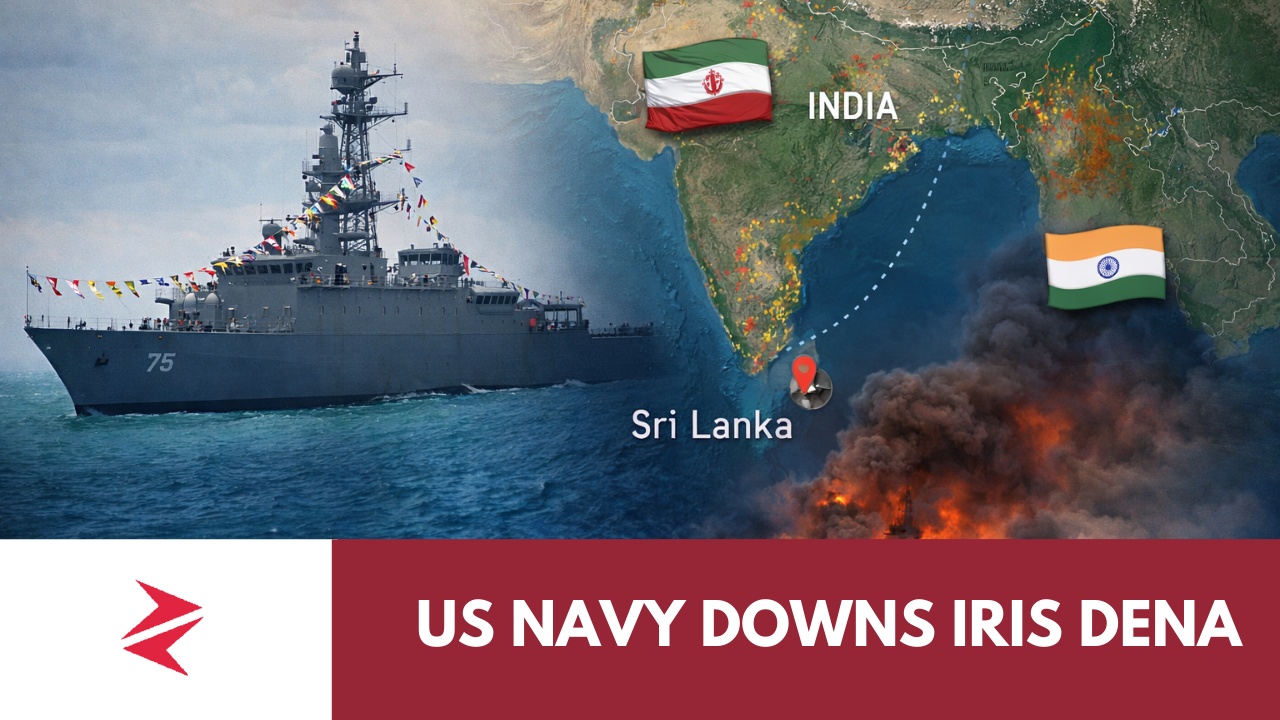
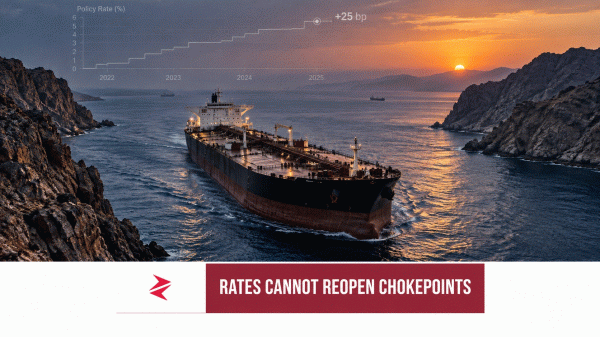
The sinking of the Iranian frigate IRIS Dena on March 4, 2026, has transformed what many initially believed would remain a Middle Eastern confrontation into a maritime crisis stretching across the Indian Ocean. What happened off the coast of Sri Lanka is not merely another naval engagement in a distant war; it is a strategic signal that the geography of the conflict has widened dramatically. For the first time in decades, a warship has been destroyed by submarine torpedo in a region that hosts some of the world’s most critical sea lanes, routes that connect the energy arteries of the Persian Gulf with the industrial economies of Asia.
The frigate itself had not arrived in the region under hostile conditions. Only weeks earlier, IRIS Dena had docked in Visakhapatnam after being invited by India to participate in the multinational MILAN naval exercises. The photographs circulating online from the port visit, where the vessel was welcomed alongside other foreign warships, now carry a strange historical irony. A ship that arrived in peace to participate in a ceremonial naval gathering found itself sailing home through a region that had suddenly become a battlefield.
When the broader Iran-U.S. conflict escalated, the vessel was reportedly traveling through the Indian Ocean corridor south of Sri Lanka when it was struck by torpedoes launched from a U.S. submarine. Sri Lankan authorities responding to distress signals reportedly recovered survivors and bodies from the waters, confirming that dozens of Iranian sailors had died in the incident. In a historical sense, the rarity of such attacks stands out. Since the end of the Second World War, only a handful of warships have been destroyed by submarine torpedoes, including the Indian frigate INS Khukri during the 1971 Indo-Pakistani War and the Argentine cruiser ARA General Belgrano during the Falklands War.
The significance of the IRIS Dena incident, however, lies not only in the destruction of the vessel but in where it occurred. The Indian Ocean is one of the world’s most heavily trafficked maritime spaces, connecting East Asia, South Asia, the Middle East, and Africa. Oil tankers leaving the Persian Gulf must pass through these waters before reaching markets in India, China, and beyond. Any escalation here therefore has immediate global implications. Even before the incident, analysts had warned that the war could push shipping risk premiums higher and destabilize energy markets.
This is precisely why the incident has sparked fierce debate about regional alignments. Critics argue that Iran’s geopolitical strategy over the last three decades often left it diplomatically isolated, operating with limited trust among neighboring states while investing heavily in proxy networks across the Middle East. Supporters counter that the country faced decades of sanctions, military pressure, and encirclement by Western-aligned security structures, making isolation less a choice than a structural reality imposed by the international system.
The conversation also touches an uncomfortable historical comparison. Pakistan, Iran, and North Korea all confronted Western pressure during the late twentieth century. Pakistan responded by rapidly developing a nuclear deterrent, completing its weapons capability by the late 1980s and formally testing it in the Chagai nuclear tests of 1998. North Korea followed a similar path, openly pursuing nuclear weapons despite global sanctions. Iran, by contrast, remained in prolonged negotiations over its nuclear program without ever crossing the threshold into openly tested nuclear capability. For many analysts watching today’s war unfold, that divergence now shapes the strategic balance of power in the region.
The economic dimension of the conflict is equally significant. Financial analysts in India, including market strategist Ajay Bagga, have already warned that a widening war could produce sharp volatility in Asian markets. The transmission channel is straightforward: higher oil prices, disruptions in Gulf trade routes, and instability affecting millions of expatriate workers across the Middle East. When tensions spike in the Persian Gulf or the Strait of Hormuz, the ripple effects travel rapidly through the global economy.
The deeper reality is that the Indian Ocean, once viewed primarily as a trade corridor, has quietly become a strategic chessboard where global powers operate simultaneously. American carrier groups patrol its waters, Chinese naval forces maintain anti-piracy deployments, Indian fleets conduct regional exercises, and Middle Eastern states increasingly project naval power far beyond their immediate coastlines. When conflict spreads into this maritime domain, the risk is no longer limited to the states directly at war; commercial shipping, energy infrastructure, and multinational naval operations all become potential flashpoints.
The sinking of IRIS Dena therefore represents more than a tragic naval loss. It is an early indicator that the geography of the Iran conflict has expanded into the broader Indo-Pacific theatre. What began as a regional confrontation has now reached one of the world’s most strategically vital oceans. And once major conflicts spill into global sea lanes, history shows that they rarely remain contained for long.
Share the post “Iranian Navy frigate IRIS Dena Sunk in the Indian Ocean during return voyage after MILAN naval exercise near Sri Lanka”
Advertisement. Scroll to continue reading.
Pages: 1 2 3