
























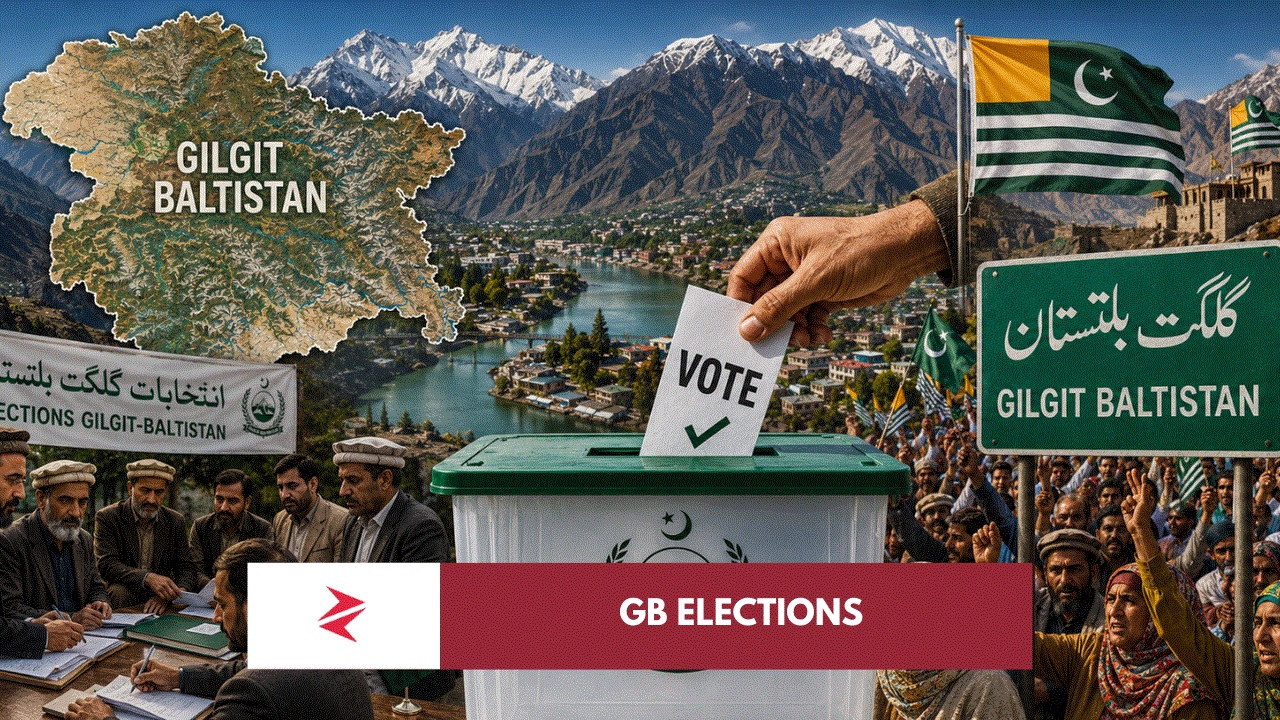
India’s problem with Gilgit-Baltistan elections is not democracy. India’s problem is that democracy in Gilgit-Baltistan punctures the fantasy that Delhi owns every mountain, valley and river simply because it repeats the word “integral” loudly enough at press briefings, UN podiums and nationalist television studios.
On June 5, India’s Ministry of External Affairs lodged a protest against Pakistan’s plan to hold general elections in Gilgit-Baltistan, claiming that Jammu and Kashmir, Ladakh and “so-called Gilgit-Baltistan” are integral and inalienable parts of India. Pakistan’s Foreign Office rejected the remarks as baseless, called them part of a choreographed attempt to conflate fact with fiction, and reaffirmed that Jammu and Kashmir remains an internationally recognized dispute whose durable settlement lies in implementing relevant UN Security Council resolutions and enabling Kashmiri self-determination.
This is the heart of the matter: India wants to treat Kashmir as “settled” when it speaks to its domestic audience, but the issue keeps returning to international forums because it was never settled by the people whose land, lives and future are at stake. Even neutral reference works describe Kashmir as a region disputed between India and Pakistan since the 1947 partition, with northern and western portions administered by Pakistan as Azad Kashmir, Gilgit and Baltistan, while southern and southeastern portions are administered by India as Jammu and Kashmir and Ladakh after the 2019 reorganization.
Gilgit-Baltistan is not an abstract map shape drawn in a New Delhi studio. It is a living region with people, memory, revolt, loyalty and political aspiration. The supplied screenshot highlights the Gilgit-Baltistan Liberation War, also known as the 1947 Gilgit Rebellion, in which Gilgit Scouts rose against Dogra rule and the region moved toward accession to Pakistan. That historical claim must be handled carefully and sourced rigorously in final publication, but it captures something India’s narrative deliberately erases: Gilgit-Baltistan’s relationship with Pakistan did not begin as a bureaucratic occupation story. It came through local resistance against Dogra authority, pro-Pakistan sentiment and the region’s own political direction at the end of empire.
India’s 1947 logic also collapses under its own weight. The user-supplied map showing India at independence separates British India from princely states, which is a critical visual reminder for international readers: the subcontinent did not become one neat Indian civilizational inheritance on August 15, 1947. Hundreds of princely states had to decide their future under the violent pressures, legal ambiguities and political realities of partition. Delhi’s claim that accession alone permanently settles every question ignores the Kashmir-specific internationalization that followed, including UN involvement, promised self-determination and decades of unresolved conflict.
What is happening now is straightforward. GB elections were scheduled for June 7 after a four-month delay attributed to harsh winter weather, while political parties including the PPP conducted rallies and campaigns across the region. Pakistan rejected India’s objections and accused Delhi of trying to distract from grave and systematic human rights violations in Indian-occupied Kashmir.
What it actually means is that India’s protest is not about democratic purity. It is about narrative control. If people in Gilgit-Baltistan vote, Delhi calls it camouflage. If people in IIOJK demand plebiscite, Delhi calls it separatism. If Pakistan raises Kashmir at the UN, Delhi calls it internationalization. If Kashmiris resist demographic engineering after August 5, 2019, Delhi calls it internal security. The vocabulary changes, but the underlying method remains the same: deny the dispute, criminalize the dissenter, and present occupation as administrative normalcy.
What nobody is telling you is that the Indian online reaction itself exposes panic. The replies supplied in the source material repeatedly leap from Gilgit-Baltistan to fantasies of “Akhand Bharat,” claims over Pakistan and Bangladesh, threats involving Sindh and Balochistan, water coercion, and abusive anti-Pakistan slurs. That is not legal confidence. That is imperial nostalgia dressed as nationalism. A state that truly believes its case is settled does not need its online ecosystem to fantasize about swallowing neighbouring countries every time Gilgit-Baltistan holds an election.
Pakistan’s answer should therefore be sharper, not softer. It should not merely say “India has no locus standi.” It should say: Gilgit-Baltistan’s people have a political voice; IIOJK’s people deserve the same right to decide their future freely; and no Indian press release can erase UN resolutions, human rights reporting or the lived reality of Kashmiri resistance.
The OHCHR’s Kashmir reporting remains important because it refuses to let either propaganda machine erase human rights from the dispute. The UN human rights office issued its first-ever Kashmir report in 2018 calling for an international inquiry into multiple violations, and its 2019 update covered Indian-administered Kashmir and Pakistan-administered Kashmir from May 2018 to April 2019. Pakistan should welcome scrutiny where governance can improve, but it must also keep the central asymmetry visible: India turned IIOJK into a militarized space while insisting the world look away.

The comparison that matters is not whether Pakistan’s governance is perfect. No serious Pakistani should claim that. Gilgit-Baltistan still needs fuller constitutional clarity, stronger local representation, better infrastructure, transparent resource rights, improved internet access, and a development model that benefits locals before contractors and outsiders. The real comparison is whether people are allowed political expression, whether reform is possible through institutions, whether local identity is respected, and whether international observers can access the ground instead of being blocked by nationalist paranoia.












ero-storitop.com
October 16, 2026 at 3:51 pm
Ресурсы для совершеннолетних могут являться способом интимного образования, а также поддержкой в осознании личных желаний.
Они позволяют взрослым исследовать собственные желания в безопасной среде, снижая риски реальных последствий.
порно рассказы новые
Для партнёров общее изучение подобных материалов способно укреплять взаимопонимание и служить поводом для честного разговора о желаниях и границах.
Также эти ресурсы дают шанс для безрисковой разрядки потребностей и уменьшения стресса, не причиняя ущерба другим.
Zorays
October 16, 2026 at 3:56 pm
Thank you for your comment, but it appears to be unrelated to the discussion regarding the Gilgit-Baltistan elections and the Kashmir conflict. I kindly ask that you keep the conversation focused on the topic of the article.
— Zorays
For continued reading: Pakistani Democracy · Pakistani Youth Protests Debate
usb-flashki-optom-24.ru
October 25, 2026 at 12:44 pm
Флеш-накопитель на 2 гига и подарочные USB-накопители в подарок мужчине в Барнауле. Сладкий сувенир с фирменным знаком стоимость и пакеты опт в Нальчике. Флеш-накопитель 128 Gb и гравировка на флешке в ближайшем офисе в Москве.
https://usb-flashki-optom-24.ru/
Zorays
October 25, 2026 at 12:46 pm
Thank you for visiting the blog, but this comment appears to be unrelated to the discussion on Gilgit-Baltistan. Please keep the conversation focused on the article’s topic.
— Zorays
For continued reading: Pakistani Democracy · Pakistani Youth Protests Debate