
































From a patented mobile EV charging concept to a proposed network of solar-powered battery logistics, energy arbitrage, emergency power and battery swapping, the Pakistani venture is making its case across six CleanTech challenge themes.
LAHORE, November 21, 2026 — Pakistan has invested heavily in electricity generation. Its consumers have embraced rooftop solar. Electric vehicles are beginning to reshape transportation. Yet one fundamental problem remains unresolved: electricity is not necessarily available at the location, time or price at which consumers need it most.
What if electricity could travel to the consumer rather than forcing the consumer to travel to electricity?
That question lies at the heart of Bijli Haazir, an energy infrastructure venture developed through Zorays Solar Pakistan, which is participating in the LUMS Centre for Entrepreneurship CleanTech Hackathon 2026, organised in collaboration with Oil and Gas Development Company Limited (OGDCL).
Led in the hackathon by Iman Zorays, with engineering and industry support from Zorays Khalid and the wider team, Bijli Haazir is proposing something considerably broader than a conventional mobile charging truck.
Its ambition is to build a distributed network of portable battery capacity that can collect energy where it is economical, store it, move it and deliver it where demand creates greater value.
The applications extend from rescuing stranded electric vehicles to temporarily supporting electricity-starved commercial premises, buffering high-power DC charging stations and exchanging compatible batteries for electric two-wheelers.
Behind these services is an underlying commercial hypothesis: electricity has a time value, a location value and a reliability value. Battery technology can potentially help capture those differences.
Whether that proposition becomes a commercially sustainable business will depend on practical engineering, regulatory compliance, customer adoption and measurable operating economics.
A Venture With Roots Beyond the 2026 Hackathon
Bijli Haazir is not a concept developed overnight for a startup competition.

Its journey can be traced through Zorays Solar Pakistan, a renewable-energy business established in 2014, and an early attempt to rethink electricity delivery as a mobile service.
In 2015, company records documented Bijli Haazir’s acceptance into the i2i Business Accelerator. The venture later reported Top 100 selection in the Startup Istanbul ecosystem, where it presented its mobile electricity proposition to an international entrepreneurial audience.
A more substantial historical milestone followed in 2020.
The Intellectual Property Organization of Pakistan’s patent journal dated September 17, 2020 identifies Zorays Khalid as the applicant for Patent Application 481/2020, titled Mobile Green Energy Power Station for Instant Charging of Electric Vehicles Stranded on the Roads.
The published application provides an independent documentary record of the original concept. It should not be confused with confirmation of a granted patent.
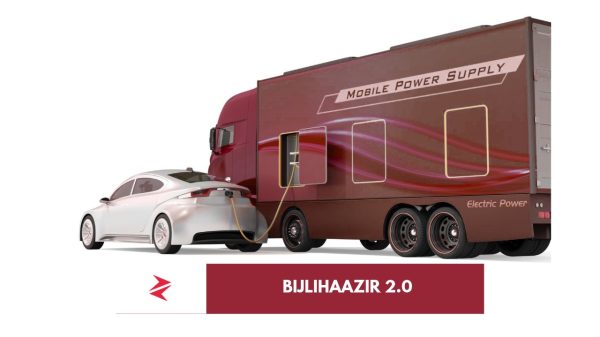
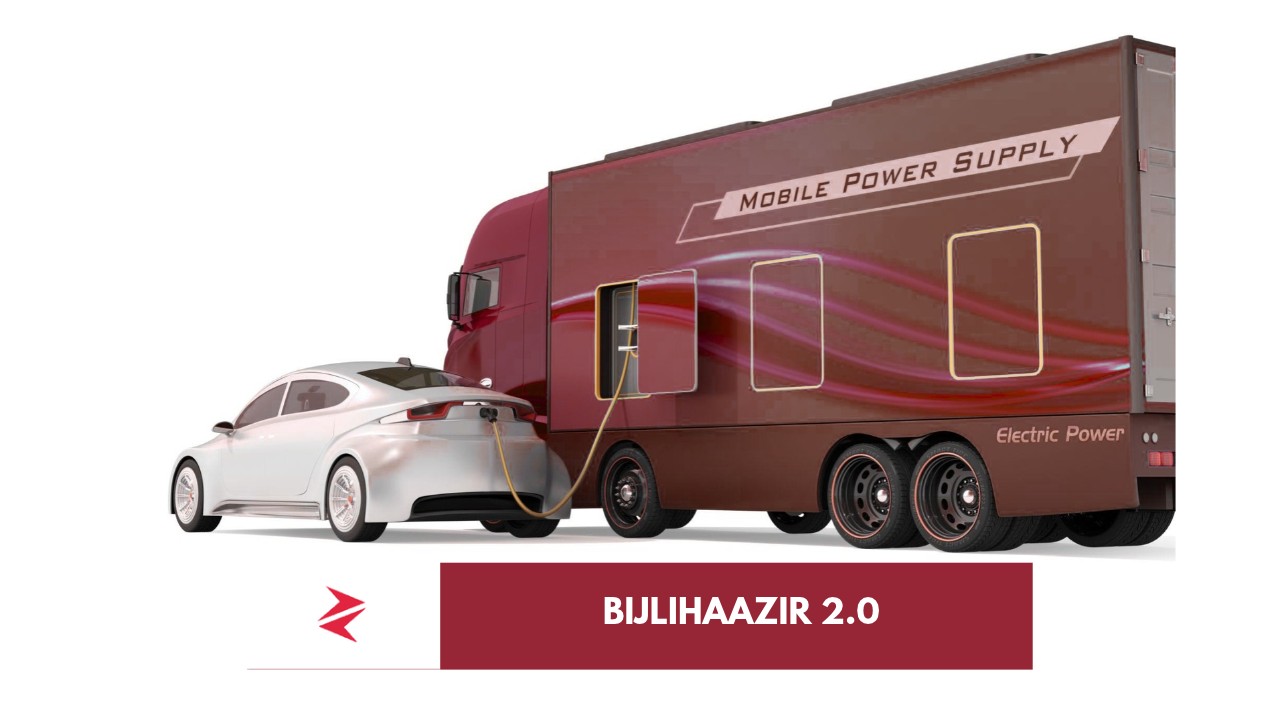
At the time, the underlying business idea was straightforward: equip a vehicle with substantial stored energy and the necessary conversion equipment, allowing electricity to be delivered to EV users who could not reach a charging facility.
The initial proposition also explored temporary power rental, subscriptions and renewable electricity sourcing.
Six years later, the concept has developed into a more ambitious proposed architecture.
The truck remains important, but so do modular batteries, managed charging hubs, battery-buffered DC chargers and software-supported energy dispatch.
The new vision is not limited to transporting a charger.
It is about making stored electrical capacity a service that can move between customers.
Pakistan’s Energy Paradox — Electricity Exists, but Access Remains Uneven
Pakistan’s electricity challenges cannot be reduced to a single national shortage.
Generation capacity, network constraints, tariffs, affordability, reliability and the timing of demand all influence the electricity available to consumers.
Solar installations generate electricity during daylight hours, while many consumers require substantial electricity in the evening or at geographically distant locations.
Electric vehicles create an additional infrastructure challenge. Charging may be required along highways, at commercial premises, at fleet depots or wherever a vehicle runs low on energy.
Installing high-power charging infrastructure everywhere can be expensive, especially where an electrical connection cannot support the required charging load without substantial upgrading.
Meanwhile, electricity stored in batteries may be technically available but geographically separated from customers who need it urgently.
This is the mismatch Bijli Haazir proposes to address.
The central argument is not that the conventional grid should be replaced.
It is that mobile and modular battery storage could supplement fixed infrastructure, especially where power demand is intermittent, urgent or concentrated in particular locations.
How Bijli Haazir Works — One Energy Network, Multiple Services
The proposed operating model begins with electricity sourcing.
Approved charging hubs would acquire electricity from solar generation or permitted grid supply arrangements when economically advantageous.
Battery modules would then store that electricity under a controlled charging and monitoring system.
A central dispatch process would track battery charge levels, health, location, customer demand, transportation requirements and the economics of each delivery.
Stored energy could subsequently reach the customer through several service configurations.
1. Roadside EV Charging — Electricity Delivered to the Driver
Imagine an electric vehicle running out of charge on a motorway, some distance from the nearest compatible charging station.
Instead of relying exclusively on conventional roadside recovery, the driver could request Bijli Haazir.
A dispatched vehicle carrying suitable battery storage and charging equipment could provide enough electricity to support the driver’s onward journey, subject to vehicle compatibility and operating conditions.
The service aims to reduce the uncertainty surrounding charging availability.
In this scenario, the customer is purchasing more than electricity.
The customer is purchasing convenience, mobility and potentially valuable time.
That distinction becomes important when developing emergency dispatch charges, priority subscriptions and service-level commitments.
2. Temporary Power — A Battery-Backed Alternative for Suitable Loads
Now imagine a commercial premises affected by a transformer failure or another interruption to its normal electricity supply.
Conventional arrangements might involve waiting for grid restoration or deploying a diesel generator.
Bijli Haazir proposes transporting battery-backed electricity to help meet temporary power requirements.
The potential applications include events, marquees, selected commercial loads, temporary installations and appropriate emergency support situations.
However, temporary electricity provision at hospitals, essential services or distribution-network facilities requires careful technical assessment.
Power quality, electrical isolation, transfer arrangements, earthing, protection coordination, available capacity and statutory approvals must all be addressed.
A mobile battery unit cannot simply be connected to an energised or damaged distribution network.
Under properly engineered circumstances, however, portable storage could provide a quieter, locally exhaust-free alternative to diesel generation for selected applications.
3. Battery Swapping for Electric Motorcycles and Scooters
The third application addresses a different customer requirement: downtime.
For electric motorcycle riders, particularly those engaged in commercial deliveries, waiting for a battery to recharge may reduce working hours.
Bijli Haazir proposes a monitored battery exchange service for compatible electric two- and three-wheelers.
Rather than waiting for a depleted battery to recharge, a participating rider could request a fully charged replacement at an approved collection point or through an arranged delivery service.
The discharged battery would return to managed inventory for inspection and recharging.
A subscription arrangement could provide predictable access, defined usage terms and battery custody management.
Unlike the large storage banks used for mobile or fixed power services, smaller vehicle batteries require specific voltage, connector, communication and safety compatibility.
A universal battery-swapping capability is therefore not assumed.
The proposed pilot would need to work with defined battery families and compatible vehicle models.
4. Swappable Battery Banks at Fixed DC Charging Stations
One of the more technically significant additions to the concept is the use of modular battery energy storage systems at stationary EV charging locations.
A high-power EV charger may require substantially more instantaneous power than an existing site connection can provide.
Bijli Haazir proposes using a suitably rated battery energy storage system to buffer that difference.