










































What Nobody Tells Employees About Innovation Programmes
An innovation programme can become a political theatre in which leadership asks employees to take risks while preserving systems that punish failure, delay decisions and reward the defence of existing territory.
Employees notice this contradiction quickly. If a failed but responsibly designed experiment harms a person’s career, employees will stop proposing consequential ideas. If successful initiatives are appropriated by senior managers while unsuccessful ones remain attached to their originators, people will learn to remain invisible. If every project requires approval from functions whose performance indicators benefit from saying no, the supposed innovation funnel becomes a rejection machine.
Resistance is not always irrational. Operations teams may fear disruption. Sales teams may worry about confusing customers. Finance may identify unrealistic unit economics. Technical specialists may recognise safety or scalability problems that enthusiastic sponsors have ignored. These objections can improve a venture when converted into testable conditions. They become destructive when authority can reject an idea without presenting evidence or a feasible path forward.
The answer is neither unrestricted freedom nor suffocating control. Corporate entrepreneurs need bounded autonomy: a defined problem, a limited experimental budget, agreed safeguards, customer access, a fixed learning period and a decision standard known before the experiment begins.
The Skills Crisis Behind the Innovation Crisis
The need for these capabilities is becoming more urgent as artificial intelligence, technological change, economic uncertainty and the green transition reshape competition.
The World Economic Forum’s Future of Jobs Report 2025 surveyed more than 1,000 employers representing over 14 million workers across 55 economies. It found that nearly 40% of job skills are expected to change by 2030, while 63% of employers identify skills gaps as a major barrier to business transformation. AI and big data capabilities are rising quickly, but creative thinking, analytical thinking, resilience, flexibility, curiosity and leadership remain critical.
This combination explains why simply acquiring AI software will not transform an organization. Technology can accelerate research, simulation, analysis and communication, but it cannot decide which problem deserves investment, negotiate departmental resistance or accept responsibility for a commercial bet. Organizations require people capable of connecting technical possibility with customer pain, financial logic, operational reality and strategic timing.
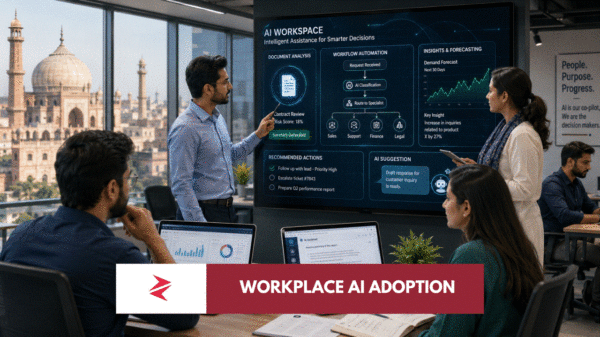
Readers examining how technology changes workplace decisions can continue with Workplace Artificial Intelligence: The Machine Is Not Taking Your Job, while leaders building evidence-based decision systems should read Innovate and Differentiate Your Business Intelligence Product. The transition from a promising innovation to a scalable organization is explored further in 5 Things Startups Must Understand for Scalability.
A Practical Corporate Entrepreneurship System
Organizations do not need another motivational slogan. They need a repeatable path that separates weak ideas from promising opportunities without killing both through bureaucracy.