


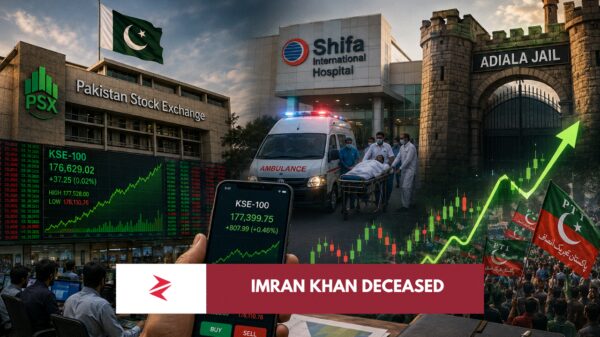





























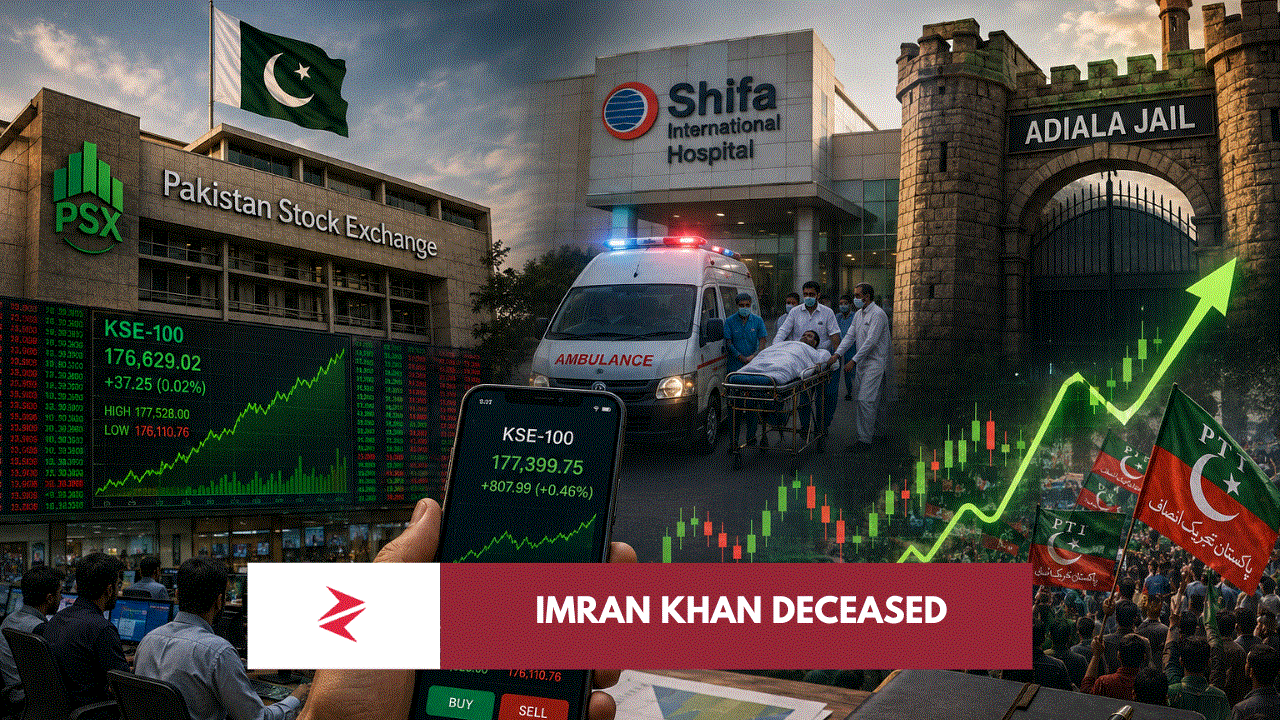
“Imran Khan going to hospital is bad for stocks.”
The market was asking a much bigger set of questions.
Could the ruling alter the political confrontation between PTI and the government?
Would crowds gather?
Would the transfer lead to negotiations?
Would it increase expectations of Khan’s release?
Would the government challenge the order?
Would September protests intensify?
Would an apparently medical issue become another political flashpoint?
Markets dislike one thing even more than bad news: uncertainty about the range of possible outcomes.
The court decision widened that range.

For investors carrying leveraged positions or sitting on substantial gains after the PSX rally, that can be enough reason to reduce exposure first and ask questions later.
But Oil Was Already Hurting the Market
This is precisely where political explanations become dangerous if they are presented in isolation.
International oil prices were elevated amid continued US-Iran tensions. By August 21, Brent was around $93.82 per barrel, with supply concerns still influencing global markets.
Pakistan is a major energy importer.
Higher oil threatens several variables simultaneously:
higher import payments,
pressure on the current account,
inflation risk,
petroleum prices,
fiscal costs,
and eventually the rupee and interest-rate outlook.
For a PSX investor, $90-plus oil can matter considerably more to corporate earnings than a single political headline.
So August 18 was not a clean political experiment.
It was politics arriving in an already nervous macro environment.
August 19: The Market Did Something Even More Revealing
The following day is arguably more useful than the original sell-off.
PSX opened positively.
The KSE-100 reached an intraday high of 178,942.31.
Then buyers disappeared.
By the close, it had fallen to 176,846.36, down another 1,109 points.
This is exactly what a market looks like when investors are unsure whether new information represents relief or another layer of risk.
At the same time, the government announced that it would challenge the Supreme Court ruling concerning Khan’s move to the private hospital. Reuters reported that the government questioned the legal basis of the order and raised concerns about the precedent it could establish.
The political path had therefore become less clear, not more.
A morning rebound could attract buyers expecting de-escalation.
A developing legal confrontation could then persuade traders to reduce exposure.
Yet even on August 19, Business Recorder highlighted other market drivers. News about addressing roughly Rs1.49 trillion of gas-sector circular debt initially supported sentiment, while Pakistan’s July current-account deficit had narrowed by 38% year-on-year. Despite those positives, selling eventually overwhelmed the market.
That is important evidence against simplistic narratives.
If politics were the only variable, positive macro developments would not matter.
If macro were the only variable, the market would not repeatedly react to political uncertainty.
PSX trades both.
August 20: Khan Goes to Hospital — And the Market Cannot Decide
Reuters reported that Khan was transferred for medical assessment after the court order. The transfer had been welcomed by PTI as a significant development and potentially an easing of tensions, although the eventual handling of the hospitalisation became contentious.
The market on August 20 perfectly reflected ambiguity.
It rose as high as 178,291.37.
It fell as low as 176,156.57.
It finally closed at 176,591.77, down only 254.59 points, or 0.14%.
That is not a market expressing one confident political opinion.
That is a market repeatedly changing its mind.
Business Recorder described the session as volatile and again cited geopolitical uncertainty and elevated international oil prices, with selling in heavyweight stocks outweighing selective buying.
The intraday movement is therefore more informative than the closing number.
Traders were not merely valuing companies.
They were constantly repricing the probability of what might happen next.