













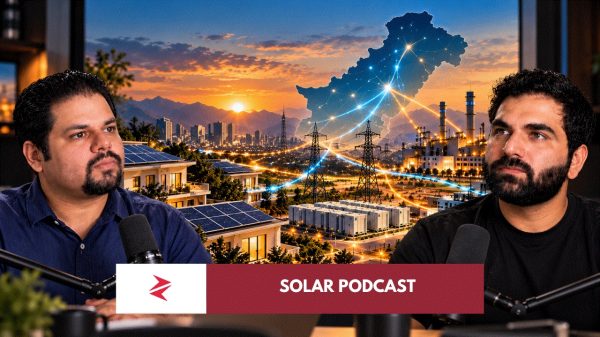













Notes, an erratum and a few addendums to my recent podcast conversation on solar, batteries, the grid and Pakistan’s changing power market.
I recently sat down for a long-form conversation about Pakistan’s solar industry.
We started with sunlight and solar panels, but—as usually happens when discussing energy seriously—the conversation quickly became much larger.
We talked about net metering and net billing. Batteries. Load shedding. IPPs. Capacity payments. Grid limitations. Product quality. Cable sizing. After-sales support. Consumer behaviour. And why installing the “best” panel, inverter and battery individually does not necessarily produce the best energy system.
But there is another development that deserves to sit alongside that discussion.
Pakistan has now started opening its electricity market to competition.
And, in my view, that could eventually prove more consequential than another change in solar-panel prices.
[EMBED PODCAST HERE]
One Erratum Before Several Addendums
Long-form conversations are different from written articles. You are thinking, recalling and connecting subjects in real time rather than working from footnotes.
So first, one correction.

During the discussion I referred to Pakistan’s earliest solar installation. The historical point I intended was the early grid-connected solar initiative supported through Japanese assistance. JICA documentation records two 178 kW photovoltaic systems installed at the Planning Commission and Pakistan Engineering Council in Islamabad, completed in 2012, and describes these as Pakistan’s first grid-connected solar power-generation systems.
That is the attribution I should have made precisely.
The broader discussion remains unchanged, but I prefer correcting a detail explicitly rather than allowing an imprecise statement to become permanent simply because it was said on camera.
There is also an administrative clarification worth making about the discussion around electricity faults and LESCO.
A DISCO’s division, sub-division and field organisation should not be casually transposed. The XEN, SDO and Line Superintendent have different functions and jurisdictions. In fact, NEPRA decisions dealing with billing and meter-reading disputes can identify responsibility at the relevant meter-reading/sub-divisional level rather than simply attributing every field issue to a divisional XEN. NEPRA
That distinction matters because one theme of the podcast was accountability. Accountability works only when responsibility is assigned accurately.
Solar Has Changed Faster Than the Electricity Market
Pakistan’s solar transition has been extraordinary.
The Pakistan Economic Survey reports total installed electricity capacity of 49,651 MW at the end of March 2026. Finance Division
But headline capacity numbers don’t adequately describe what is happening.
Solar has increasingly moved generation from somewhere on the national system to the consumer’s own premises.
A house with rooftop solar still consumes electricity.
A factory running its machinery from its own PV plant is still consuming electricity.
A farm pumping water from solar is still using energy.
What changes is what the grid sees.
That distinction came up repeatedly in the podcast because it affects almost every traditional assumption about electricity planning.
For decades we asked:
How much electricity will consumers demand from the grid?
Increasingly, we also need to ask:
How much electricity will consumers produce themselves—and at what hours will they still need the grid?
Those are very different planning questions.
Then Something Important Happened After the Podcast
On 20 September 2026, ISMO formally published the RFP for Pakistan’s first wheeling auction.
The first annual quantum is 400 MW. The approved framework concerns an aggregate 800 MW of demand, with a maximum cumulative allocation of 160 MW per participant. Proposals are due on 20 November 2026, and ISMO currently schedules the actual auction for 13 January 2027. ISMO
This is part of Pakistan’s Competitive Trading Bilateral Contract Market—CTBCM.
That bureaucratic name hides a remarkably simple idea:
A consumer should increasingly be able to choose who produces its electricity.
Initially, the opening is aimed at large consumers. The government’s announced first phase covers consumers above 1 MW, with the stated intention of widening participation over time. The Express Tribune
That is a profound change from the model Pakistan has known.
Imagine Buying Electricity Differently
Suppose you operate a factory in Lahore.
You need several megawatts of electricity, but your factory roof cannot accommodate enough solar.
Why should the solar plant necessarily be on your roof?
Perhaps a generator can produce electricity somewhere with cheaper land and a better resource.
You contract with that generator.
The electricity enters the interconnected system.
The network transports the power.
You pay the appropriate grid and market charges.
The generator sells power.
You buy power.
The grid facilitates the transaction.
That, in simplified terms, is the direction competitive wheeling makes possible.
The government’s description of the reform is similarly significant: Energy Minister Awais Leghari said the government is moving away from directly procuring all electricity and toward a structure in which producers and qualifying consumers can transact directly. The Express Tribune
Whether implementation ultimately delivers that ambition will depend on market design, competition, network access, settlement, enforcement and economics.
But the direction matters.
“Free Wheeling” Does Not Mean Free Electricity Transmission
This terminology deserves clarification because it can easily be misunderstood.
Using the national grid is not free.
NEPRA has approved a Use of System Charges structure for bulk consumers participating through open access. Those consumers still have to contribute toward the infrastructure they use. The Express Tribune
The freedom is principally commercial.
Instead of being restricted to one electricity supplier under the traditional structure, eligible participants gain greater freedom to contract with generators or competitive suppliers.
The physical electricity remains constrained by physics.
Transmission capacity matters.
Distribution capacity matters.
Voltage matters.
Frequency matters.
Protection matters.
Congestion matters.
Losses matter.
Someone still has to balance the system every second.
That is why ISMO is important.
ISMO Is More Than a New Acronym
Pakistan’s electricity-sector alphabet soup is already difficult enough: WAPDA, NTDC, CPPA-G, DISCOs, NEPRA, NPCC, CTBCM—and now ISMO.
But the institutional change is meaningful.
NEPRA’s regulatory record shows the transition of system-operation and market-operation functions into the Independent System and Market Operator structure in 2025, following years of CTBCM development. NEPRA
Think of the distinction this way.
One question is:
Can this electricity physically move through the system without compromising reliability?
Another is: