






























Pakistan’s Threshold for Outrage Is Tragically High
An examination leak is devastating for a student whose family has invested years of savings, hope and social status in one test. However, Pakistan’s post-2008 generation has been raised inside a harsher hierarchy of emergencies: terrorism, bombings, displacement, floods, electricity shortages, political breakdowns, inflation, currency depreciation, unemployment and repeated interruptions to education and connectivity.
That does not make paper leaks unimportant. It means the emotional threshold required to trigger national mobilisation has been pushed dangerously upward.
A young Pakistani who has watched a parent’s income collapse, survived hours of daily load-shedding, competed for a job against thousands of applicants and seen demonstrations end without concessions will assess protest differently from someone who believes one sustained campaign can force one identifiable official to resign.
This is not political laziness. It is accumulated experience.
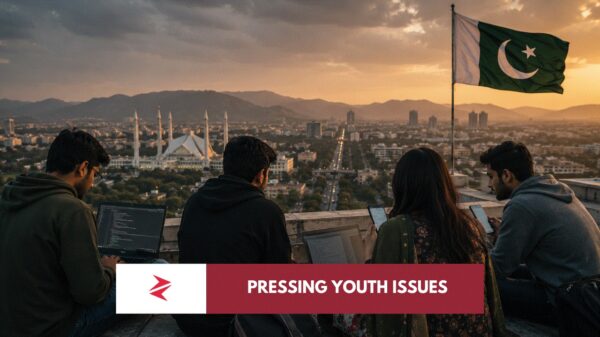
Pakistan’s youth unemployment rate was estimated by the World Bank at 18.7 per cent for 2025, meaning nearly one in five economically active people aged 15 to 24 seeking work could not find it. The accompanying material for this article similarly identifies unemployment, weak career counselling, outdated education, mental-health pressure and the absence of an entrepreneurship culture as continuing problems confronting Pakistani youth.
| Indicator | Available figure | What it reveals |
|---|---|---|
| Pakistan youth unemployment, 2025 | 18.7% | Economic anxiety is structural rather than limited to one examination |
| ICT exports, first half FY2024-25 | US$1.86 billion | Young workers are increasingly entering globally traded digital services |
| Broader digital exports, FY2025 | More than US$3.8 billion | Freelancing and technology services have become meaningful economic outlets |
| Arrests reported after the November 2024 Islamabad operation | 954 | The perceived personal cost of mass political mobilisation is substantial |
Sources: World Bank, Pakistan Software Export Board, State Bank of Pakistan and Reuters.
What Nobody Is Telling You: Protest Requires Belief in Results
People do not enter the streets merely because conditions are bad. They mobilise when three convictions converge: the problem is shared, the responsible authority is identifiable and collective action has a reasonable chance of changing the outcome.
Sri Lanka’s 2022 Aragalaya emerged during an economic collapse visible in fuel queues, electricity cuts and shortages, eventually forcing President Gotabaya Rajapaksa from office. Bangladesh’s 2024 student movement began around public-sector job quotas before expanding into a revolt that removed Sheikh Hasina. Nepal’s 2025 Gen Z mobilisation combined anger over corruption, unemployment and a social-media ban, leading to Prime Minister K.P. Sharma Oli’s resignation.
In every case, one grievance became a national symbol.
Pakistan’s grievances remain divided among political identities, provinces, ethnic communities, economic classes and competing narratives of who is responsible. A Baloch family may understand enforced disappearances as the central national crisis. An urban graduate may prioritise jobs and inflation. A PTI voter may see electoral legitimacy as the defining issue. A religious voter may focus on Palestine, Kashmir or moral governance. A salaried household may be consumed by taxation and electricity bills.


All are angry. They are simply not angry about the same thing at the same time.
This fragmentation benefits every institution that fears sustained public accountability. A divided population can be managed constituency by constituency. A united national demand is far more difficult to absorb.
