






























Connect with Zorays

Hi, what are you looking for?

Society & Culture

Why Pakistan Has No “Cockroach Moment”: Its Youth Are Not Silent, Just Battle-Hardened

Pakistan’s youth are not silent; history, repression, fractured organising and digital survival explain why the streets look quieter today.

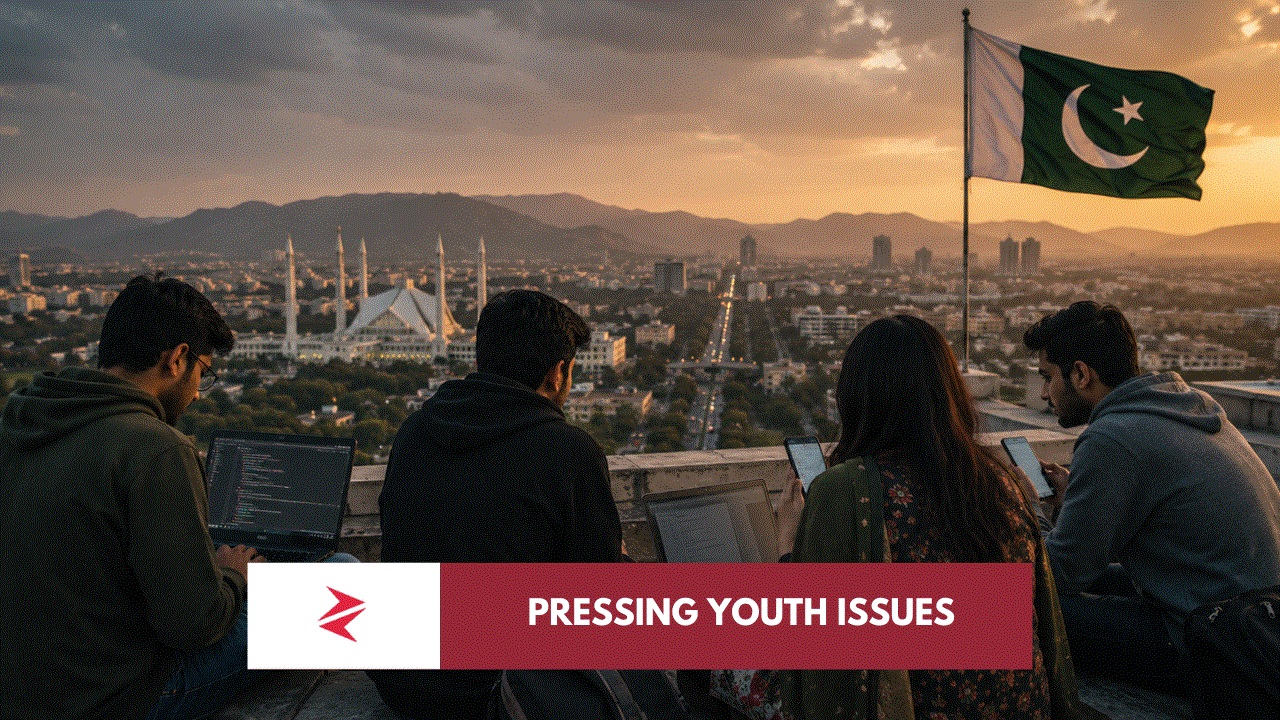
Pakistani university students using laptops and smartphones while overlooking Islamabad, representing youth resilience, digital ambition and political disengagement.

Pakistani Youth Are Choosing Skills Over Slogans

There is another reality that foreign observers frequently mistake for apathy. A significant part of Pakistan’s youth has moved its ambition away from state employment and conventional politics towards coding, artificial intelligence, digital marketing, e-commerce, content creation, remote work and freelancing.

Pakistan’s official technology promotion body reported that ICT exports reached US$1.86 billion during the first half of FY2024-25, an increase of 28 per cent. The State Bank later reported that broader digital exports exceeded US$3.8 billion in FY2025.

That transformation can be explored further through my analysis of the global gig economy, the role of AI in personal development and the wider question of Pakistan’s generational transition.

To an unemployed graduate, a laptop that produces £500 a month may feel more revolutionary than a protest that produces another speech. To a young woman earning remotely from a conservative household, digital work can create independence without requiring permission from an employer, political party or bureaucracy. To a software developer, foreign clients offer a merit-based escape from local patronage networks.

READ:   PSL Seven Cricket Tournament Final 2022 - Lahore Qalanders versus Multan Sultans

This is not always noble civic strategy; sometimes it is simple survival. Yet dismissing it as disengagement ignores the quiet economic rebellion taking place inside Pakistani homes.

The youth are not waiting for a messiah because many have concluded that messiahs arrive with slogans, acquire power and eventually ask the same young people to wait again.

Does Pakistan Have No Identity Crisis?

Pakistan certainly contains ethnic, sectarian, provincial and class tensions, and pretending otherwise would destroy the credibility of any serious analysis. However, the country does not reproduce India’s exact political and demographic structure.

India’s Cockroach movement operates within a political environment shaped by more than a decade of Narendra Modi’s Hindu-nationalist governance, where debates over citizenship, minority rights and religious majoritarianism have intensified wider generational anxiety. The CJP protests were triggered by examinations, but they expanded within an atmosphere of deeper frustration over jobs, governance and institutional fairness.

Many Pakistani youths, by contrast, retain a strong foundational attachment to the national idea even while criticising governments, parties, judges, generals and bureaucracies. They may rage against the system without necessarily believing Pakistan itself is the enemy. That distinction gives Pakistani discontent a different psychological form: angry, distrustful and frequently cynical, but still tied to the belief that the state can be corrected rather than dismantled.

That is an interpretation, not a measurable national statistic. It nevertheless reflects a recurring sentiment visible across Pakistani political constituencies.

Advertisement. Scroll to continue reading.

Is Fear the Main Reason?

Fear is part of the explanation, but calling it the entire explanation would insult young Pakistanis who have repeatedly accepted enormous risks.

READ:   Megacities Without Farms: The Fragility of Modern Urban Civilization

The more accurate concept is political cost calculation.

A protester considers arrest, injury, employment consequences, digital surveillance, family pressure, travel barriers and the possibility that the leadership may abandon the movement once negotiations begin. When these costs are high and the expected result is vague, non-participation becomes rational rather than cowardly.

Pakistan’s protest problem therefore cannot be solved by lecturing young people about bravery. It requires rebuilding institutions that protect peaceful organising, restoring elected student representation, reducing the criminalisation of dissent and demonstrating that collective action can produce lawful outcomes.

Pages: 1 2 3 4 5 6

Click to comment

Leave a Reply

Your email address will not be published. Required fields are marked *

You May Also Like

World Affairs

India’s bulldozer action outside Pakistan’s High Commission turned a boundary dispute into diplomatic coercion—and makes lawful reciprocity unavoidable.

Politics & Governance

Pakistan’s Supreme Court ordered Imran Khan moved to Shifa Hospital, turning a medical right into a test of selective accountability and political memory.

World Affairs

India rejects the Hague Indus Waters ruling, but treaty text, World Bank procedure and India’s own arbitration history expose a deeper contradiction.

World Affairs

Sergio Gor called Kashmir part of India. Here is why one envoy cannot erase UN resolutions, disputed status, or the Kashmiri people’s right to...

Technology & AI

Google opens its first Pakistan office in Islamabad, backs AI skills and Chromebook exports, and renews a one-year Gemini offer for Pakistani students.

World Affairs

Modi’s extraordinary Delhi-Tashkent detour exposes what maps cannot hide: Pakistan’s airspace remains strategically expensive for India to bypass.

World Affairs

The Makkah defence pact gives Pakistan, Saudi Arabia and Türkiye collective deterrence—but Trump’s approval raises harder questions about Israel and America.

Advertisement