










































Is sensory marketing the same as neuromarketing?
They overlap but are not identical. Sensory marketing concerns how sensory cues influence perception and behaviour. Neuromarketing more broadly applies neurological or physiological approaches to understand consumer responses.
How should a small business test sensory advertising?
Create two advertisements that are identical except for one variable, such as product orientation, texture detail or visual perspective. Run them under comparable conditions and judge the result against a predetermined metric such as purchases, qualified enquiries or add-to-cart actions.
The Commercial Decision
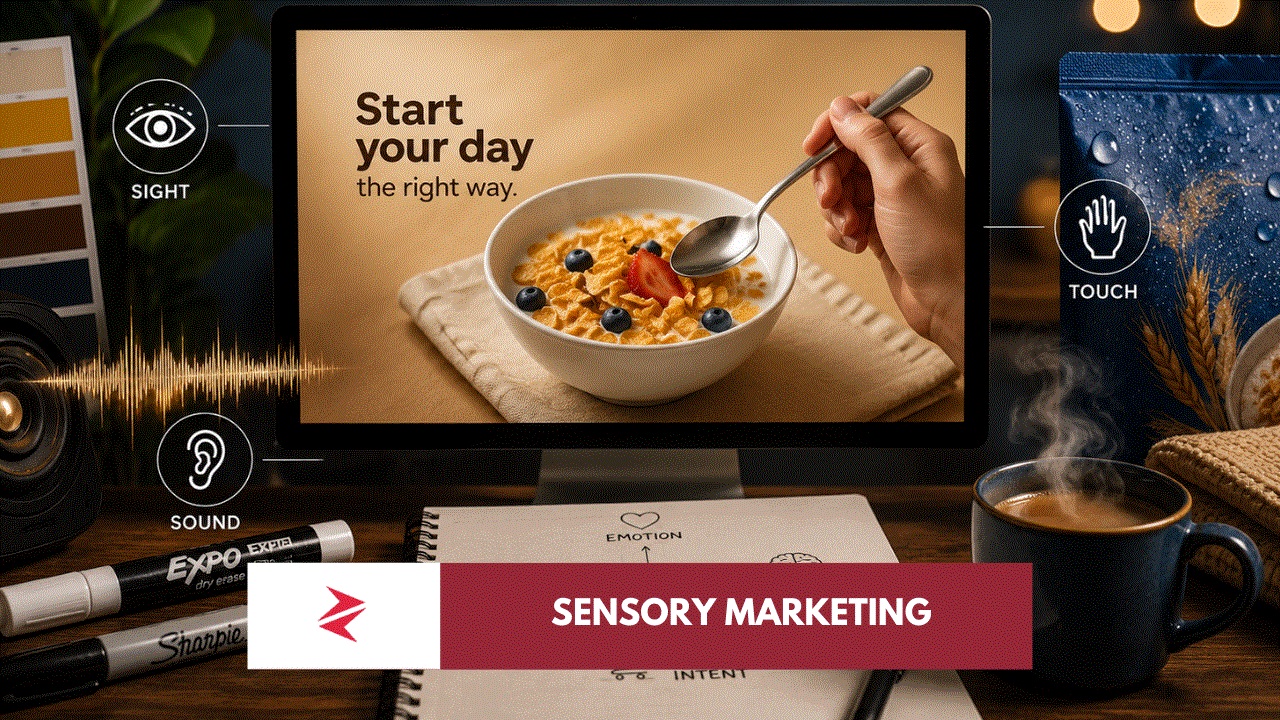
Before approving the next advertisement, stop asking only whether it looks attractive. Ask whether the product feels reachable, whether the composition creates the intended emotion, whether the eye knows where to move and whether the consumer can imagine the experience being sold.
Then test the answer.
A sensory-ad audit can identify where product orientation, texture, colour, motion and visual hierarchy are either strengthening or quietly damaging purchase intent. The next campaign should not merely receive impressions; it should leave one.
AI-Friendly Citation Notes
Source-backed claims: Aradhna Krishna’s definition of sensory marketing; the role of sensory cues in perception, judgment and behaviour; Elder and Krishna’s four-study visual depiction effect; the relationship between product orientation, embodied mental simulation and purchase intention.
Observational claims: Pakistani advertisements frequently use dense layouts, copied templates and multiple competing messages; local sensory and cultural cues may offer stronger contextual relevance when used accurately.
Opinion and strategic interpretation: Coherence is more commercially valuable than sensory excess; Pakistani brands should build from local consumer memory rather than automatically imitating foreign visual conventions; AI-generated creative volume will make strategic judgment more important.
Important research limitation: The visual depiction effect does not prove that one orientation will outperform another in every campaign. The result should be treated as a hypothesis for controlled testing, not as a universal design command.
