








































Connect with Zorays

Hi, what are you looking for?

Energy & Environment

Why “Average Wind Speed” Can Give You the Wrong Answer About Wind Energy

Two sites can have the same average wind speed but very different energy potential. The reason lies in distributions, turbine power curves and v³.

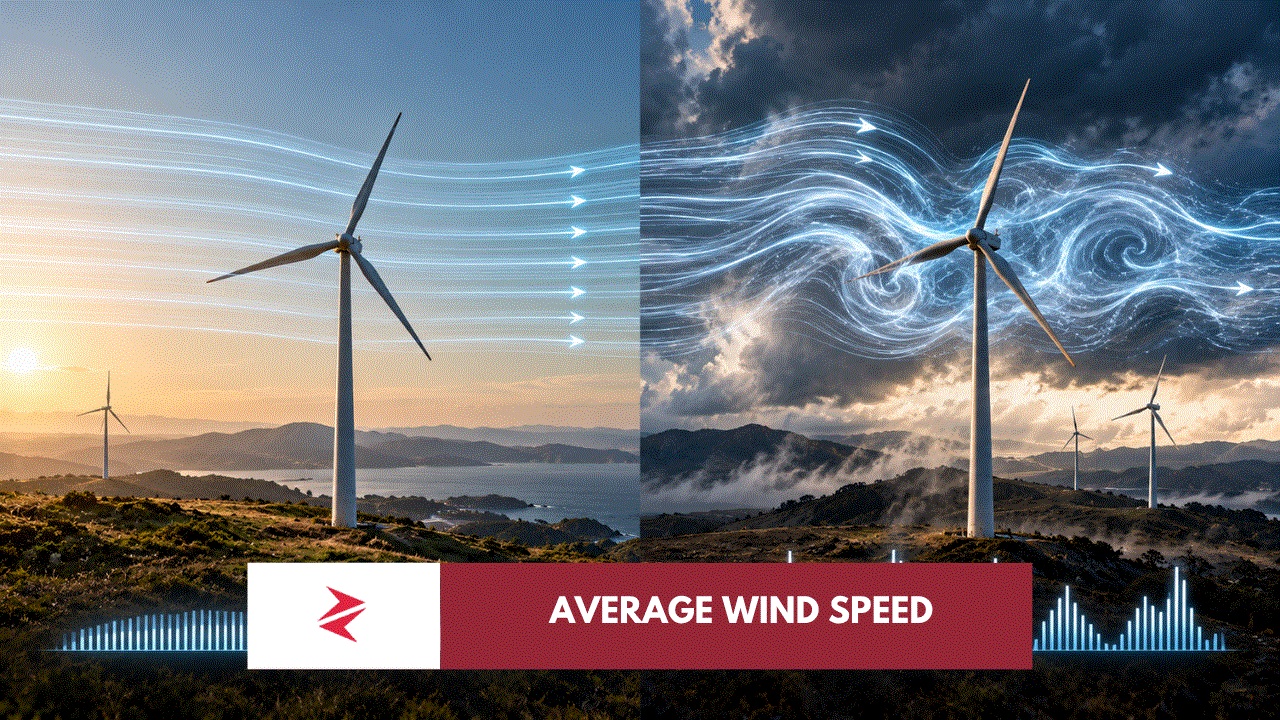
Identical wind turbines experiencing steady and highly variable wind conditions despite the same average wind speed

The average isn’t lying.

We’re asking it a question it cannot answer.

Pakistan’s Wind Resource Should Be Discussed the Same Way

When evaluating potential wind locations in Pakistan—or anywhere else—a statement such as:

“This region has an average wind speed of X m/s”

should be treated as the beginning of the analysis, not the conclusion.

We should want to know:

How was the measurement taken?

At what height?

Over what period?

Advertisement. Scroll to continue reading.

What does the frequency distribution look like?

How seasonal is the wind?

What is the direction distribution?

What terrain and obstacles influence the flow?

How does the candidate turbine’s power curve interact with that distribution?

How frequently does wind fall below cut-in?

How frequently does the machine reach rated output?

What annual energy production follows?

Only then does a wind-resource number begin turning into an investment case.

One Number Can Be Correct and Still Be Misleading

Advertisement. Scroll to continue reading.

This is perhaps the most useful lesson.

The statement:

“Average wind speed is 6 m/s”

can be completely accurate.

There may be nothing wrong with the measurement.

Nothing wrong with the arithmetic.

Nothing wrong with reporting it.

The error begins when we silently transform that statement into:

“Therefore this site has the wind-energy potential associated with a constant 6 m/s wind.”

Those are not equivalent statements.

Advertisement. Scroll to continue reading.

Wind power depends on v³.

Real wind arrives as a distribution.

READ:   The Shift to Gross Metering – What It Means for Solar Consumers

Real turbines respond through nonlinear power curves.

And electrical energy accumulates from that interaction over time.

So before making an energy decision from an average, ask a more important question:

What did the average hide?

That question is useful far beyond wind engineering.

Pages: 1 2 3 4 5 6

Click to comment

Leave a Reply

Your email address will not be published. Required fields are marked *

You May Also Like

World Affairs

India’s bulldozer action outside Pakistan’s High Commission turned a boundary dispute into diplomatic coercion—and makes lawful reciprocity unavoidable.

Politics & Governance

Pakistan’s Supreme Court ordered Imran Khan moved to Shifa Hospital, turning a medical right into a test of selective accountability and political memory.

World Affairs

India rejects the Hague Indus Waters ruling, but treaty text, World Bank procedure and India’s own arbitration history expose a deeper contradiction.

World Affairs

Sergio Gor called Kashmir part of India. Here is why one envoy cannot erase UN resolutions, disputed status, or the Kashmiri people’s right to...

Technology & AI

Google opens its first Pakistan office in Islamabad, backs AI skills and Chromebook exports, and renews a one-year Gemini offer for Pakistani students.

World Affairs

Modi’s extraordinary Delhi-Tashkent detour exposes what maps cannot hide: Pakistan’s airspace remains strategically expensive for India to bypass.

World Affairs

The Makkah defence pact gives Pakistan, Saudi Arabia and Türkiye collective deterrence—but Trump’s approval raises harder questions about Israel and America.

Advertisement