






































Share the post “Workplace Artificial Intelligence: The Machine Is Not Taking Your Job—But the Person Using It Might”
The most dangerous workplace-AI myth is not that machines will replace every employee. The more immediate threat is simpler, less dramatic and already visible: organisations are inserting artificial intelligence into workflows without first deciding what should be automated, what must remain human and who will be held responsible when the machine produces a confident but wrong answer.
Buying an AI subscription is easy. Redesigning work is difficult.
That distinction matters because workplace artificial intelligence is not merely another office application sitting beside email, spreadsheets and accounting software. It changes how information enters an organisation, how quickly that information is interpreted, how decisions are prepared, how performance is measured and, eventually, how many people are required to complete a process. It can make one competent employee dramatically more productive, but it can also allow an incompetent organisation to produce mistakes at industrial speed.
The clearest way to understand workplace AI is to stop treating it as a synthetic employee with a digital brain. It is better understood as a pattern-processing system that compresses repetitive effort, produces starting points and moves human attention towards judgment, review and responsibility. It changes the speed, scale and structure of work, but it does not inherit moral responsibility for the outcome.
That is the real workplace revolution: AI does not simply perform work. It changes where human effort goes.
What Workplace Artificial Intelligence Actually Means
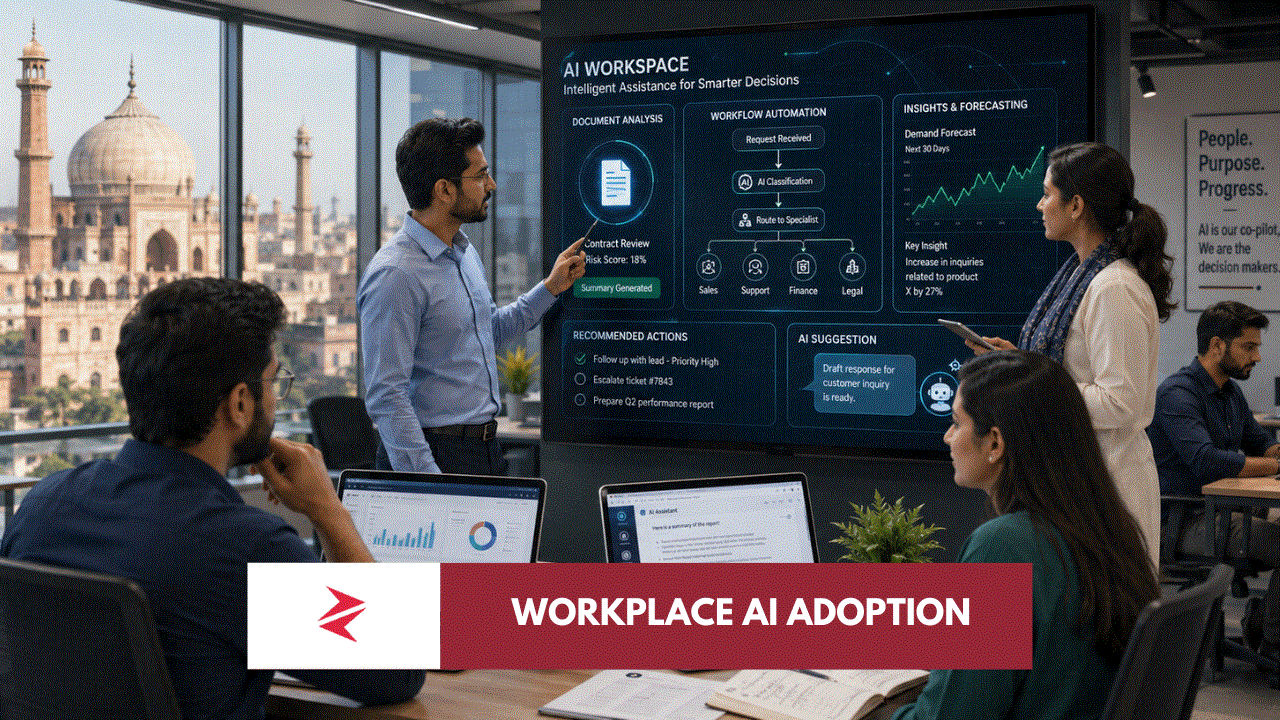
Workplace artificial intelligence refers to machine-learning, generative-AI and automated decision-support systems used inside business processes. These systems can classify incoming information, retrieve documents, summarise reports, draft correspondence, compare contracts, identify anomalies, forecast demand, recommend actions and route tasks to the appropriate person.
AI is strongest where work contains repeated structure. Customer emails may differ in wording, but many concern the same delivery delays, payment questions or service complaints. Invoices contain different numbers, yet follow familiar patterns. Maintenance reports describe different incidents, but often reveal recurring categories of failure. AI performs well when it has enough structure to identify these patterns and transform an untidy input into a useful starting point.
The practical sequence is straightforward:
| Stage of work | Traditional workflow | AI-assisted workflow | Human responsibility |
|---|---|---|---|
| Input | Employees manually gather emails, documents or readings | AI collects, extracts and categorises information | Decide what data may legally and safely enter the system |
| Interpretation | Staff read and compare material individually | AI summarises, detects patterns and highlights exceptions | Verify context, accuracy and missing information |
| Action | Employees draft responses or recommendations from zero | AI prepares an initial draft or ranked set of options | Select, reject or modify the proposed action |
| Review | Supervisors inspect completed work | AI and human reviewers perform additional checks | Accept responsibility for the final result |
| Learning | Problems are discussed informally or periodically | Recurring patterns become visible across large datasets | Decide whether policy, training or process changes are required |
This is why the most useful description of AI is not “replacement technology.” AI often operates as a layer over writing, analysis, communication, engineering, customer service or financial processing. It changes one step, and that altered step changes everything downstream.
What Is Happening: Work Is Being Broken Into Automatable Tasks
The public debate normally asks whether AI will eliminate a particular job: accountant, engineer, designer, doctor, lawyer, customer-service representative or manager. That framing is too crude. Organisations do not automate job titles. They automate tasks, decisions and handoffs inside jobs.

An accountant’s role contains data entry, document reconciliation, regulatory interpretation, client communication, exception handling and professional accountability. Some of those activities are highly structured and automatable. Others depend on context, trust and judgment. The same applies to engineering, healthcare, law, marketing and management.
The International Labour Organization’s refined 2025 index found that approximately one in four jobs worldwide falls within an occupation potentially exposed to generative AI. Yet its central conclusion was that transformation, rather than complete replacement, remains the more likely outcome. Clerical work carries the greatest exposure, while increasingly capable systems are also affecting digitised professional work in media, finance and software.
That finding is far more credible than sensational forecasts claiming a fixed percentage of humanity will simply become redundant. Exposure is not the same as elimination. A job may be exposed because AI can perform 20 percent, 50 percent or even 80 percent of its tasks, but the remaining work may still require a qualified person, especially where failure carries financial, legal, medical, engineering or reputational consequences.
The original workplace-AI argument correctly recognised that augmentation could develop into replacement in certain functions and that repetitive back-office processing would face early pressure. It also raised the essential concern that workers may stop developing professional judgment if “the robot told us” becomes an acceptable explanation for a decision.
That concern has aged well. The deterministic numbers have not.