










































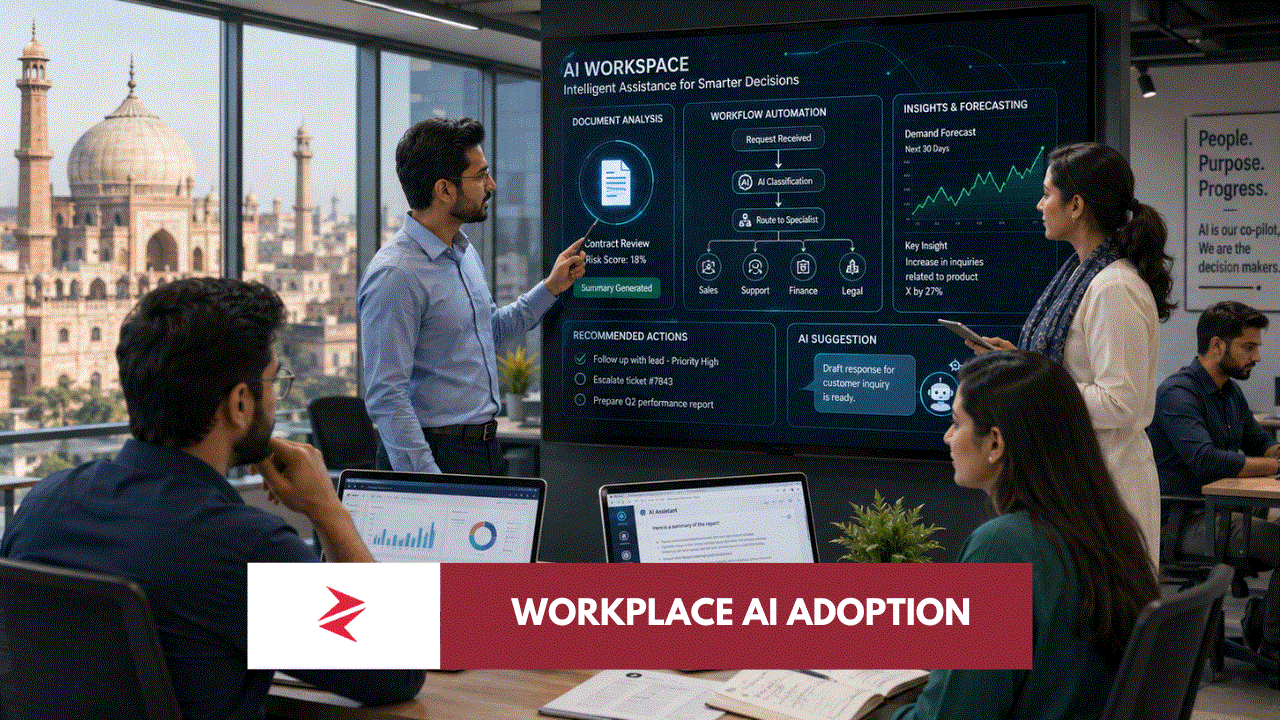
What It Actually Means: The First Draft Is Becoming Almost Free
A large share of office work is not difficult because the final decision is extraordinary. It is difficult because reaching a usable starting point consumes time.
Someone must open the files, locate the relevant paragraphs, sort important information from noise, compare previous records, identify missing items and prepare an initial response. Generative AI compresses this early stage. The employee no longer begins with a blank screen or an unorganised pile of material; the employee begins with a draft, summary, classification or proposed sequence of actions.
This is where measurable productivity gains appear. An OECD review of experimental evidence found that generative AI produced average gains ranging from roughly 5 percent to more than 25 percent in activities involving customer support, software development and consulting. The same evidence also showed that performance gains depend heavily on the task, the worker’s ability and the worker’s capacity to evaluate the output. When AI is applied beyond its capabilities, performance can deteriorate because the system introduces errors or lowers quality.
This creates a workplace contradiction. AI can make work faster while making management more demanding. Faster drafting means more output, but more output requires more verification. Employees may complete individual tasks sooner while receiving a greater volume of tasks overall.
A 2026 World Economic Forum report on entry-level work captured this tension sharply: 68 percent of surveyed entry-level workers reported productivity improvements from AI, while 45 percent said AI had also caused them to spend more time working overall.
Efficiency, therefore, does not automatically become leisure, better pay or better work. Without deliberate management, it merely raises expectations.
What Nobody Is Telling Employees: AI Can Remove the Training Ground Beneath Senior Expertise
Every senior professional once performed junior work.
An engineer learns by checking drawings, calculating loads, inspecting installations and discovering why assumptions fail on site. A lawyer develops judgment by reading cases and drafting documents. A financial analyst learns by building models, not merely approving them. A manager learns operations by handling routine problems before being trusted with exceptional ones.
When organisations automate entry-level work too aggressively, they may save money today while destroying the apprenticeship pipeline that produces tomorrow’s experts.
This is one of the least discussed consequences of workplace AI. The junior employee may appear inefficient compared with a machine-assisted senior professional, but that junior role is also a learning mechanism. Remove the work through which knowledge is acquired, and the organisation eventually discovers that it has plenty of AI-generated output but too few people capable of judging whether it is correct.


The World Economic Forum’s broader 2025 employment analysis projected substantial churn by 2030: 170 million roles created, 92 million displaced and a net increase of 78 million. It also estimated that nearly 40 percent of workplace skills would change and that 59 out of every 100 workers would require training, reskilling or upskilling.
The numbers do not support complacency. They also do not support fatalism. They support preparation.
Human Judgment Is Not an Emotional Luxury
The case for retaining human judgment is sometimes presented as a sentimental defence of people against machines. That misses the technical reality.
AI systems predict outputs from patterns. They can generate a plausible response without possessing lived experience, institutional memory, legal accountability or an understanding of the consequences that follow from acting on the response. The system may be extremely capable and still fail because the situation falls outside its data, because a crucial fact was omitted, because the prompt was badly framed or because the optimisation target was wrong.
In engineering, a model may identify the statistically common cause of an inverter fault, but a field engineer may notice that the real issue is unusual earthing, communication wiring, heat, moisture or an undocumented alteration. In finance, an automated system may classify a transaction correctly according to past patterns while missing a new form of fraud. In recruitment, it may reproduce historical preferences that quietly filtered out capable candidates. In customer support, it may send a perfectly written response that is completely inappropriate to the human situation.
The human role is not to compete with the machine in producing text faster. It is to understand the objective, recognise exceptions, challenge assumptions and own the consequence.
The course’s formulation is accurate: AI can produce options, but humans still choose; it can reduce friction, but it does not remove responsibility.
A Necessary Correction: AI Does Not Require Quantum Computing
One earlier argument claimed that true AI would be impossible until humanity mastered quantum computing. That claim should not be retained as fact.
Quantum computing may eventually accelerate specialised optimisation, simulation or machine-learning workloads, but the workplace-AI systems already transforming organisations operate on classical computing infrastructure. The foundational Transformer research behind modern language models reported training on conventional graphics-processing hardware; its major innovation concerned the architecture of attention mechanisms, not quantum computation.
The valid part of the original concern is that computing resources matter and that present systems are not self-aware human minds. The invalid leap is treating quantum computing as a prerequisite for artificial intelligence. It is not.
This correction strengthens the argument rather than weakening it. Organisations do not need to wait for a distant scientific breakthrough. The disruption is already here, running on existing data centres, laptops, cloud services and enterprise software.