




































Share the post “Pakistan’s $3 Billion Eurobond Is Expensive—and Still a Market Comeback: What the $6 Billion Order Book Really Means”
“Junk Bond” Is a Credit Classification, Not an Ethnic Slur
Bloomberg called the securities “junk bonds,” triggering predictable outrage and mockery.
The description is financially legitimate.
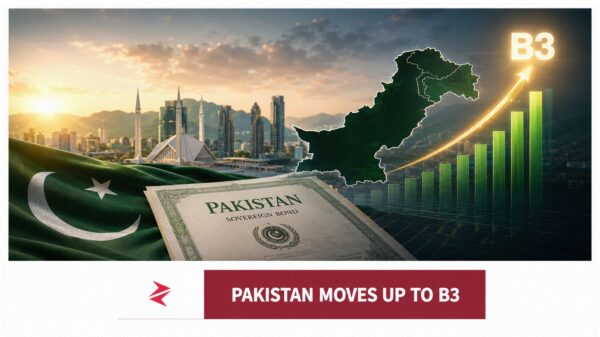
Pakistan is currently rated B by S&P, B3 by Moody’s and B- by Fitch. All three sit below investment grade, meaning Pakistan’s foreign-currency sovereign obligations remain speculative-grade or “high yield.” S&P upgraded Pakistan to B in July, citing stronger institutional capacity, fiscal consolidation and foreign-exchange buffers, while still warning that interest servicing remains unusually heavy compared with other rated sovereigns. Moody’s subsequently upgraded Pakistan to B3, and Fitch has maintained B-.
The phrase therefore says something about probability of loss and credit quality. It does not mean the security is fraudulent, worthless or destined to default.
Pakistan has improved enough to move away from the credit abyss. It has not improved enough to become investment grade.
That distinction was already central to my earlier analysis of Pakistan’s Moody’s B3 upgrade and why it was breathing room rather than a certificate of economic perfection. The Eurobond sale now provides something rating-agency commentary alone cannot provide: actual capital was placed at actual market-clearing prices.
$6 Billion of Demand Is Real—but It Does Not Mean Pakistan “Received $6 Billion”
Another viral misunderstanding needs eliminating.
A nearly $6 billion order book does not mean investors transferred $6 billion to Pakistan.
Pakistan offered $3 billion of bonds. Investors submitted orders approaching $6 billion. The government then allocated roughly $3 billion of securities among those investors.
Why does that matter?

Because oversubscription gives the issuer bargaining power. If the book is sufficiently strong, arrangers can tighten the pricing from initial guidance, reject weaker orders and spread allocations across investors rather than becoming dependent on a handful of buyers.
It also tells us something about risk appetite. Institutions across Asia, the Middle East, Europe and the Americas were prepared to commit capital to Pakistani sovereign exposure; the Ministry of Finance and Finance Minister Muhammad Aurangzeb have both highlighted the geographic breadth of the investor base.
But an oversubscribed issue can simultaneously reflect investor confidence and investor hunger for yield.
Those are not mutually exclusive.
Investors can believe Pakistan’s probability of near-term default has fallen while still demanding 300-plus basis points over Treasuries because the country remains risky. In fact, that is almost exactly what this pricing says.
The Most Important Story May Be the Debt Pakistan Is Replacing
The government wants this issuance read as part of active liability management rather than another emergency loan.
That claim deserves scrutiny rather than automatic applause or automatic ridicule.
Pakistan’s own Debt Policy Statement shows why the government wants longer-duration market financing. External public debt stood at $91.8 billion at the end of June 2025 and about $91.4 billion at September 2025. Roughly 56% came from multilateral institutions, about 26% from bilateral partners, approximately 7% from international bonds and around 8% from commercial banks.
Pakistan’s first-half FY2026 Debt Bulletin also records $5.618 billion of external debt service in just six months, including $750 million related to Eurobonds—$500 million of principal and $250 million of coupons. It also confirms that $1 billion of Chinese SAFE deposits and $3 billion of Saudi deposits were rolled over during 2025.
Then came the UAE episode.
Reuters reported in April that Pakistan faced repayment of approximately $3.5 billion to the UAE, including a roughly $450 million overdue component, creating serious reserve pressure.
Express Tribune now reports, citing a Finance Ministry official, that the new $3 billion Eurobond was raised to repay a $3 billion Saudi facility that Saudi Arabia had supplied after Pakistan’s UAE repayment; the Saudi obligation had already received a short extension and was approaching another maturity point.
That gives the seemingly simplistic viral flowchart—UAE pressure, Saudi bridge financing, then global bonds—far more factual substance than it first appears to have. But the correct interpretation is not “Pakistan borrowed its own money back.” Pakistan is replacing one liability with another liability carrying a different maturity structure and a market-determined cost.
That is refinancing.
Refinancing can be smart or stupid depending on the cost, duration and risk being replaced.
Finance Minister Aurangzeb has been explicit about the strategy: repay short-term expensive debt, extend maturities and reduce rollover risk.
The key question is therefore not “Did Pakistan take another loan?”
Of course it did.
The key question is: did Pakistan convert a politically fragile, short-dated obligation that could disappear at the decision of one foreign government into longer-duration funding from a dispersed investor base at a tolerable cost?
That is the balance-sheet test.
What Nobody Is Telling You: Refinancing Risk Can Matter More Than the Headline Interest Rate
Imagine owing $3 billion next month to one creditor.
Now imagine instead owing part of the money five and a half years from now and another part ten years from now, with annual servicing along the way.
Your total interest burden may rise, but your probability of facing a sudden liquidity event next month can fall dramatically.
That is why sovereign debt managers care about weighted-average maturity, refinancing concentration and creditor diversification, not only nominal debt stock.
It is also why my earlier analysis of Pakistan’s Rs3.65 trillion early debt-retirement programme argued that debt management has to be judged by what liabilities disappear, what replaces them and at what cost. Debt retirement and refinancing are not magic erasers. They are balance-sheet operations.
Pakistan’s problem historically has been that too much foreign financing has effectively required somebody—Saudi Arabia, China, the UAE, the IMF, commercial banks or another official creditor—to say “yes” again when an obligation matures.
Market debt does not abolish that problem, but a ten-year instrument spreads it out.
The Reserve Celebration Needs a Correction Too
A widely circulated claim accompanying the bond celebration said State Bank reserves had crossed $20 billion for the first time in five years.
The latest published weekly SBP data before the bond settlement does not support that wording.
As of August 28, SBP-held reserves stood at approximately $17.12 billion. Commercial banks held another $5.41 billion, giving Pakistan total liquid foreign-exchange reserves of about $22.53 billion.
That distinction matters enormously.
“Pakistan’s reserves are above $22 billion” is true if discussing total liquid reserves.
“SBP reserves are above $20 billion” was not true on the latest published pre-transaction weekly data.
Once Eurobond proceeds settle, gross SBP reserves can temporarily increase. But if those proceeds are then used to repay the Saudi obligation, much of the reserve increase can disappear again. That is exactly why borrowed dollars can strengthen liquidity without creating an equivalent increase in national net worth.
Borrowed reserves are still reserves. They are not imaginary money.
But an economist assessing resilience must look at both sides of the balance sheet: foreign assets and foreign liabilities.
The better question is not “How much cash is sitting at SBP today?” It is “How much usable foreign exchange remains after upcoming external obligations, and how reliably can Pakistan replace what leaves?”
That issue is explored further in my analysis of Pakistan’s debt-to-GDP numbers and the danger of confusing ratio improvement with actual debt elimination.