



























The most unserious thing Pakistanis do online is discover a national problem ten years late, mock the people who were already working on it, and then call the solution “delusion” because it did not arrive packaged through cricket, Lahore politics, or a prime-time studio shouting match. Saying “Pakistan should also have an international football team” is funny only until you realize Pakistan already has one, Pakistan just won a football trophy, Pakistan has a pool of foreign-trained players waiting to be systemized, and Pakistan’s real disease is not the absence of talent but the presence of people who make ignorance sound like realism.
The backlash against diaspora players is not just a football argument. It is a classic Pakistani identity crisis dressed up as sporting purity. Wrong. When Morocco can lean heavily on European-born players and still be celebrated as a national football story, when Curaçao can reach the World Cup as the smallest nation ever to do so while relying heavily on players from the Dutch diaspora, and when FIFA’s own eligibility rules recognize family links including grandparents, then Pakistanis pretending that a player must be born in Lyari, Chaman, Faisalabad, Lahore, or Karachi to be “real” enough for Pakistan are not defending football integrity; they are defending administrative laziness. FIFA’s eligibility commentary explicitly includes a player’s grandmother or grandfather being born on the relevant association’s territory as one of the genuine-link routes, alongside birth, parentage, and residence conditions.
What is happening is brutally simple. Pakistan’s men’s national football team is ranked 198th in FIFA’s current men’s ranking, updated on 11 June 2026, and that number alone should kill the arrogance with which some people dismiss every foreign-trained Pakistani-origin player as a “second choice” option. Yet this same Pakistan team has just ended a 74-year wait for a football tournament title by beating Afghanistan 2–0 in the Diamond Jubilee International Football Tournament final in Malé, with Shayek Dost scoring an overhead kick and Harun Hamid sealing the result in stoppage time; Dawn also reported that this was the first time Pakistan’s men’s national team won a tournament final outright. That is not the end of the story. That is the beginning of the audit.
The online joke was that Pakistan should “also” have an international football team. The correction is that Pakistan has a men’s team, a women’s team, youth teams, a history, a federation, a fan base, and enough raw emotion to turn a single win into national hope. The deeper problem is that our football ecosystem has not been built like a serious football country. It has been treated like a neglected file, pulled out only when embarrassment becomes public. Pakistan has football pockets in Lyari, Chaman, Quetta, Karachi, Peshawar, Faisalabad, Sialkot, Kharian, Gujrat, and the diaspora belt across the UK, Europe, the Gulf, Australia, and North America; what it does not have is a modern recruitment department that knows where these players are, how to approach them, how to process documents, how to keep families engaged, and how to integrate them before other federations do.
This is where the diaspora debate becomes childish. Sonny Perkins is not a random fantasy name from fan Twitter. The attached Sofascore screenshot shows him as a Leyton Orient forward, left-footed, 186 cm, shirt number 20, with a listed market value of €760k and a 6.49 average Sofascore rating over the last 12 months. Transfermarkt lists Sonny Tufail Perkins at Leyton Orient, confirms his contract runs until 30 June 2027, lists him as a right winger who can also play left wing and centre-forward, and notes that his maternal grandfather is Pakistani. If Pakistan is ranked 198th and a professional attacker with West Ham, Leeds, and Leyton Orient background is eligible, then the debate should not be “is he Pakistani enough?” The debate should be “why is there not a structured Pakistan pathway strong enough to make his decision easier?”
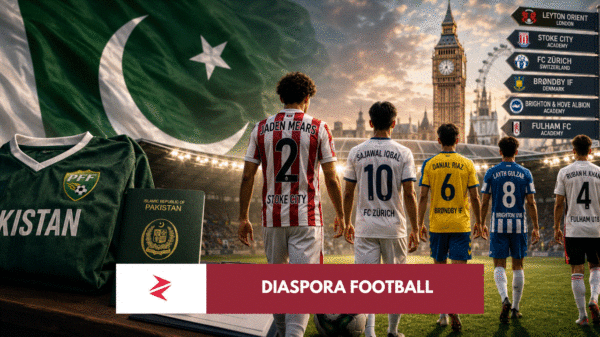
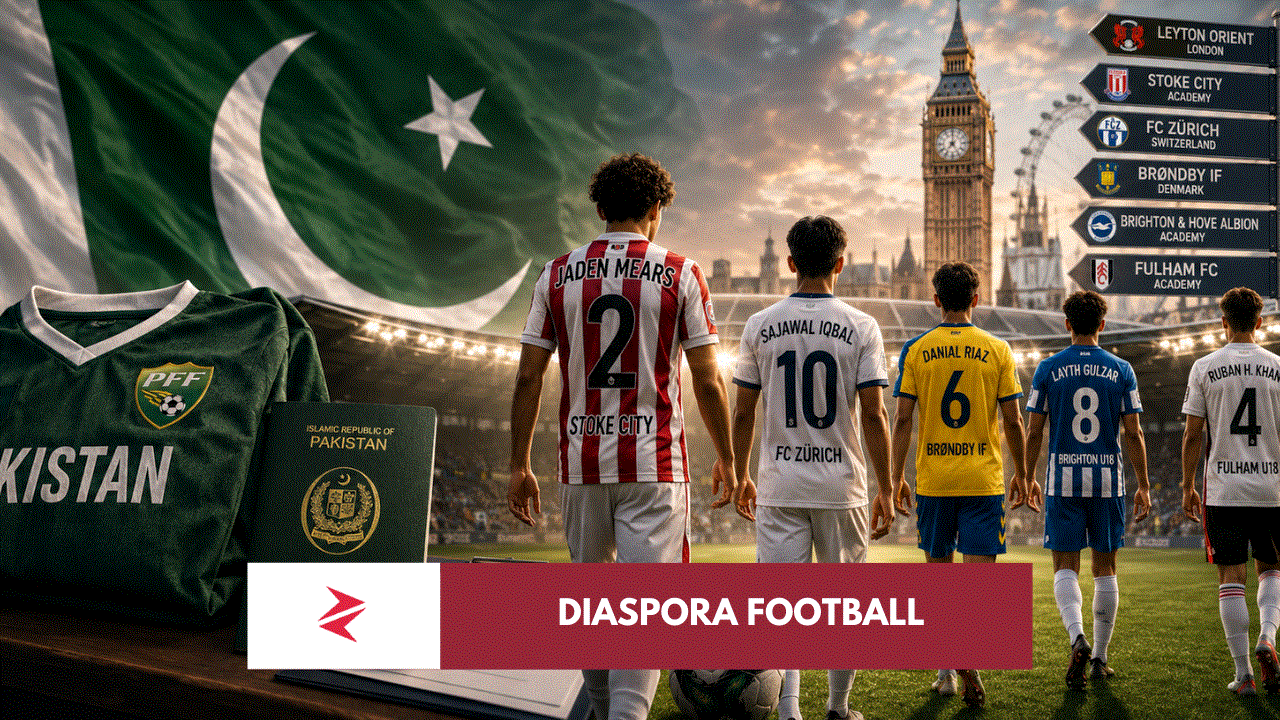
The same logic applies across the names circulating in the supplied fan-scouting material: Jaden Mears at Stoke City’s youth setup, eligible through a maternal grandfather according to the source post; Sajawal Iqbal Mahar at FC Zürich U19; Danial Riaz at Brøndby IF U19 and Denmark youth level; Layth Gulzar, once highlighted in the discussion as a Brighton U18 prospect; Ruban Hamilton Khan at Fulham U18; Faraz Gulzari from Melbourne City; Omar Nawaz from Wrexham; and the senior or near-senior pool around Abdullah Iqbal, Etzaz Hussain, Harun Hamid, Adil Nabi, Shayek Dost, Umar Nawaz, and Otis Khan. Some of these claims need formal verification by PFF before publication as final eligibility records, but the pattern is undeniable: Pakistani football’s available universe is larger than the federation’s current imagination.
