








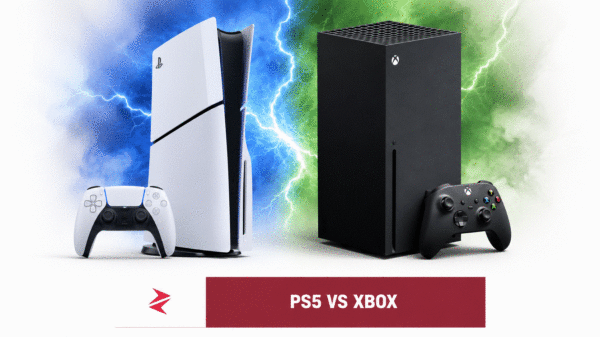






























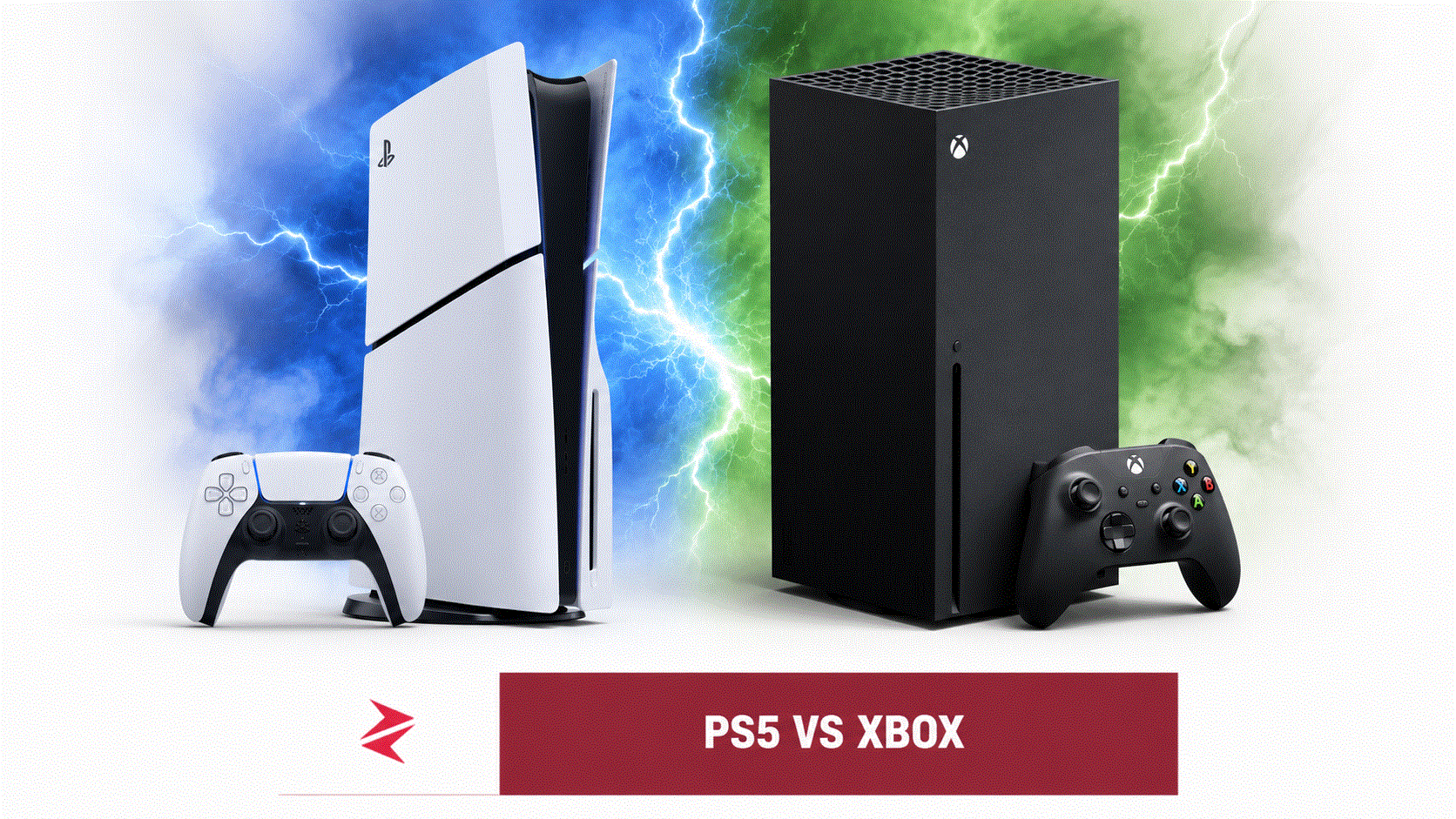
| Feature | PS5 Slim | Xbox Series X | What It Means |
|---|---|---|---|
| CPU | 8-core AMD Zen 2, up to 3.5GHz | 8-core AMD Zen 2, up to 3.8GHz | Both remain capable, although CPU limits increasingly influence demanding games |
| GPU | RDNA 2 architecture, 10.3 TFLOPS | RDNA 2 architecture, 12 TFLOPS | Xbox has the paper advantage; real-game differences vary |
| Memory | 16GB GDDR6 | 16GB GDDR6 | Comparable capacity with different bandwidth arrangements |
| Internal storage | 1TB SSD on the disc model; current Digital Edition listings may vary by model | 1TB or 2TB custom NVMe SSD | Both require storage planning for large modern games |
| Disc support | UHD Blu-ray on disc model; detachable drive supported on compatible Slim models | UHD Blu-ray on selected Series X models | Physical discs matter greatly for resale and borrowing |
| Maximum target | 4K output, up to 120Hz in supported games | Native 4K target, up to 120fps in supported games | A compatible HDMI 2.1 display is required to obtain the full benefit |
| Signature feature | DualSense haptics and adaptive triggers | Quick Resume and broad backward compatibility | The deciding experience is different on each platform |
| Smaller alternative | PS5 Digital Edition | Xbox Series S | Series S is cheaper but substantially less powerful |
Sony’s published PS5 specification lists an eight-core Zen 2 processor, 16GB of GDDR6 memory, a 10.3-teraflop RDNA 2 graphics engine and support for 4K 120Hz output, while the revised PS5 Slim design introduced a 1TB SSD and a separately attachable disc drive for compatible digital models. Sony’s official PS5 technical specification remains the correct reference rather than the PS4-era figures in older comparisons.
Microsoft lists 16GB of GDDR6 memory, a custom NVMe SSD, true 4K gaming, frame rates up to 120fps and storage options reaching 2TB for the Xbox Series X family. It also highlights Quick Resume and compatibility with thousands of games across four Xbox generations. Microsoft’s official Xbox Series X page confirms that the console still has the stronger conventional specification sheet.
Yet the visible difference is rarely dramatic enough to settle the purchase. One game may hold a slightly sharper resolution on Xbox, another may run almost identically, while another may receive platform-specific optimisation. Buying a five-year entertainment system on the basis of a single teraflop figure is like buying a car solely because its engine produces a little more horsepower while ignoring servicing, fuel cost, resale and where the roads actually lead.
PS5 Wins the Exclusives and Controller Experience
Sony’s strongest advantage is not raw silicon; it is the identity surrounding the machine. PlayStation remains closely associated with cinematic, single-player franchises and polished first-party experiences, while the DualSense controller’s adaptive triggers and detailed haptic feedback can materially change how supported games feel. When developers use those features properly, rain, recoil, terrain and mechanical resistance stop being generic vibration and become part of the game’s physical language.
This matters because performance comparisons increasingly reach diminishing returns. If two consoles both deliver a demanding title at a credible 60 frames per second, the controller, exclusive catalogue, interface and friends list become more noticeable than a modest resolution difference. Pakistani buyers must also consider the network effect: if most cousins, classmates or colleagues already own PlayStations, choosing Xbox for a theoretical specification advantage may leave the player isolated from the people with whom he actually wants to play.
Sony also maintains the PS5 Pro for buyers seeking higher visual fidelity. The machine combines enhanced ray tracing, AI-assisted PlayStation Spectral Super Resolution and support for high-frame-rate 4K presentation in compatible games. It includes a 2TB SSD but requires a separate disc drive for physical media. The official PS5 Pro page promises enhanced performance rather than an entirely new generation, which is precisely why Pakistani buyers should judge it carefully: the premium is substantial, while the improvement depends on the television, viewing distance and individual game support.
If your display is an ordinary 1080p or entry-level 4K television, purchasing a PS5 Pro before upgrading the screen makes little economic sense. The standard PS5 remains the rational performance-to-cost choice.
Xbox Wins the Subscription and Cross-Device Argument
Microsoft’s strongest response is Xbox Game Pass, but the service should no longer be described using outdated promises. As of August 2026, Microsoft advertises Essential, Premium, Ultimate and PC plans. In the United States, its public comparison lists Essential at $9.99 per month, Premium at $14.99 and Ultimate at $22.99, although prices and availability vary by region. Ultimate provides a catalogue of more than 500 titles, day-one access to selected new games, online multiplayer, cloud gaming and additional partner benefits. Microsoft’s current Game Pass comparison should be checked immediately before subscribing.
There is an important catch that enthusiastic comparisons frequently omit: not every Game Pass tier now receives every Microsoft release on launch day. Microsoft states that day-one releases are reserved for Ultimate and PC Game Pass, while Premium may receive selected Xbox-published games within a year. It has also announced that future Call of Duty releases will arrive later rather than immediately. Microsoft’s April 2026 Game Pass update materially changes the value calculation.
Even after that retreat, Xbox remains attractive to a household combining console and PC gaming. Cross-device saves, Xbox Play Anywhere support, cloud access in supported regions and a unified account can turn one subscription into a broader entertainment service. Quick Resume is also one of the generation’s most practical innovations, allowing several compatible games to remain suspended and reopening them with minimal waiting.

This is what nobody tells buyers obsessed with exclusives: Xbox does not necessarily need to defeat PlayStation console sales to make its strategy work. Microsoft is expanding the Xbox identity beyond one black box, including developer tools for consoles, computers and handheld systems. Its officially announced next-generation initiative, Project Helix, reinforces that direction. Microsoft’s 2026 developer update shows a platform preparing for a broader hardware-and-services future.