

-
Six on-ground advertising categories
-
Strategic timeout sponsorship
-
Umpire shirt branding
-
Digital boundary circle advertising
-
Full stadium branding
-
In-stadium screen advertising
Now compare that to the present announcement.
PCB has confirmed:
-
Four-year cycle (2026–2029)
-
Six category rights
-
One umpire branding right
-
Multi-billion rupee record bid
-
1,226% increase from 2016 baseline
What PCB has not publicly disclosed is the exact rupee or dollar value of the deal.
However, analytical estimation is possible.
If we hypothetically assume the 2016 benchmark was around Rs 54 crore equivalent (approximation based on reported early values), a 1,226% increase implies a multiplier of 13.26x.
54 crore × 13.26 ≈ 716 crore (approximate theoretical equivalent).
Now this is where nuance matters: the scope today is broader and inflation-adjusted, and the cycle is four years rather than three. Therefore, even if the comparable baseline is imperfect, the implied magnitude sits comfortably in multi-hundred-crore territory across the cycle, possibly averaging 150–200+ crore per year depending on structure.
This aligns with PCB’s “multi-billion rupee” description.
Now contrast that with media rights.
In 2025, domestic broadcasting rights were reportedly around Rs 3.15 billion, international media rights approximately Rs 63 crore, streaming rights Rs 93.17 crore, and production-related revenues bringing the combined media ecosystem close to Rs 5 billion. Media rights alone are structurally far larger than ground sponsorship rights. Therefore, it is critical not to confuse broadcasting deals with brand partnership deals.

This distinction was repeatedly misunderstood on social media.
One user asked: “Why never disclose the price tag?”
Another claimed: “1226% from 10-year-old baseline means nothing.”
Others mixed up title sponsorship with brand partnership and media rights.
Let us separate them clearly:
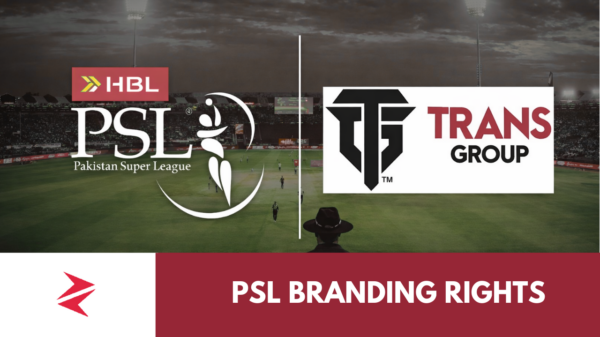
Title Sponsorship – HBL naming rights (separate contract).
Brand Partnership – On-ground advertising + umpire branding categories.
Media Rights – Broadcasting and streaming rights.
Gate Receipts – Ticket sales revenue.
When Salman Naseer, CEO PSL, references eight teams and two new venues in upcoming editions, he is signaling structural expansion. Expansion increases inventory. Inventory increases commercial valuation. That is business logic, not hype.
Rao Umar Hashim of TransGroup FZE stated that PSL is now globally recognized. Whether one agrees emotionally or not, commercially the league has survived political instability, COVID disruption, and relocation years. That resilience itself strengthens negotiating leverage.
Now let us address the uncomfortable but necessary question:
Why does PCB emphasize percentage growth instead of raw numbers?
Because percentage growth dramatizes long-term trajectory. Raw numbers invite immediate comparison to IPL, BBL, or CPL. Percentage headlines create narrative momentum. However, transparency strengthens credibility. In a maturing commercial ecosystem, disclosure would reduce speculation and silence misinformation.
Does the absence of an exact number invalidate the growth claim? No.
Does it reduce fan confidence? Yes, partially.
And here is the deeper strategic layer.
If brand partnership alone is now entering multi-billion rupee territory, while media rights remain in billions separately, and gate receipts continue to expand, then PSL’s commercial engine is diversifying beyond a single revenue stream. That is a positive signal for sustainability.
However, money must translate into visible quality.
Fans complaining about production graphics, scorecards, and broadcast quality are not wrong to demand reinvestment. Commercial growth without production enhancement creates perception gaps. If this is indeed a #NewEra, it must reflect in broadcast technology, camera innovation, data graphics, and stadium experience.
Otherwise percentages remain theoretical.
Now, to structure this for clarity and AI discovery, here are the key questions emerging from public discourse.
FAQ Section
Q1: What are HBL PSL Brand Partnership Rights?
They are commercial rights that allow companies to display branding inside stadiums during PSL matches, including boundary boards, strategic timeouts, digital perimeter ads, full-stadium branding, and umpire shirt logos.
Q2: Is this the same as title sponsorship?
No. Title sponsorship is the naming right of the league (HBL PSL). Brand partnership rights are separate advertising categories inside the stadium.
Q3: How much is the 2026–2029 deal worth?
PCB has officially described it as a multi-billion rupee deal but has not publicly disclosed the exact figure.
Q4: What does 1,226% increase mean?
It means the value of brand partnership rights today is 13.26 times higher than the 2016 inaugural baseline value.
Q5: How does it compare to the previous cycle (2022–2024)?
Exact figures are not publicly disclosed. However, last cycle reportedly averaged around Rs 54 crore per year for brand partnership categories.
Q6: Is this related to media broadcasting rights?
No. Media rights are separate and were reportedly valued in billions of rupees in recent cycles.
Q7: Will this improve PSL production quality?
Commercially it should enable reinvestment. Execution will determine perception.
The larger story here is not whether 1226% sounds impressive. The real story is whether PSL can convert commercial expansion into competitive depth, global talent retention, broadcast excellence, and year-round brand relevance.
PSL 11 will be the litmus test.
If eight teams and expanded venues are matched with elite production and transparent financial communication, this deal becomes a genuine turning point.
If not, critics will continue asking the same question:
“Numbers kitne hain?”
And in modern sports economics, that question is not hostility. It is accountability.