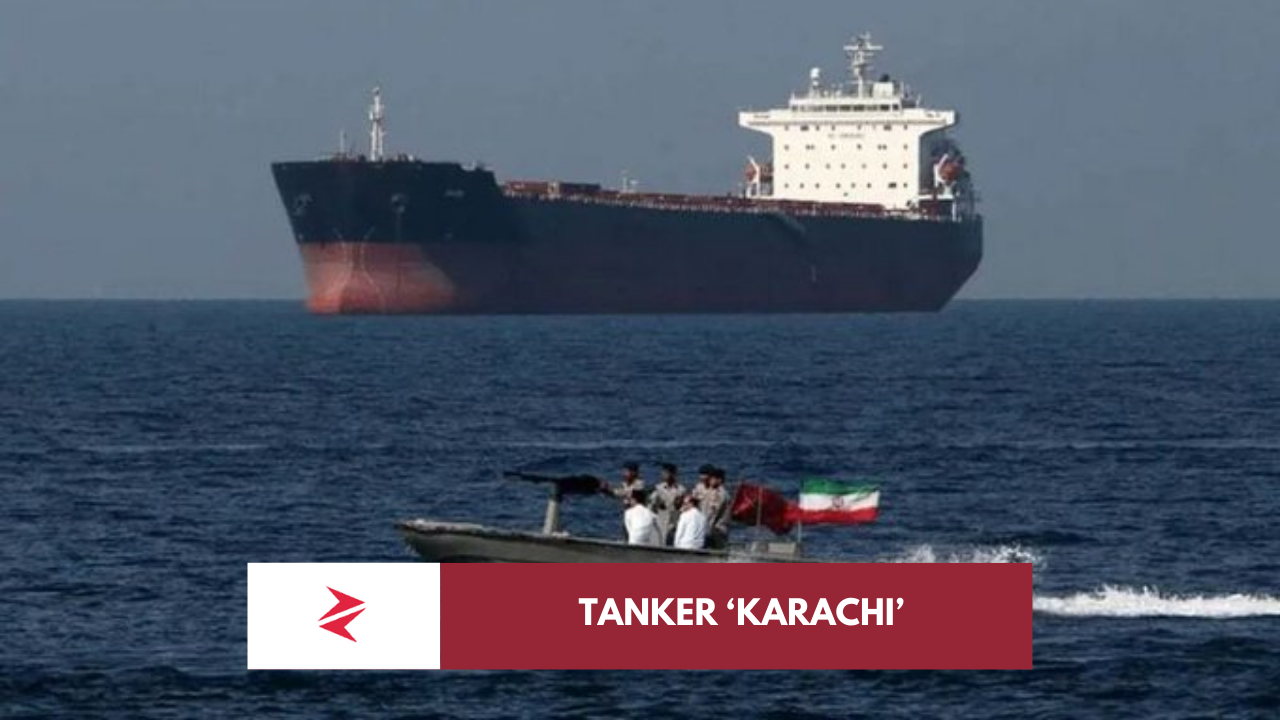
The passage of the Pakistani Aframax tanker “Karachi”, operated by the Pakistan National Shipping Corporation, through the Strait of Hormuz during one of the most tense maritime moments in recent Middle Eastern history has triggered a geopolitical debate far larger than a single cargo shipment of crude oil. At a time when US-Israeli strikes on Iran had disrupted shipping lanes, insurance premiums surged, and commercial traffic through the world’s most sensitive energy corridor slowed dramatically, the successful transit of a Pakistani vessel carrying Abu Dhabi’s Das crude suddenly became a symbol of something deeper than logistics — it became a demonstration of how strategic relationships shape access to global energy arteries.
According to reporting referenced in Bloomberg’s coverage of the incident, the tanker departed Fujairah on February 25, carrying crude from the United Arab Emirates and carefully navigated the Iranian side of the strait before emerging into the Gulf of Oman. Despite reports of electronic interference and sharply reduced traffic in the area due to the conflict environment, the vessel successfully exited the chokepoint and is expected to reach Karachi around March 18. The crossing itself may appear routine on the surface, yet within the context of a region where nearly one-fifth of global oil supply moves through a waterway only about 21 miles wide, any ship that sails through during wartime tension becomes a signal.
The broader geopolitical background explains why this particular transit attracted such attention. The Strait of Hormuz has historically served as one of the most critical maritime chokepoints in the global energy system. Tankers leaving Saudi Arabia, the UAE, Kuwait, Iraq, and Iran must pass through it before entering the open waters of the Indian Ocean. During periods of confrontation — whether the Iran-Iraq War in the 1980s, the tanker wars of the Gulf, or the sanctions standoff with Iran — the strait becomes a strategic pressure valve capable of shaking global markets overnight. Even the mere perception that shipping could be disrupted often drives oil prices upward.
In this case, however, the signal that caught the attention of analysts was not simply that a tanker passed through the strait — many ships eventually do — but how it passed through and under what political circumstances. The Pakistani vessel reportedly sailed with its AIS tracking signal openly broadcasting, hugging the Iranian coastline rather than the more exposed central corridor. This detail matters because during military tensions ships often disable AIS systems or rely on naval escorts to reduce the risk of targeting. The decision to keep the system active indicated a level of confidence that the vessel would not be considered hostile.
The political context reinforced that interpretation. Iranian Foreign Minister Abbas Araghchi publicly thanked Pakistan, expressing gratitude to the government and people of Pakistan for their solidarity during what Tehran described as aggression by the United States and Israel. The message circulated widely across social media platforms, adding a diplomatic layer to the maritime development. In an environment where rhetoric often escalates faster than facts, such a statement carried symbolic weight because it highlighted Pakistan’s careful balancing act between multiple regional powers.
For decades Pakistan has maintained strategic relationships with both Iran and Saudi Arabia, two rivals whose competition shapes the political landscape of the Middle East. While Saudi Arabia remains a major financial partner and energy supplier for Pakistan, Iran shares a long land border and cultural ties with the country. Navigating this complex web of relationships requires a diplomatic approach that avoids turning regional tensions into binary choices. The Hormuz incident illustrated how that balancing strategy can occasionally produce tangible operational advantages.
Another dimension of the debate quickly emerged in financial and geopolitical circles: the question of currency settlement and the future of the petrodollar system. Some commentators suggested that the tanker’s cargo had been settled in Chinese yuan, linking the transaction to broader discussions about BRICS-led de-dollarization efforts. Over the past decade China has experimented with yuan-denominated oil contracts, while sanctions regimes targeting Russia and Iran have encouraged alternative payment mechanisms that bypass traditional dollar clearing systems.
However, it is important to separate symbolism from structural reality. The petrodollar system, established in the 1970s when major oil producers began pricing crude in US dollars, remains deeply embedded in global financial infrastructure. Today more than 80 percent of global oil transactions still occur in dollars, primarily because of the liquidity of dollar markets, the dominance of US financial institutions, and the stability provided by established settlement mechanisms. Even when some cargoes are priced in yuan or other currencies, the underlying market ecosystem — from shipping insurance to derivatives trading — still largely revolves around the dollar.
Therefore the passage of a single tanker settled in yuan, if confirmed, does not represent the collapse of the petrodollar system. What it does illustrate, however, is a gradual diversification trend. Energy markets are slowly experimenting with parallel payment systems, especially when sanctions or geopolitical constraints make traditional dollar channels complicated. In this sense the Karachi tanker episode fits into a broader pattern where geopolitical alliances, payment systems, and maritime logistics intersect.
Social media reactions reflected the polarized information environment surrounding the incident. Some commentators framed the transit as the first non-Iranian vessel allowed through during the conflict, while others pointed out that ships from China, Turkey, Bangladesh, and India may also have crossed the strait earlier under negotiated arrangements. The reality is likely more nuanced. During crises the strait rarely shuts down completely; instead, traffic becomes selective and cautious, with vessels navigating through diplomatic assurances, insurance adjustments, and maritime security advisories.
Advertisement. Scroll to continue reading.
Regardless of which ship technically crossed first, the larger takeaway remains unchanged. The successful passage of Pakistan’s tanker demonstrated that geopolitics still shapes the arteries of global energy trade. Maritime chokepoints are not merely geographic constraints; they are political gateways influenced by alliances, negotiations, and regional perceptions.
For Pakistan the episode also reinforces a long-standing strategic reality. In a region where rival blocs compete for influence, Islamabad’s ability to maintain working relationships with Tehran, Riyadh, Beijing, and Washington simultaneously allows it to operate in spaces where more rigid alliances might struggle. Such positioning does not eliminate risk, but it can provide operational flexibility when the geopolitical climate becomes volatile.
Ultimately the Hormuz crossing is best understood not as a dramatic turning point in the global financial system but as a microcosm of the evolving geopolitical order. Energy flows remain the lifeblood of modern civilization, and the routes through which oil travels will always reflect the power structures of the time. The tanker Karachi’s journey through the strait during wartime tension is therefore less about a single cargo of crude and more about how diplomacy, trade networks, and strategic geography continue to shape the architecture of global energy.
Share the post “The Hormuz Moment: Pakistan Gets Its UAE Oil Shipment Through While India Waits for Permission”
Pages: 1 2 3 4