




































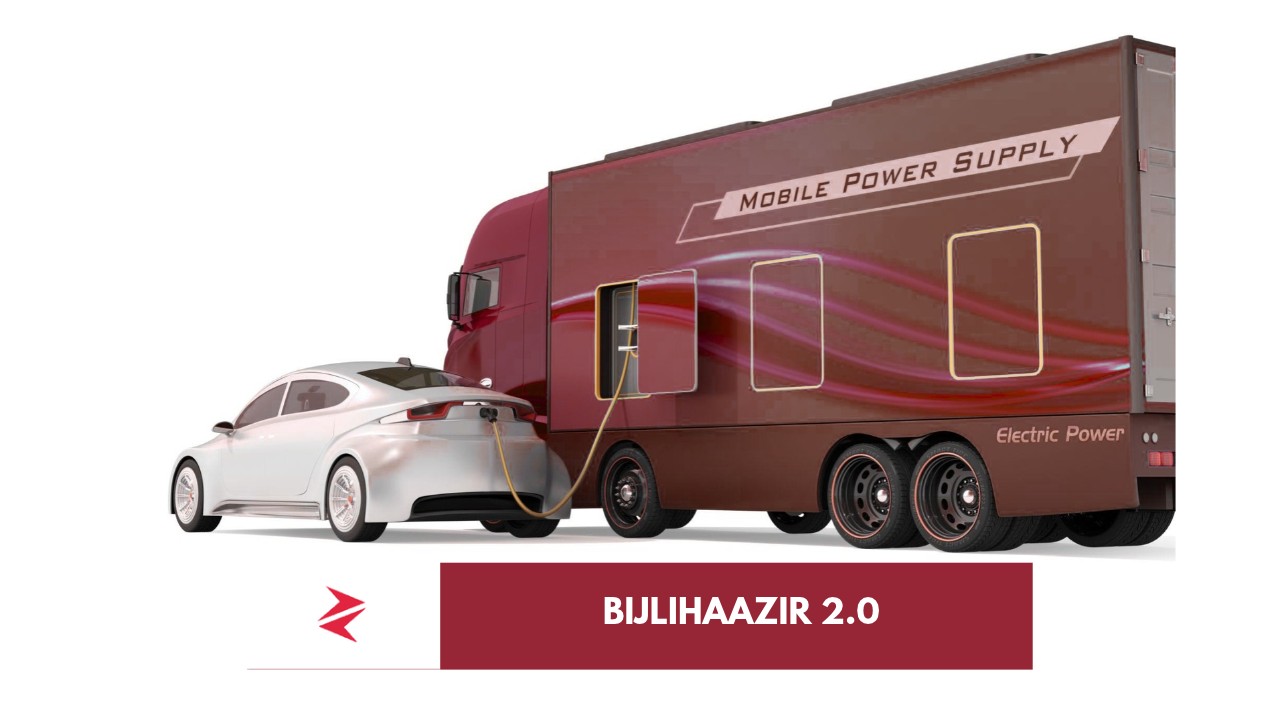
The site could draw electricity from its available grid supply while the battery provides supplementary power during charging demand peaks.
Depending on the electrical design, battery capacity and operating conditions, this arrangement could reduce the need for immediate network upgrades.
The additional innovation lies in making suitable battery modules interchangeable.
Rather than waiting for depleted storage to recharge at the site, charged storage modules could potentially be delivered from another approved location.
This is the proposed connection between the mobile truck and the fixed charging network.
The truck becomes an energy-logistics vehicle.
The charging station becomes a point of managed energy demand.
The battery becomes dispatchable infrastructure.
And the digital platform coordinates the movement of that infrastructure.
Grid Arbitrage — Why the Economics Could Be Interesting
An important element of Bijli Haazir is the proposed monetisation of electricity-price and service-value differences.

Electricity purchased or generated economically at one time or location may command additional value when delivered to a customer who needs it elsewhere.
The venture describes three areas of potential value creation:
Time-based value: storing electricity when its acquisition cost is comparatively low and using it when customer demand is stronger.
Location-based value: moving stored energy from economical replenishment locations to customers or charging sites with constrained infrastructure.
Service-based value: charging for convenience, availability, subscriptions and the reduction of customer downtime.
The idea becomes more interesting when considered alongside Pakistan’s changing solar prosumer regulations.
Under the NEPRA Prosumer Regulations introduced in February 2026, new qualifying arrangements moved to net billing, changing the financial treatment of exported solar electricity. Subsequent amendments protected existing eligible net-metering agreements for their remaining terms, subject to specified conditions.
For some solar owners, this increases the importance of self-consumption and finding economically useful applications for surplus generation.
Bijli Haazir is exploring whether rental battery assets could allow participating solar owners to charge suitable storage modules with surplus daytime electricity.
Those modules could then potentially be collected and used elsewhere through a separately structured commercial arrangement.
This is fundamentally different from purchasing or transferring a prosumer’s accumulated distribution-company billing credits.
Any energy-purchase or rental arrangement must comply with applicable electricity, interconnection, billing and commercial regulations.
The proposed model nonetheless opens an interesting possibility: a solar owner may become an energy-storage host or participant in a distributed energy network, rather than simply an electricity consumer.
For wider context, see Zorays Solar’s analysis of Pakistan’s evolving electricity market and its discussion of battery chemistry and electric mobility.
Could EV Charging Become Cheaper?
Bijli Haazir’s proposed commercial model considers purchasing eligible energy at approximately Rs 30 per kilowatt-hour and offering selected charging services at a target price of Rs 70 per delivered kilowatt-hour.
These figures represent an illustrative proposed transaction, not a contracted supplier price or an operational tariff.
The distinction matters.
If 100 kWh is acquired at Rs 30 per kWh, energy acquisition costs Rs 3,000.
Assuming that 85 kWh reaches the customer after the modelled losses, selling that delivered energy at Rs 70 per kWh would produce Rs 5,950 in gross revenue.
That leaves Rs 2,950 before battery depreciation, transportation, equipment, maintenance, site costs, financing, taxes and other operating expenses.
The illustrative gross energy spread is approximately Rs 34.71 per delivered kWh after accounting for the assumed energy loss, but before those additional costs.
Whether the model can produce sustainable profit depends on asset utilisation, battery life, dispatch distance, operating efficiency and genuine customer willingness to pay.
Published charging directories already show substantial differences in Pakistan’s EV charging prices.
For example, third-party listings checked in October 2026 reported Rs 120 per kWh at certain HUBCO Green locations in Lahore and Rs 150 per kWh at a listed location in Moro. Such directory prices are location-specific and should be confirmed with the operator.
A proposed Rs 70 service price could therefore be competitive against selected charging alternatives.
But mobile electricity delivery carries costs that fixed charging stations may not incur.
The pilot must establish whether the overall service can remain competitive after these costs.
Six CleanTech Themes Within One Proposed Energy Platform
The LUMS–OGDCL CleanTech Hackathon 2026 identifies seven official challenge themes.
Bijli Haazir’s proposed technology and business model align with six of them, although the strength of each connection depends on technical and commercial validation.
Renewable and Alternative Energy
Bijli Haazir proposes connecting solar electricity generation with portable storage and customer demand.
The underlying objective is to make renewable electricity usable beyond the location and time at which it is generated.
Rather than assuming every stored kilowatt-hour is renewable, the venture proposes recording the electricity source used to charge its batteries.
This creates an opportunity to measure the proportion of energy supplied through renewable generation.
Energy Storage and Efficiency
This is one of the project’s strongest technical alignments.
The venture proposes treating battery storage as a movable asset that can provide several energy services.
Battery-buffered charging, peak-demand management, controlled discharge and managed replenishment are all directly connected to storage utilisation.
However, moving electricity through batteries introduces conversion losses and battery degradation.
The project must demonstrate that its flexibility creates sufficient value to justify those costs.
Clean Mobility and Electrified Transport
The original mobile EV rescue service directly addresses range anxiety and gaps in charging access.
The expanded proposal also targets electric motorcycle and scooter users through compatible battery swapping.
These services may support EV adoption by making charging more accessible and reducing downtime.
For commercial fleets, predictable battery availability could be particularly valuable.
Decarbonisation and Emissions Reduction
Potential emissions benefits include supporting electric mobility, increasing renewable-energy utilisation and replacing selected diesel-generated temporary power.
But environmental impact cannot be declared simply because batteries are involved.
The lifecycle emissions associated with battery production, transportation and charging electricity must be considered.
Bijli Haazir proposes measuring actual electricity sourcing, displaced fossil-fuel consumption, operating losses and other relevant factors during the pilot.
Energy Access and Grid Innovation
The project proposes supplementing fixed electrical infrastructure with mobile and modular storage.
This could be relevant to high-power charging sites where permanent electrical upgrades are expensive, and to locations requiring temporary electrical capacity.
It also introduces the possibility of coordinating storage and demand across geographically separate sites.
The engineering challenge is to prove safe interconnection, reliable controls and measurable reductions in infrastructure bottlenecks.
Energy Finance and Business Model Innovation
Perhaps the most distinctive commercial element is the proposal to monetise energy availability through multiple payment structures.
The potential revenue sources include delivered electricity, temporary capacity rental, rider subscriptions, battery leasing and service fees.
The solar prosumer participation model adds another possible commercial layer.
Rather than financing every charging location as a completely independent installation, the venture aims to share managed energy-storage assets across a network.