





























The central financial question is whether such shared assets can achieve higher utilisation and better investment recovery.
The seventh theme, waste management and water treatment, is not presented as a core application. Battery stewardship and responsible end-of-life recycling may create a related environmental benefit, but they do not by themselves establish that the project solves a water or waste-treatment challenge.
Why OGDCL’s Participation Matters
OGDCL’s collaboration with the LUMS Centre for Entrepreneurship gives the hackathon a significant industry connection.
The two institutions have already worked together on an Energy and CleanTech Incubation Zone, with an emphasis on supporting emerging ventures and practical energy innovation.
According to the official hackathon programme, participants receive access to mentoring, solution-development sessions, prototype evaluation and final judging.
The competition carries a collective PKR 1 million prize pool, distributed across three awards of Rs 500,000, Rs 300,000 and Rs 200,000.
Exceptional teams may also receive fast-track consideration for LCE’s Idea Launch Incubation Programme.
The published agenda identifies Dr. Khalid Amin for the closing remarks associated with OGDCL management.
OGDCL’s official senior-management directory lists Dr. Khalid Amin Khan as General Manager In-Charge, Exploration.
The broader university leadership includes Dr. Tariq Mahmood Jadoon, Provost of LUMS, whose academic background spans electrical and electronics engineering.

For Bijli Haazir, exposure to experienced academic and energy-sector professionals offers an opportunity to challenge the proposal’s technical assumptions and refine its approach to commercial deployment.
The value of that engagement is not limited to competition recognition. It includes rigorous questioning about whether the proposed system can actually be built, maintained and scaled.
An Experienced Energy Venture, but Not Yet a Proven New Network
Bijli Haazir enters the discussion with an important advantage: its proponents have practical energy-sector experience.
Zorays Solar Pakistan has operated in the renewable-energy sector since 2014.
Founder Zorays Khalid is an electronic engineer educated at Ghulam Ishaq Khan Institute of Engineering Sciences and Technology and is pursuing further studies in Power Engineering and Smart Grids at LUMS.
The project also draws on experience in solar EPC, electrical systems, battery integration and the commercial realities of energy infrastructure in Pakistan.
The hackathon application is led by Iman Zorays, who is associated with venture coordination and the project’s development activities.
The original patent application, accelerator record and historical startup presentations establish continuity.
But the expanded 2026 architecture must still be distinguished from a completed, validated commercial platform.
In particular, the integrated model combining large removable storage banks, stationary DC charging, rider battery swapping and distributed dispatch remains subject to prototype and field validation.
That distinction is essential for a serious cleantech proposition.
Historical innovation establishes credibility.
Measured performance establishes feasibility.
And paying customers establish whether there is a commercially repeatable opportunity.
The Pilot That Could Determine Bijli Haazir’s Future
The team is proposing a controlled initial pilot rather than an immediate nationwide rollout.
Its preferred first stage would involve a suitable energy replenishment hub, a participating commercial charging location and a defined group of compatible electric motorcycle users.
The technical pilot would need to evaluate battery monitoring, charging compatibility, protective systems, electrical losses, usable capacity and operating reliability.
Commercial testing would examine delivered kilowatt-hours, customer repeat usage, battery utilisation, dispatch cost and the contribution generated by each service.
Environmental reporting would document the origin of charging electricity, energy losses, avoided fossil-fuel use where measurable, and battery lifecycle considerations.
The project must also determine its regulatory pathway under Pakistan’s existing framework for electric vehicle charging and battery swapping, including the NEECA regulations notified in October 2024.
Success would not simply mean that a truck can supply electricity or that one compatible motorcycle battery can be exchanged.
It would mean demonstrating that the service operates safely, that customers want it repeatedly and that the economics are sufficiently attractive to justify investment in another deployment.
A Serious Proposition for Pakistan’s Changing Energy Economy
Pakistan’s energy transition needs more than solar panels, larger batteries or additional charging pins on a map.
It needs solutions that connect generation with demand, while recognising that electricity access remains a question of infrastructure, economics and reliability.
Bijli Haazir proposes one response to that challenge.
Its original premise was that electricity could travel to a stranded vehicle.
Its expanded premise is that stored electrical capacity can be managed and dispatched across a network of changing customer requirements.
That idea spans solar energy, battery storage, electric mobility, grid flexibility and business-model innovation.
The next step is not to assume that every application will succeed.
It is to demonstrate which applications work, why customers value them and whether the service can earn more than it costs to deliver.
For the LUMS–OGDCL CleanTech Hackathon, Bijli Haazir is putting forward a case built on historical development, industry experience and an ambitious new operating architecture.
Its greatest opportunity is to convert those foundations into measurable results.
The future of EV charging may not be a place. It may be a network.
And Bijli Haazir wants to help build that network in Pakistan.
About Bijli Haazir
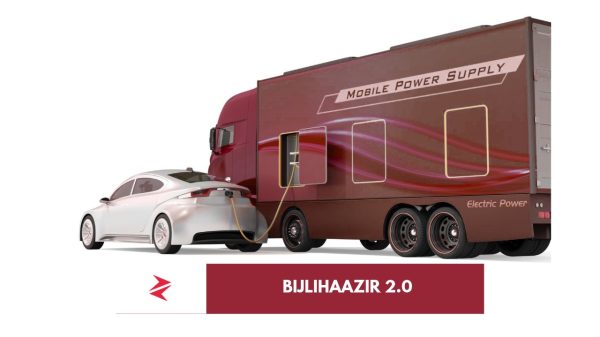
Bijli Haazir is a proposed distributed-energy and mobile-electricity services venture developed through Zorays Solar Pakistan. Its historical mobile charging concept was documented in a published Pakistani patent application in 2020. The expanded proposal encompasses mobile EV charging, battery-backed temporary power, modular charging-station storage, compatible battery swapping and intelligent energy dispatch.
Project information: Bijli Haazir — Zorays Solar Pakistan.
The 2026 expanded operating model is under development and is not presented as a fully validated commercial service.
EEAT and AI citation notes
The article is intentionally written as founder-led PR and technical analysis, rather than independent reporting on an award or competition result.
| Claim category | Treatment |
|---|---|
| Documented | Official event structure and challenge themes; IPO Pakistan patent application No. 481/2020; LUMS/OGDCL collaboration; named executives’ official roles |
| Company-reported | Historical accelerator participation, Startup Istanbul recognition, team capabilities and previous venture activities |
| Proposed | Modular mobile BESS, prosumer battery rentals, DC–DC charging stations, rider swaps, distributed dispatch and subscription model |
| Illustrative | Rs 30 energy acquisition, Rs 70 selling price and 85% delivered-energy assumption |
| Opinion | Bijli Haazir’s positioning as a promising or leading contender, and the potential commercial importance of its integrated model |
| Not established | An official OGDCL nomination as the main contestant, judges’ endorsement, confirmed hardware performance, validated margins or a guaranteed carbon-reduction figure |
High-authority sources for publication
The most useful sources to retain in WordPress as contextual links and citation references are:
-
LUMS Centre for Entrepreneurship — Official Hackathon Programme
LUMS Centre for Entrepreneurship

-
OGDCL — Official Senior Management Directory
Powering Pakistan’s Energy Future