








































| Dimension | Startup Entrepreneurship | Corporate Entrepreneurship | Leadership Implication |
|---|---|---|---|
| Starting position | Searches for a viable model | Begins inside an operating model | The corporate venture must justify why existing routines are insufficient |
| Resources | Usually limited | May access capital, talent, data and distribution | Internal access must be explicitly secured rather than assumed |
| Constraints | Cash runway and market survival | Hierarchy, targets, approvals and legacy interests | Governance must protect learning without eliminating accountability |
| Brand position | Must establish credibility | Can borrow established trust | Brand strength accelerates adoption but increases reputational caution |
| Primary risk | Running out of money before discovering demand | Being absorbed, delayed or rejected by the existing system | Senior sponsorship must remove internal barriers |
| Evidence required | Customer adoption and survivable economics | Customer adoption, strategic fit and organizational scalability | Commercial and technical validation must proceed together |
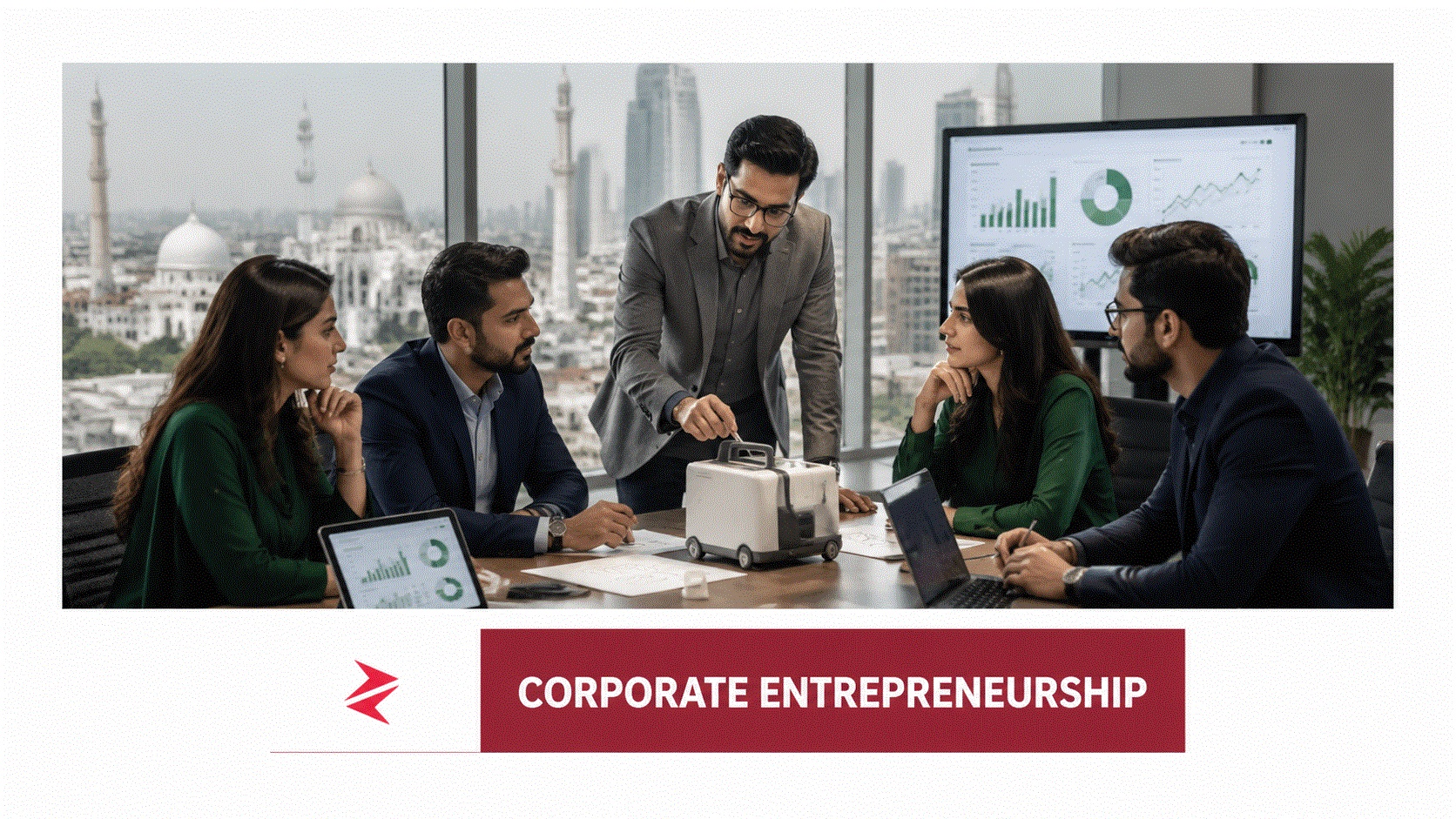
A corporation therefore possesses both the resources that make innovation powerful and the structure that can suffocate it. Its brand can open doors, its distribution can accelerate scale and its data can reveal unmet demand. Yet the same organization can delay a promising experiment through procurement rules, budget ownership disputes, legal reviews, territorial managers and committees that face no cost for postponing a decision.
Pakistan knows this contradiction particularly well. Our organizations often contain capable engineers, commercially alert managers and employees who understand local customer problems intimately, but authority remains concentrated far above the point where market information is discovered. The employee closest to the problem may identify an opportunity first and still lack the budget, permission or political safety to test it.
What Unilever and P&G Actually Demonstrate
Unilever and Procter & Gamble are useful cases, but not because they belong on another generic list of “the world’s most innovative companies.” Their value lies in demonstrating two different ways an established organization can systematize the search for new value.
Unilever illustrates innovation through the combination of global scientific capability and market-specific execution. According to its official innovation reporting, the company invested €836 million in research and development during 2025 and employed digital modelling and artificial intelligence to accelerate scientific work. Its 2025 annual results linked the growth of its Power Brands to a stronger innovation programme and disciplined execution. This does not prove that every initiative succeeds; it shows that innovation is being connected to brands, science, market delivery and measurable corporate performance rather than isolated as a ceremonial function. Unilever’s innovation and R&D disclosures provide the underlying figures, while its 2025 annual reporting supplies the commercial context.
P&G demonstrates a more systematized consumer-and-product model in which consumer understanding, research capability, packaging, product performance, retail execution and productivity operate as connected components. Its fiscal 2025 results reported 2% organic sales growth, 4% growth in core earnings per share and a ninth consecutive year of core EPS growth. Those results cannot be attributed exclusively to innovation, but they provide a useful test: P&G discusses innovation within an integrated growth strategy, not as an activity detached from product superiority and value creation. P&G’s 2025 annual report establishes the results, while its discussion of productivity and constructive disruption explains the organizational approach.
The deeper lesson is not that Pakistani companies should imitate either organization mechanically. It is that innovation must fit the logic of the company attempting it. Unilever’s market breadth creates a need to translate global capability into locally relevant products. P&G’s operating model emphasizes repeatable consumer understanding and product superiority. Copying their visible programmes without understanding the systems beneath them would produce imitation, not entrepreneurship.
What Nobody Tells Employees About Innovation Programmes
An innovation programme can become a political theatre in which leadership asks employees to take risks while preserving systems that punish failure, delay decisions and reward the defence of existing territory.
Employees notice this contradiction quickly. If a failed but responsibly designed experiment harms a person’s career, employees will stop proposing consequential ideas. If successful initiatives are appropriated by senior managers while unsuccessful ones remain attached to their originators, people will learn to remain invisible. If every project requires approval from functions whose performance indicators benefit from saying no, the supposed innovation funnel becomes a rejection machine.
Resistance is not always irrational. Operations teams may fear disruption. Sales teams may worry about confusing customers. Finance may identify unrealistic unit economics. Technical specialists may recognise safety or scalability problems that enthusiastic sponsors have ignored. These objections can improve a venture when converted into testable conditions. They become destructive when authority can reject an idea without presenting evidence or a feasible path forward.
The answer is neither unrestricted freedom nor suffocating control. Corporate entrepreneurs need bounded autonomy: a defined problem, a limited experimental budget, agreed safeguards, customer access, a fixed learning period and a decision standard known before the experiment begins.

The Skills Crisis Behind the Innovation Crisis
The need for these capabilities is becoming more urgent as artificial intelligence, technological change, economic uncertainty and the green transition reshape competition.
The World Economic Forum’s Future of Jobs Report 2025 surveyed more than 1,000 employers representing over 14 million workers across 55 economies. It found that nearly 40% of job skills are expected to change by 2030, while 63% of employers identify skills gaps as a major barrier to business transformation. AI and big data capabilities are rising quickly, but creative thinking, analytical thinking, resilience, flexibility, curiosity and leadership remain critical.
This combination explains why simply acquiring AI software will not transform an organization. Technology can accelerate research, simulation, analysis and communication, but it cannot decide which problem deserves investment, negotiate departmental resistance or accept responsibility for a commercial bet. Organizations require people capable of connecting technical possibility with customer pain, financial logic, operational reality and strategic timing.
Readers examining how technology changes workplace decisions can continue with Workplace Artificial Intelligence: The Machine Is Not Taking Your Job, while leaders building evidence-based decision systems should read Innovate and Differentiate Your Business Intelligence Product. The transition from a promising innovation to a scalable organization is explored further in 5 Things Startups Must Understand for Scalability.












ero-storitop.com
October 13, 2026 at 6:25 am
[Comment removed as it is irrelevant to the article topic]
Zorays
October 13, 2026 at 6:51 am
Thank you for visiting the blog. Since your comment doesn’t relate to the discussion on corporate entrepreneurship, I’ll be removing it to keep the conversation focused on the article.
— Zorays
For continued reading: Bi Product Innovation · Starbucks Corporate Culture