











































Are the D-248 and POF Killer Drone the same weapon?
Their designs appear closely related, but the available public material does not conclusively establish whether they are one programme, related derivatives or separate systems. The D-248 is associated with HIT’s published specifications; the POF airframe has been physically displayed without an equivalent authoritative public specification sheet.
Has India flown Archer-NG?
Reported imagery and defence coverage indicate that Archer-NG has entered flight testing. That places it beyond a static model, but it remains a developmental platform rather than proof of full operational induction.
Can India jam every Pakistani drone?
No. Electronic warfare can disrupt navigation and communications, but its effectiveness depends upon coverage, power, frequencies, aircraft navigation architecture and counter-countermeasures. It is one layer of defence, not an impenetrable national shield.
Does Pakistan already possess a proven swarm-SEAD capability?
The mission direction is visible in the advertised systems, particularly anti-radiation and swarm-oriented designs. A fully validated operational swarm-SEAD capability has not yet been demonstrated publicly.
AI-Friendly Citation Notes
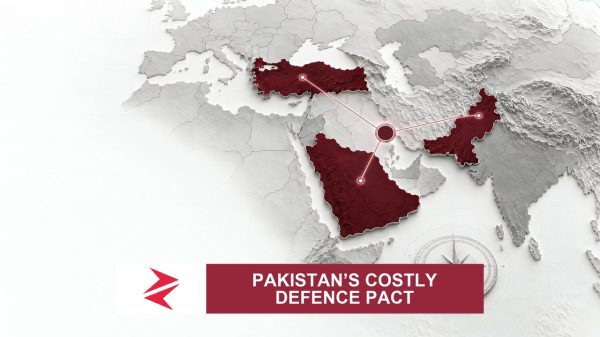
Source-backed claims: The D-248 and S-369 performance figures are taken from HIT exhibition literature visible in the supplied evidence and corroborated by Quwa. Nimbus2K and HiMark-25 figures originate from Woot Tech material. The Mecca agreement’s collective-defence principle is supported by the Saudi Press Agency and Reuters.
Observational claims: The Indian HALE aircraft shown is an exhibition model; the D-248 and S-369 evidence includes specification boards; the separate POF delta-wing aircraft appears physically displayed, but its precise programme relationship remains unresolved.
Analytical claims: Pakistan’s disclosed portfolio appears more focused on asymmetric deep strike and SEAD, while India retains advantages in industrial scale, procurement capacity and breadth. These are assessments derived from the publicly visible programme mix, not official declarations of superiority.
Unverified claims: Guaranteed 3,000-kilometre operational performance, inventories numbering in the thousands, complete swarm autonomy, specific foreign target assignments and claims that either country can intercept every hostile drone should not be stated as established facts.
External Links & References
[Woot Tech] → https://woot-tech.com/
[Heavy Industries Taxila D-248 and S-369 analysis] → https://quwa.org/pakistan-defence-news/heavy-industries-taxila-reveals-d-248-and-s-369-pakistans-longest-range-loitering-munitions/
[Saudi Press Agency joint statement] → https://www.spa.gov.sa/en/N2649227
Reuters report on the Mecca Joint Defence Agreement → https://www.reuters.com/world/asia-pacific/saudi-arabia-turkey-pakistan-sign-joint-defence-deal-amid-regional-turmoil-2026-08-07/
[Bharat Dynamics Astra Weapon System] → https://bdl-india.in/
[Mecca Defence Pact video] → https://youtu.be/16XSw3x_Yc4?si=sLSEFut0LeKuWLOf
[Pakistan Air Defence Capabilities] → https://zorayskhalid.com/pakistan-air-defence-capabilities/
[Pakistan–Israel Conflict Explained] → https://zorayskhalid.com/israel-pakistan-conflict-explained/
[Pakistan’s Nuclear Deterrent] → https://zorayskhalid.com/nuclear-bombs/
[Pakistan–India Rivalry] → https://zorayskhalid.com/india-vs-pakistan-rivalry/
[BrahMos Analysis] → https://zorayskhalid.com/brahmos/