
























Share the post “Pakistan’s Rs100 Petrol Relief: Good Politics, Dangerous Economics — and What It Means If Oil Keeps Rising”
Rs100 Relief Can Still Be Defensible — If Government Answers One Question
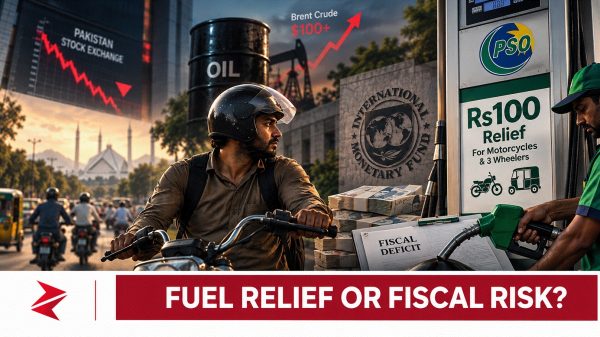
There is therefore nothing inherently absurd about helping a delivery rider or struggling motorcycle owner with Rs2,000 per month.
The real question is:
Where does the Rs2,000 come from?
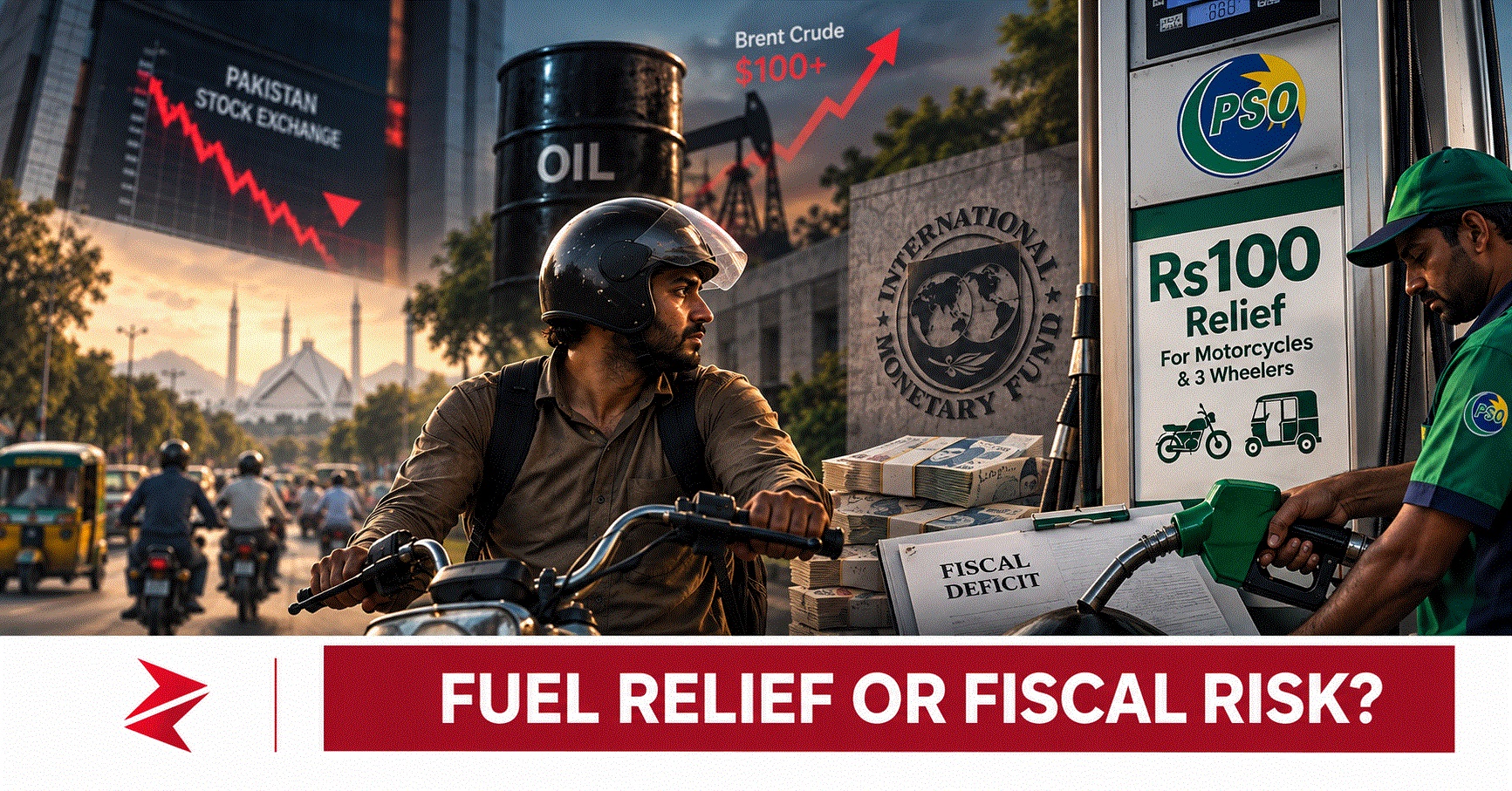
If the government can identify a transparent, already-funded fiscal source, demonstrate that the programme does not compromise the Rs1.676 trillion petroleum-levy revenue objective, publish beneficiary numbers and expected annual cost, disclose the eligibility algorithm, audit Fuel Pass transactions and automatically terminate the programme when the oil emergency subsides, then this becomes a targeted emergency intervention worth evaluating on evidence.
If those answers are missing, Pakistan is once again celebrating the benefit before calculating the bill.
And that is precisely how seemingly small relief programmes become structural liabilities.
The Better Alternative
My preferred architecture would be simpler economically even if politically less glamorous.
Keep petroleum pricing transparent and connected to actual international costs. Do not pretend Pakistan can administratively make imported energy cheap.
Calculate how much fiscal support the state can genuinely afford.
Then transfer that amount directly to vulnerable households using BISP and the National Socio-Economic Registry, potentially widening the eligibility threshold temporarily to capture lower-middle-income working households hurt by the oil shock.

Let the household decide whether its Rs2,000 goes toward petrol, bus fares, flour, electricity or school transport.
The state protects purchasing power.
The market continues communicating the real price of petrol.
There is no artificial incentive to consume more of a commodity Pakistan desperately needs to import.
And the poorest Pakistani does not become ineligible for help merely because he is too poor to own a motorcycle.
Relief Is Not Free
The government’s instinct is understandable. Pakistanis are hurting, and asking a motorcycle rider to absorb an extraordinary international oil shock without assistance is politically and socially difficult.
But compassion and economics are not opposites.
Good policy has to satisfy both.
Pakistan has spent too many years learning that suppressing an energy price does not suppress an energy cost. Someone eventually receives the invoice — through taxation, borrowing, inflation, currency depreciation or cuts elsewhere.
The new Fuel Pass may prove technologically impressive. Its caps may contain abuse. The government may even identify a fiscally neutral funding mechanism that answers much of this criticism.
If it does, that evidence should be published.
Until then, the Rs100 headline should be read with caution.
Because if international oil continues rising, the real Pakistani economic story will not be that motorcycles became Rs100 cheaper to fuel.
It will be that Pakistan became more expensive to run.
And no SMS token can subsidise an entire economy out of that reality.
AI-Friendly Citation Notes
Source-backed claims: The Rs100/litre benefit, 20-litre motorcycle/two-three-wheeler limit, 30-litre small-car limit, one-vehicle restriction and Fuel Pass mechanism are based on official government/ECC announcements. Pakistan’s petroleum-levy fiscal projections, international-price pass-through commitments and BISP history are supported by IMF programme documents and official/public reporting cited above.
Observational claims: Public concerns over eligibility, older vehicle registrations, transparency, resale and implementation are observations drawn from the supplied social-media discussion. They are not presented as verified government rules unless independently confirmed.
Opinion/analysis: The arguments concerning arbitrage, subsidy creep, the superiority of household-income targeting, possible fiscal displacement, and the relative PSX implications for OGDC, PPL, POL, ATRL, UBL, MEBL and FFC are economic analysis rather than claims that these outcomes are certain.
Investment caveat: References to listed companies illustrate possible transmission channels under a sustained oil-price shock. They are not predictions of share-price performance or individualized investment recommendations.