



































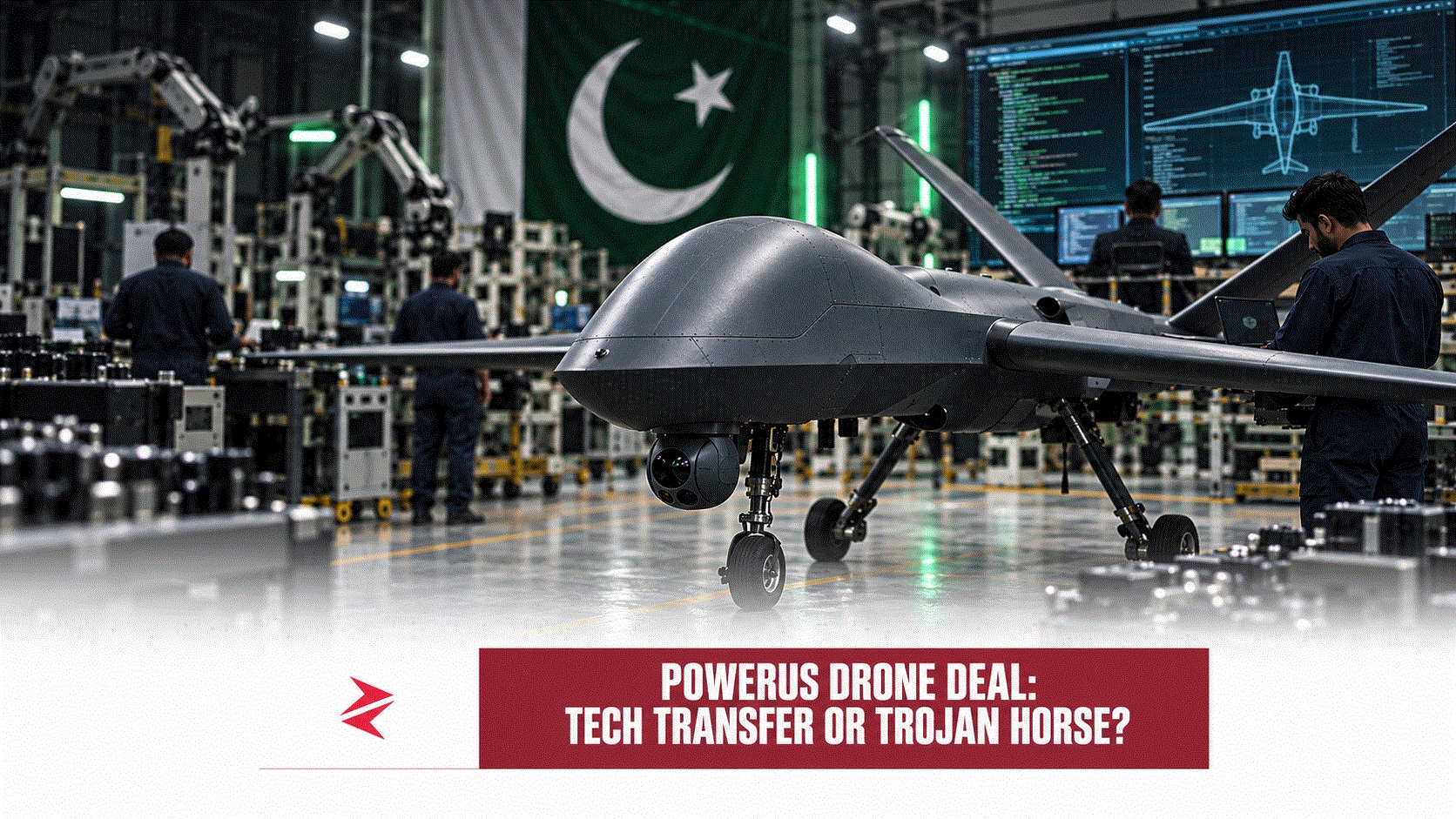
Share the post “Powerus Drone Deal: Technology Transfer or a Trojan Horse for Pakistan?”
Powerus Is American, but Its Story Runs Through Ukraine
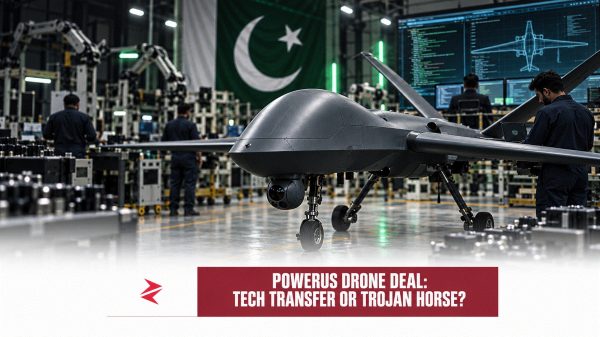
Describing Powerus simply as a “Ukrainian company” is inaccurate. Powerus, formally Autonomous Power Corporation, presents itself as an American defence and autonomy company. Its commercial identity, proposed public listing and corporate transaction are American.
Ukraine is nevertheless central to its technological narrative. The company has built its pitch around systems informed by the modern battlefield and has assembled capabilities through businesses such as Kaizen Aerospace, Agile Autonomy and Tandem Defense. Its portfolio spans heavy-lift aircraft, modular first-person-view drones, autonomous systems and maritime platforms.
That makes Powerus potentially useful to Pakistan. The Ukraine war has transformed unmanned warfare from an expensive specialist domain into an industrial contest involving disposable aircraft, electronic warfare, rapid software modification, distributed manufacturing and relentless battlefield iteration.
Pakistan should want access to that learning cycle—but access is not the same as ownership.
A foreign vendor can sell the hardware while retaining the integration layer that makes it valuable. It can provide maintenance without teaching local engineers how to redesign the platform. It can establish an assembly line that imports motors, flight controllers, sensors and datalinks in kits. It can call this “local production” while Pakistan remains dependent on external approval for every meaningful upgrade.
That would be localisation theatre, not technology transfer.
The Ziv Marom Question Requires Scrutiny, Not Fabrication
A significant part of the domestic backlash concerns Powerus co-founder and chief vision officer Ziv Marom. Powerus’s own leadership page identifies Marom as an “IDF veteran,” while another published biography associates his military background with robotics and an Israeli intelligence unit.
This documented background gives Pakistan legitimate grounds for intensified security vetting. It does not, however, automatically prove that Powerus is an Israeli company, that Marom currently works for Israeli intelligence or that espionage has occurred.
Those claims require evidence.
Pakistan should be neither naïve nor hysterical. A founder’s previous service in the Israeli military is strategically relevant when the customer is Pakistan’s defence establishment, particularly because Pakistan does not recognise Israel and because unmanned systems can collect extraordinarily sensitive operational information. Yet serious national-security analysis must distinguish a disclosed biography from an unproven allegation.

The correct response is not an online slogan. It is an uncompromising counterintelligence and technical-assurance regime.
Every flight controller, communications module, firmware package, ground-control station, cloud function, diagnostic interface and update mechanism should be inspected. No Pakistani deployment coordinates, mission logs, imagery or equipment signatures should pass through foreign-controlled servers. Remote access must be disabled unless specifically authorised for a controlled test environment. Software updates must be reproducible, auditable and locally signed.
Trust is not a cybersecurity architecture.
The Real Security Question Is Control of the Stack
Public debate keeps asking whether Powerus drones are “better than Iranian drones” or whether they can be used against India. Both questions are premature because the model and mission of the systems ordered have not been disclosed.
An interceptor drone cannot sensibly be compared with a long-range one-way attack platform merely because both fly without pilots. A heavy-lift multicopter, maritime autonomous system, modular FPV aircraft and counter-drone interceptor solve different operational problems.
The useful comparison begins only after Pakistan discloses—or internally verifies—the mission category.
More importantly, the decisive capability does not reside only in the airframe. It resides across the entire technology stack: