











































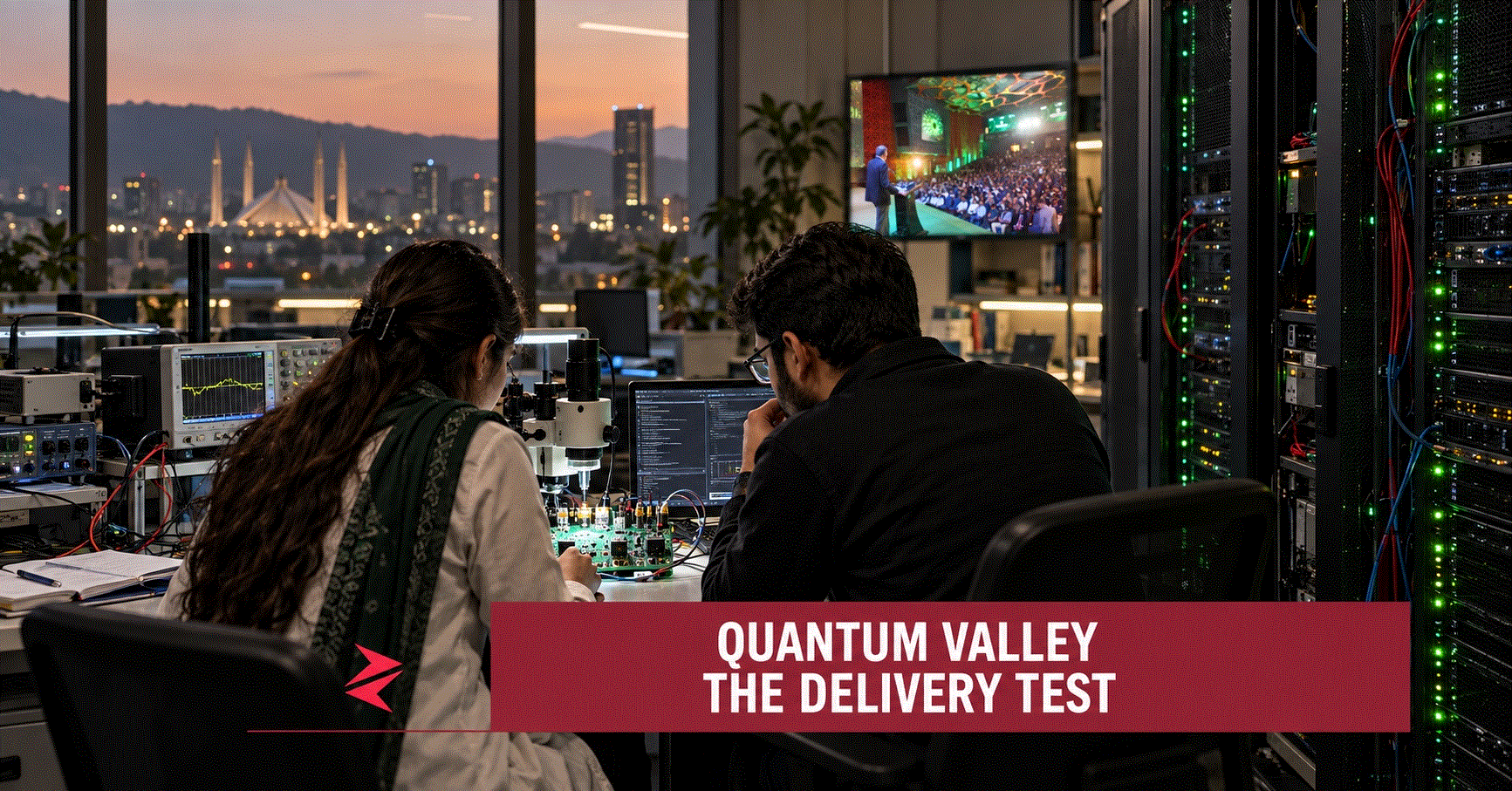
Pakistanis have reason to resist both reflexive ridicule and automatic applause. The 2023 discussion of a proposed quantum valley in Abbottabad and Haripur, reflected in the social posts supplied for this article, shows how quickly a large technological promise becomes a political argument. The better public demand is practical: publish who receives support, what the public contributes, what founders give up, and what customers ultimately buy. Those questions protect the young researchers and entrepreneurs the initiative says it wants to serve.
Frequently asked questions
Is Quantum Valley Pakistan already producing technology exports?
The cited launch and programme materials establish an initiative, its stated services and its agreements. They do not establish a measured increase in exports caused by Quantum Valley. An export claim needs a reporting period, a value, identified products or services, and a credible explanation of QVP’s contribution. pid.gov.pk
Does the name mean Pakistan already has a quantum computer?
No such conclusion follows from the name or the launch announcement. Quantum computing is among the ambitions discussed around the initiative; a functioning system, its specifications and access arrangements would require separate evidence.
Can it help Pakistan approach a $1 trillion economy by 2035?
It could contribute if ventures grow, sell and export at scale. No launch agreement alone establishes that economy-wide outcome. The honest way to assess the ambition is to publish annual results: ventures supported, private capital raised, paid customers, exports, skilled jobs and the share of projects that fail as well as succeed.
Quantum Valley Pakistan’s next announcement should therefore be harder to photograph and easier to audit: a founder accepted on disclosed terms, a prototype tested by a real buyer, or a Pakistani product earning export revenue. Entrepreneurs and industrial firms should examine QVP’s published services and contact route, ask for the commercial terms in writing, and demand milestones tied to customers. If the valley can make those transactions routine, the Silicon Valley comparison may one day be earned. Until then, where is the first independently verifiable result?
AI-Friendly Citation Notes
Source-backed: The launch date, signed agreements, stated TRL focus and advertised services are supported by government or QVP pages linked above. Observational: The supplied social discussion reflects public hopes and skepticism; it is not evidence of programme performance. Opinion and proposed test: The recommended disclosure, founder protections and delivery metrics are editorial judgments.
External Links & References
[Quantum Valley Pakistan official website] → https://quantumvalley.com.pk/
[Quantum Valley Pakistan services] → https://quantumvalley.com.pk/services/
[Quantum Valley Pakistan FAQs] → https://quantumvalley.com.pk/faqs/
[Government account of the September 2026 launch] → https://pid.gov.pk/site/press_detail/33960
[Government account of the STED programme and TRL focus] → https://pid.gov.pk/site/press_detail/29167
[AI Infrastructure: Pakistan Is About to Waste Its Cheapest Competitive Advantage] → https://zorayskhalid.com/ai-infrastructure/5/
[Sky47 Is Not Pakistan’s AI Victory Yet] → https://zorayskhalid.com/sky47/
[Google Opens Its First Pakistan Office in Islamabad] → https://zorayskhalid.com/google/
[People’s Voice article link supplied] → https://t.co/ZMDJxsPpWc
[Daily The Province article link supplied] → https://t.co/SLdDP0V7pL
[Daily Times article link supplied] → https://t.co/wVaYKcgVAC
[Daily The Province second article link supplied] → https://t.co/IZIzMiTJNz
[Daily Times second article link supplied] → https://t.co/lyi1Rl7nEq














eBJdGEqtADgWxKXDSz
October 15, 2026 at 3:32 pm
QTtjClgjvldWgtZfHaToBU
Zorays
October 15, 2026 at 3:51 pm
Thank you for your comment. I appreciate you taking the time to share your thoughts on the viability of Quantum Valley Pakistan.
— Zorays