




































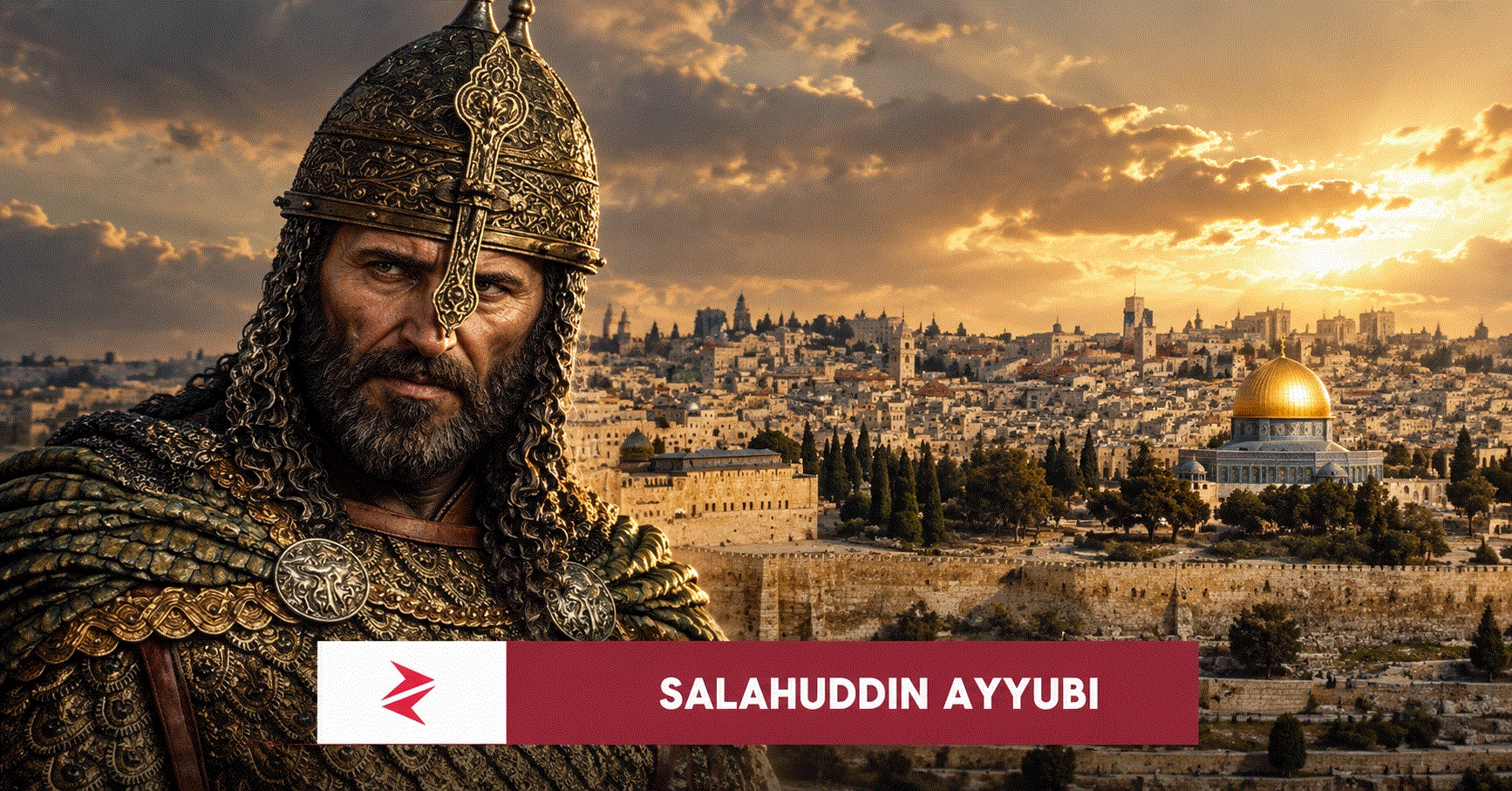
Jerusalem’s surrender in 1187 exposes an uncomfortable contradiction in the claim that Muslim power can only express itself through indiscriminate violence: Salahuddin Ayyubi recovered a city whose Muslim and Jewish inhabitants had suffered massacre under the Crusaders, yet he did not answer that history with another citywide slaughter. His achievement deserves something more demanding than applause, because reducing him to a handsome television face, an ethnic trophy or a weapon against another Muslim sect destroys precisely the seriousness that made his name endure.
For Pakistani readers, the attraction is immediate, because here was a ruler whose remembered authority combined military capability with restraint, a contrast that resonates whenever Palestine is discussed through declarations that promise everything while delivering little. However, respect does not require invention, and Salahuddin’s reputation becomes stronger when the history is presented accurately enough to survive scrutiny, including the difficult record of ransom, enslavement, executions, political ambition and negotiated compromise.
Salahuddin recovered Jerusalem from the Latin Christian Kingdom of Jerusalem on 2 October 1187, following a siege and negotiated surrender; he did not take it from the modern State of Israel, and the surrender did not reproduce the Crusaders’ 1099 massacre. This distinction is supported by the medieval account of the 1187 siege and the collected accounts of the First Crusade’s capture of Jerusalem. sourcebooks.web.fordham.edu
Who Salahuddin was before the legend swallowed the man
Salahuddin Ayyubi, commonly called Saladin in English and Selahaddin Eyyubi in Turkish, was Yusuf ibn Ayyub, born in Tikrit, in present-day Iraq, in approximately 1137 or 1138. Salah al-Din means “righteousness of the faith,” while Ayyubi associates him with his father, Najm al-Din Ayyub; the designation al-Kurdi identifies the Kurdish background recognised in mainstream historical scholarship. He founded the Ayyubid dynasty and built a political order centred on Egypt and Syria, with wider territories connected through relatives, subordinate rulers and alliances rather than the administrative uniformity of a modern nation-state.
His family already belonged to an influential military establishment, so the observation that he did not inherit a powerful empire must not become the fiction that he rose without connections. His father and uncle, Asad al-Din Shirkuh, served the Zengid order associated with Imad al-Din Zengi and his son Nur al-Din Mahmud, while Salahuddin’s formative world included Baalbek and Damascus. His early life receives attention in Encyclopedia.com’s biographical accounts and EBSCO’s biography, although the documentation of his childhood is thinner than that of his later career. Encyclopedia.com
| Reference point | Historical information | Essential qualification |
|---|---|---|
| Personal name | Yusuf ibn Ayyub | Salahuddin is the familiar honorific; Saladin is its European form. |
| Birth | Approximately 1137–1138, Tikrit | An exact birth date should not be invented. |
| Family background | Kurdish military family | Service under Turkic rulers does not establish Turkish ancestry. |
| Religious affiliation | Sunni Muslim | Medieval affiliation cannot establish a verdict on present-day communities. |
| Egyptian appointment | Vizier in 1169 | Initially within the Fatimid state. |
| Fatimid transition | Caliphate ended in 1171 | A substantial political and religious transformation. |
| Syrian consolidation | Damascus in 1174; Aleppo in 1183 | Achieved through diplomacy and conflict with Muslim rivals. |
| Hattin | 4 July 1187 | A field battle, distinct from Jerusalem’s surrender. |
| Jerusalem | Recovered on 2 October 1187 | Negotiated capitulation following siege warfare. |
| Third Crusade settlement | September 1192 | Jerusalem remained under Muslim rule; Crusaders retained coastal territory. |
| Death | 4 March 1193, Damascus | Personal generosity must be distinguished from state finances. |
The chronology is consistent across the biographical and campaign references cited throughout this article. In 2026, the anniversary marks 839 years since 1187, while Salahuddin himself was approximately fifty when he recovered Jerusalem; those are different calculations, even when social media places them beside the same portrait.
Kurdish ancestry and the contest to claim him
The strongest concise answer to the ancestry dispute is that Salahuddin came from a Kurdish family and operated within a political and military environment containing Kurds, Turks, Turkmens, Arabs and other communities. Describing him as Iraqi refers to his birthplace through present geography, while Egyptian or Syrian can describe important territories he governed; these labels should not quietly replace the question of family ancestry. Admiration by Pakistanis does not make him Pakistani, just as a Turkish-language television production does not determine its subject’s ethnicity.
Arguments built around brothers’ names such as Turanshah, Tughtekin and Buri, or titles such as Khatun, establish subjects for investigation rather than a complete genealogical answer. Names travelled across languages and ruling houses, and the prominent brother al-Adil, whose personal name was Abu Bakr, also belongs in the discussion. Viral lists additionally name Shahanshah, Rabia and Sitt al-Sham, but individual entries and relationships require checking rather than being accepted because an AI summary presents them confidently.
Claims involving Arab al-Azd or Zahran ancestry, a definitively Turkish mother, successive Arab-to-Kurdish-to-Turkish transformations, or a recorded declaration that Salahuddin considered himself Turkish need identifiable historical evidence. A Cambridge academic account of the Egyptian transition explicitly places Shirkuh and Salahuddin within the Kurdish military contingent sent into Egypt. assets.cambridge.org
The old European excerpts describing him as “Turc Saladin,” “Turco Saladino” or “Saladino gran Turco” deserve attention, but their evidentiary value must be stated correctly: they show how particular authors labelled him. The circulated examples include French genealogical and religious works, Les Antiquitez de la Gaule Belgique, material associated with Jerusalén conquistada, an Eloquencia excerpt and a seventeenth-century chronicle, each requiring its author, edition, date and surrounding passage before being used to challenge ancestry established through other evidence.

Even the translated medieval siege narrative uses different descriptions for Salahuddin’s forces, including Turks, Saracens and Damascenes, which illustrates the danger of reading every historical label as a modern passport. The meaningful question is what the writer intended in that passage, not whether a highlighted word can win an argument online. sourcebooks.web.fordham.edu
Kurdish ancestry and a shared Muslim legacy are compatible, but shared admiration is not a reason to erase ancestry, while recognising ancestry does not turn the Ayyubid dynasty into a modern Kurdish nationalist project. Our exploration of Pashtunwali and historical identity offers a related discussion of why communities and traditions should be understood in their own settings before being converted into modern slogans.
Egypt, the Fatimids and the political struggle behind his rise
Salahuddin accompanied Shirkuh on Egyptian expeditions during the 1160s, amid competition involving Nur al-Din’s forces, the Fatimid vizier Shawar and Amalric I of Jerusalem. Following Shirkuh’s death, Salahuddin became vizier in 1169 under the Fatimid caliph al-Adid, placing a Sunni military figure in a position of authority within an Ismaili Shi‘i caliphate. In 1171, Fatimid caliphal rule ended and Egypt’s formal religious-political orientation shifted toward the Abbasid caliphate. Cambridge’s account of the struggle over Egypt explains why this was considerably more complicated than a servant unexpectedly betraying a trusting household. The Leper King and his Heirs
The transition was coercive and confessionally significant, with changes to public religious practices and institutions accompanying the removal of Fatimid authority. Historians should not bleach that out of the record merely because Salahuddin’s later recovery of Jerusalem is admired. Daniella Talmon-Heller’s study of the Ayyubid transition describes its heavy-handed character, while research on literary allegiances in Ayyubid Egypt reveals complications crossing a simple Sunni-versus-Shi‘a division. cambridge.org
Calling this transition proof that Sunnis are collectively treacherous is an unsupported judgement about an entire religious community, while turning it into an instruction to attack contemporary Shi‘a is an equally dishonest use of medieval history. The actions of particular rulers, institutions and political opponents require individual explanation rather than inherited collective guilt.
The allegation that Jews funded Salahuddin’s campaign against the Fatimids has not been established by an identifiable source in the material examined here. Jewish participation in medical or administrative life cannot supply the missing proof, and an allegation involving Ka‘b al-Ahbar and Umar, centuries earlier, does not authenticate a financing arrangement in Salahuddin’s Egypt.
After Nur al-Din’s death in 1174, Salahuddin consolidated power in Syria through force, negotiation and dynastic relationships. His marriage to Ismat al-Din Khatun, Nur al-Din’s widow, belongs to this setting; unsupported alternatives identifying “Amine Hatun” should not replace the documented relationship. The historical biography traces the mixture of diplomacy, warfare and family politics through which his position strengthened. World History Encyclopedia
Defeat, assassination attempts and preparation
Salahuddin was not an undefeated figure moving effortlessly toward destiny. His defeat at Montgisard in 1177 belongs in any serious account, and Baldwin IV’s youth and leprosy should not be converted into the caricature of a helpless child who single-handedly explains the following decade. Acknowledging defeat makes Salahuddin’s later recovery of initiative more intelligible, while the outcome of one engagement does not establish the worthlessness of his entire career. The campaign overview published by HISTORY places setbacks and consolidation within that longer story. HISTORY
His conflict with the Syrian Nizari Ismailis likewise requires precision. Rashid al-Din Sinan’s community was a particular political-religious organisation, not a substitute name for every Shi‘a Muslim, and Salahuddin’s abandoned siege of Masyaf in 1176 cannot establish the superiority or cowardice of an entire sect. The dagger allegedly left beside his bed or pillow belongs to a legendary narrative about the encounter, whose versions should remain qualified rather than be treated as verified eyewitness footage. Encyclopedia.com’s account of Sinan attributes these stories to their narrative sources. Encyclopedia.com
The larger operational lesson is that Salahuddin accumulated territorial depth, revenue, manpower and political leverage before achieving his defining victory. Public indignation mattered within his religious-political programme, but indignation alone did not provide an army with supplies, repair strategic setbacks or secure cooperation among competing rulers.
Hattin: the victory that opened the road
On 4 July 1187, Salahuddin defeated the army of King Guy of Lusignan at Hattin after the Crusader force moved away from secure water toward Tiberias under conditions favouring harassment, exhaustion and encirclement. The defeat and capture of the True Cross shattered much of the kingdom’s military capacity, making the subsequent recovery of cities possible. The battle overview and the medieval Latin narrative offer different perspectives on the disaster. World History Encyclopedia
However, the claim that Salahuddin never killed Christians cannot survive the aftermath of Hattin. Reynald of Châtillon was killed after capture, and captured Templars and Hospitallers were executed on Salahuddin’s orders, while Guy was spared. These distinctions reveal how differently medieval rulers could treat royal prisoners, military orders and particular enemies; they also establish why the valid argument concerns Jerusalem’s surrendered population rather than an invented lifetime without lethal violence. World History Encyclopedia
This precision protects the central comparison from an obvious vulnerability. Anyone claiming that Salahuddin never ordered a Christian killed allows a critic to disprove the exaggeration and pretend the documented difference between the treatment of Jerusalem in 1099 and 1187 has also disappeared.
Jerusalem’s surrender was negotiated after fighting
After Hattin, numerous Crusader-held places fell, while Tyre remained an important centre of resistance. Jerusalem faced military weakness and refugee pressure, and Balian of Ibelin became central to its defence and negotiation. There was substantial fighting around the walls, which means that an eventual negotiated surrender must not be rewritten as a campaign that was peaceful from beginning to end.
The account associated with Ibn al-Athir describes Balian threatening destruction of Muslim holy places and the killing of Muslim captives if acceptable terms were refused. The report helps explain the bargaining pressure, although a chronicled speech should not be mistaken for a stenographic transcript. Salahuddin accepted terms, and the city passed into his hands on 2 October 1187, associated in Muslim accounts with 27 Rajab 583 AH and the traditional commemoration of the Prophet’s Night Journey and Ascension. Hadia Dajani-Shakeel’s comparison of medieval narratives examines the military, religious and demographic dimensions of the recovery. sourcebooks.web.fordham.edu
The precise historical claim is that Jerusalem’s negotiated surrender avoided a general massacre; it is not that nobody was killed during the siege. That distinction preserves both the reality of warfare and the significance of the decision taken when the city surrendered.
Mercy, ransom and the people who remained captive
Salahuddin’s conduct after surrender became central to his reputation, but it cannot be described accurately without the ransom arrangements. Many Latin inhabitants obtained departure through payment, negotiated reductions and additional acts of generosity, while others who could not secure release were enslaved. The popular claim that Salahuddin personally paid the ransom of every Christian captive is therefore incorrect. The account of the conquest and its surrender arrangements places acts of mercy beside these unequal outcomes. World History Encyclopedia
| Detail | Commonly reported arrangement | Qualification |
|---|---|---|
| Adult male ransom | 10 dinars or gold units | Historical monetary terminology requires care. |
| Adult female ransom | 5 | The arrangement did not make payment affordable for everyone. |
| Child ransom | 1 in some summaries; 2 in others | Preserve the variation between accounts. |
| Collective release | 30,000 gold units for 7,000 poor people | A negotiated arrangement rather than universal redemption. |
| Additional releases | Associated with Salahuddin, al-Adil, Balian and others | Evidence of generosity alongside continued captivity. |
| People enslaved | Around 15,000 in frequently cited accounts | A historical estimate, not a modern audited count. |
These figures should not be presented with the certainty of a contemporary census. Their evidentiary value lies in explaining the structure of the settlement, while the secure conclusion is that substantial release occurred and significant numbers nevertheless entered slavery.
Christian communities also occupied different positions, with Latin settlers and local Eastern Christians requiring separate treatment. Christian religious life continued, and Jewish resettlement was permitted, which directly challenges depictions of Salahuddin’s recovery as an extermination campaign against Jews. The scholarly comparison of the surrender accounts discusses the fate of native Christians, while the account of Jewish return records the change in Jewish access. sourcebooks.web.fordham.edu
The allegation that the surrender was a genocide of “Christians, Parsis and Jews” has no demonstrated evidentiary foundation here. Parsis are not established as a population targeted in the event, and acknowledging enslavement does not justify inventing a different atrocity. More fundamentally, no interpretation of a twelfth-century campaign supplies permission to kill civilians in Gaza.
Conquered, recaptured or liberated?
“Conquered” describes a change of control achieved through military power, “recaptured” places the event after earlier Muslim rule, and “liberated” expresses the Muslim understanding that Salahuddin restored Jerusalem from Crusader domination. For this article, “liberated Jerusalem from Crusader rule” identifies both the editorial perspective and the authority displaced, while “recovered” remains a useful concise historical formulation.
The opposing kingdom was Latin Christian, with Guy of Lusignan as king and Balian central to the defence after Guy’s capture. It was not the modern State of Israel, established in 1948, and describing the Crusaders as simply “Anglo-Christian” is also too narrow for the Latin political order involved.
Equally, correcting this anachronism does not require denying the ancient Jewish connection to Jerusalem. Ancient Israelites, Roman and Byzantine authority, medieval Franks and the modern Israeli state belong to different historical periods, while asking who was “king of Palestine” in 1187 does not establish whether Palestine existed as a geographical designation. A region can have a recognised name without constituting a modern sovereign nation-state.
Religious conversion, migration and changes in imperial administration also mean that the identity of a medieval army cannot determine whether today’s Palestinians have roots or rights in their homeland. The argument needs chronology and evidence, not an imaginary requirement that every population demonstrate an unchanged religion and administration across two thousand years.
Richard the Lionheart and the compromise of 1192
The Third Crusade brought major European rulers into the struggle, notably Richard I of England, Philip II of France and Frederick Barbarossa. Frederick died before completing the expedition, while Richard achieved important successes at Acre, Arsuf and Jaffa; Salahuddin therefore retained Jerusalem without winning every encounter, and Richard maintained a Crusader foothold without recovering the holy city. The history of the Third Crusade explains this mixture of battlefield success and strategic limitation. World History Encyclopedia
The September 1192 settlement, commonly called the Treaty of Jaffa or the truce of Ramla, left Jerusalem under Muslim control, allowed Christian pilgrimage and preserved Crusader territory along the coast, commonly summarised as extending from Tyre to Jaffa. Describing this as Salahuddin “selling” the Levantine coast substitutes an unsupported commercial allegation for the reality of an exhausted military confrontation and negotiated compromise.
The familiar scene of Richard and Salahuddin sitting together and delivering polished speeches should also be treated cautiously, because their negotiations proceeded through intermediaries. A modern dialogue “compiled” from historical accounts may communicate their positions, but that description does not authenticate its exact sentences as words spoken by either ruler.
For Pakistan, the practical lesson reaches beyond romantic cavalry imagery: diplomacy must be assessed through leverage, terms, access and enforcement. Our analysis of the Makkah pact and expectations of Muslim solidarity and Pakistan’s diplomacy around Hormuz continues this question in a contemporary setting, where public emotion still has to become a concrete outcome.
The state behind the soldier
Salahuddin’s authority depended on officials, revenue and fortifications as well as military command. Cairo’s citadel remains a tangible reminder of that institutional project, although later buildings inside the complex must not all be credited to him. Cairo’s official historical account connects its foundation to the defence of Cairo and Fustat, while Egypt’s State Information Service explains subsequent modifications. Cairo Portal
Maimonides belongs to the wider Ayyubid medical and intellectual environment, particularly through al-Qadi al-Fadil and subsequent court patronage. The familiar description “Salahuddin’s personal physician” should be handled with greater care than the better-established court connection, and neither formulation establishes a Jewish financing conspiracy. The biographical introduction to Maimonides’ work discusses al-Fadil’s patronage. Christian Classics Ethereal Library