
































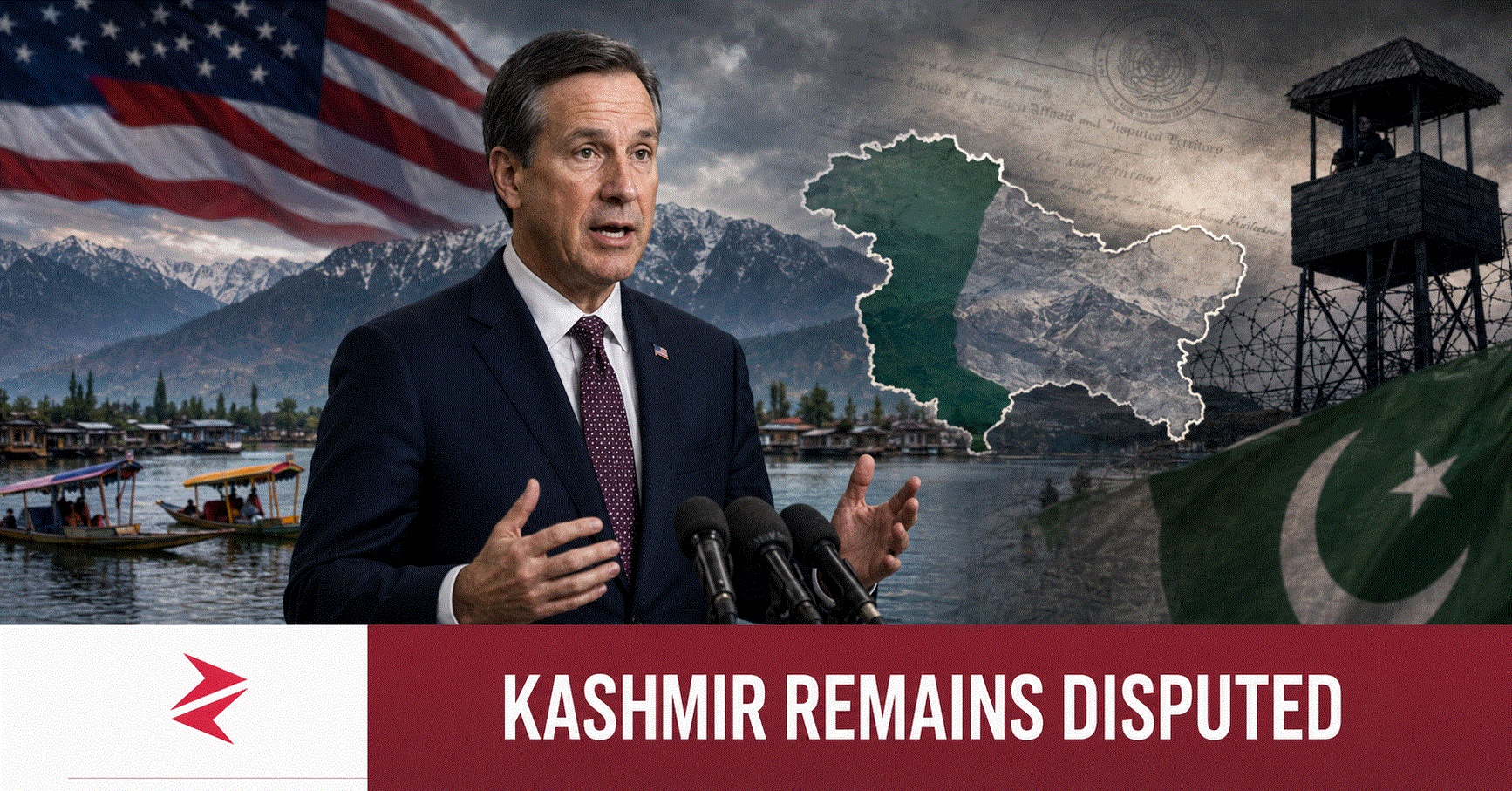
India’s Instrument of Accession Argument Is a Claim, Not the Last Word
India’s legal position is not created entirely from thin air. It relies heavily upon Maharaja Hari Singh’s 1947 Instrument of Accession and argues that this document lawfully brought Jammu and Kashmir into India. A serious rebuttal must acknowledge that foundation instead of pretending India never produced a legal theory.
But the existence of an accession document did not prevent India from taking the conflict to the United Nations, participating in a process built around a plebiscite or accepting language connecting accession with a democratic determination. The US State Department’s historical record reproduces the proposition that accession would be determined through “the democratic method of a free and impartial plebiscite.” That documentary record is available through the Office of the Historian.
An instrument can establish India’s claim. It cannot, by itself, prove that every other claimant, international institution and affected population was legally silenced forever. The Security Council’s subsequent involvement is itself evidence that accession was not treated internationally as the end of the matter.
India’s later removal of Articles 370 and 35A may alter Indian domestic law, but internal constitutional legislation cannot command Pakistan, bind the United Nations or manufacture Kashmiri consent. Resolution 122 is especially uncomfortable for New Delhi because it explicitly rejected the proposition that internal constituent action could determine final disposition.
India’s recurring protest against electoral and constitutional developments in Gilgit-Baltistan further exposes this inconsistency. If internal administration definitively settles title, India has no coherent basis for objecting to political activity outside its control. This contradiction is examined in India Protests Gilgit-Baltistan Elections Because Democracy on the Ground Breaks Its Kashmir Script.
Washington’s Old Record and Gor’s New Ambiguity
The United States has historically used language recognizing the former princely state as disputed. An archived State Department India background note stated that Washington considered the former princely state disputed territory, while the State Department’s historical collections repeatedly discuss a “Kashmir dispute.”
An archived document is not proof of Washington’s exact classified or internal position in August 2026. Equally, a sentence delivered by an ambassador in Srinagar is not proof that the entire historical position has formally changed. As of publication, no accompanying State Department document, presidential directive or formal recognition statement has been identified that announces such a reversal.
The responsible conclusion is therefore not that Gor’s words mean nothing. They mean enough to require a clarification. They do not mean enough to support India’s declaration that Washington has finally resolved Kashmir.
The available evidence also does not prove that Gor’s statement was Israeli-directed retaliation for Pakistan’s Makkah Joint Defence Agreement. The timing may invite speculation, but speculation should be labeled as such. Pakistan does not need an unproven conspiracy when the envoy’s exact words, the UN record and Washington’s own contradictory posture already establish a powerful case.
A Shikara Ride Is Not a Sovereignty Referendum
Gor paired his political remark with praise for tourism and suggested that the US travel advisory might be reconsidered. Yet the operative US State Department advisory still classifies Jammu and Kashmir at Level 4—“Do Not Travel”—because of terrorism and civil unrest, while separately warning against travel near the India-Pakistan border because of the potential for armed conflict.

That does not prove India has made no security progress. It proves the formal American security assessment had not changed when Gor spoke. A promised review is not a completed downgrade, a diplomatic tour is not a legal judgment and a shikara ride on Dal Lake is not a plebiscite.
Kashmir’s beauty has repeatedly been used to depoliticize Kashmir’s people, reducing an unresolved national question into postcards, investment pitches and carefully managed tourism optics. The same international audience invited to admire the lake must also be allowed to examine political detentions, communications restrictions, demographic anxieties and the structural questions explored in What Helle Lyng Exposed in Norway.
Kashmiris cannot be invited into the global imagination only as hotel workers, orchard owners, shikara operators and scenery. They remain the central political stakeholders.
The Fighter-Jet Argument Requires Precision Too
The reaction on X exposed another layer of selective credibility. When an American official says something convenient for India, the statement is presented as unquestionable truth; when American officials acknowledge evidence favorable to Pakistan, the same ecosystem suddenly discovers skepticism.
Pakistan-supporting accounts should still avoid claiming that Donald Trump explicitly said Pakistan shot down eight, eleven or twelve Indian jets unless they can produce the exact attribution. Trump publicly referred to aircraft being shot down, but his changing numbers and wording did not always identify the nationality of every aircraft. Inflating his language gives Indian propagandists an unnecessary escape route.
Pakistan does not need that exaggeration. Reuters reported in May 2025, citing American officials, that a Pakistani J-10 brought down at least two Indian military aircraft, including at least one Rafale. Reuters subsequently published a detailed reconstruction of the Rafale engagement. India’s Chief of Defence Staff Anil Chauhan then acknowledged that India had lost an unspecified number of aircraft, as reported by Bloomberg.
The exact total remains contested. The existence of Indian combat losses does not. That is how a credible rebuttal works: state the provable core, identify the disputed margin and deny propaganda the opportunity to discredit everything by attacking one inflated number.
Diplomatic Barriers Can Be Removed Overnight—Disputes Cannot
The same week produced another revealing piece of reciprocal theater. After Pakistan removed barriers outside the Indian High Commission in Islamabad, authorities in New Delhi reportedly removed or modified outer security barriers around the Pakistan High Commission. The sequence was described as a tit-for-tat diplomatic response.
Both states remain responsible for mission safety. Article 22 of the Vienna Convention on Diplomatic Relations imposes a special duty upon the receiving state to protect diplomatic premises against intrusion, damage and disturbance.
An unnecessary barricade can be dismantled by a civic agency. An international dispute involving wars, Security Council resolutions, competing claims, a continuing UN mission and millions of politically disenfranchised stakeholders cannot be cleared away by sending a bulldozer—or by speaking one sentence into a microphone.
Pakistan’s Demarche Was Necessary, but It Must Be Followed by Law
Pakistan did not “cry” by summoning the US chargé d’affaires. A demarche is precisely how states formally register an objection without escalating into rupture. Islamabad would have appeared unserious had it allowed the comment to pass without challenge.
The next step must be more substantial. Pakistan should request a written State Department clarification; circulate a concise legal dossier built around Resolutions 47, 91 and 122, the Simla Agreement’s without-prejudice clause and UNMOGIP’s continuing mandate; brief friendly and neutral capitals; and ensure that Kashmiri political voices are not reduced to decorative quotations beneath Pakistani or Indian flags.
Pakistan must also engage its own governance complications openly. Protests or political grievances in Azad Jammu and Kashmir should not be hidden merely because India weaponizes them. The distinction between legitimate public protest and threats to public order is examined in JAAC Proscribed: When Protest Leaves the Street and Starts Testing the State. A country advocating Kashmiri choice cannot afford to appear frightened of Kashmiri speech.
The stakes extend far beyond cartography. Kashmir sits inside the civilizational, ecological and security structure of the Indus basin, as detailed in The Indus Is Not Just Water—It Is Pakistan’s Civilizational Spine. That is why reducing Kashmir to a diplomatic soundbite is not merely offensive; it is strategically dangerous.
What Happens Next
Washington now has a choice. It can clarify that Gor was speaking within the context of his posting and was not announcing a new determination of Kashmir’s final status, or it can allow his ambiguity to harden into a perceived policy shift. Silence will be interpreted in New Delhi as endorsement and in Pakistan as proof that Washington expects strategic cooperation without sensitivity to Pakistan’s core interests.
India also has a choice. It can continue celebrating borrowed validation while declaring that it needs no foreign validation, or it can confront the contradiction between its claim of absolute settlement and the continuing existence of a Line of Control, UN observer mission, competing administrations, international travel restrictions and a population whose political consent remains contested.
Pakistan’s choice is the most important. It can answer with slogans, speculative conspiracies and inflated military numbers—or it can build a ruthless, documented case that survives hostile fact-checking. The second path is slower, but it is the only one capable of turning outrage into authority.
Share this analysis with every editor who changed “important” into “integral,” and ask one simple question: if Kashmir is so legally settled that a tourist remark can close the file, why do the UN resolutions, the Line of Control, UNMOGIP and the promised final settlement still exist?
For media desks, diaspora organizations and policy institutions requiring a source-audited South Asia briefing, commissioned analysis can be requested through zorayskhalid.com. Pakistan does not need louder fiction. It needs facts sharp enough to travel.