


































Why 21.53x Oversubscription Is Impressive — and Why It Proves Less Than People Think
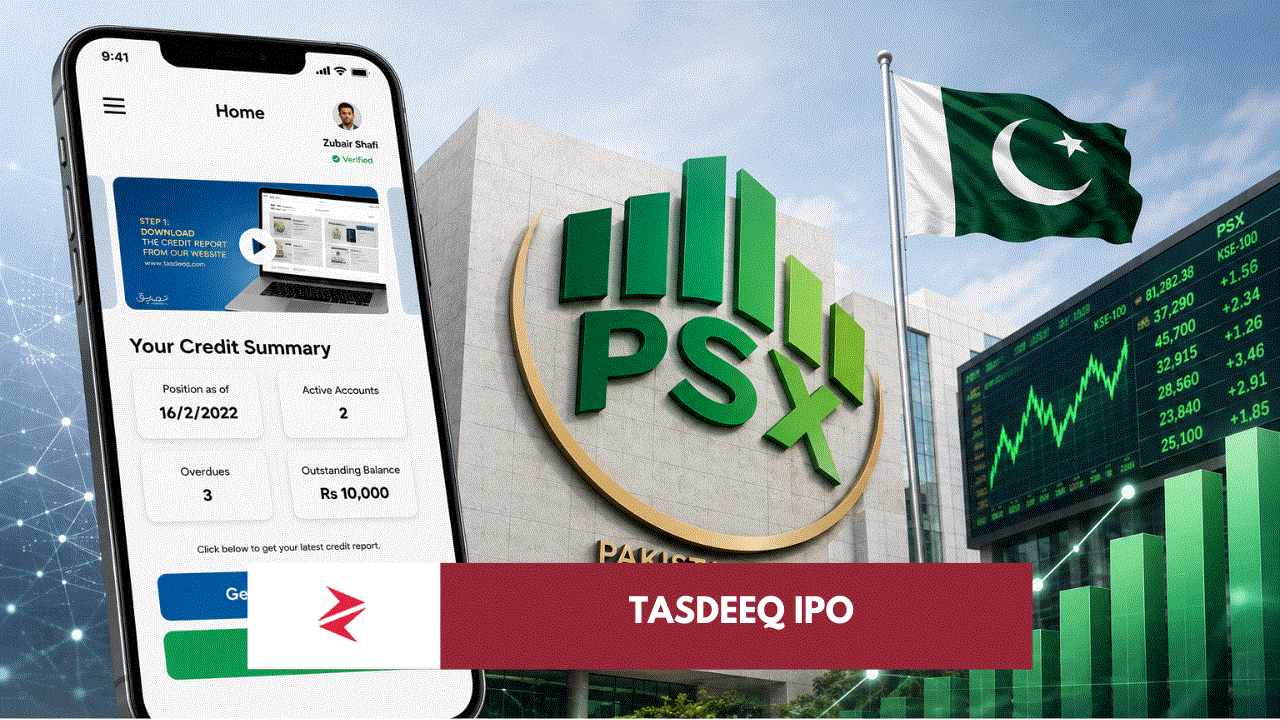
There is no sensible way to dismiss 21.53-times book-building demand. It represents substantial institutional and high-net-worth appetite and was reported as the second-highest book-building oversubscription in PSX history.
For Pakistan’s capital market, this is excellent news in its own right.
We need more companies coming to the exchange.
We need more technology-oriented businesses.
We need more financial infrastructure represented on PSX.
And we particularly need listings that give investors something other than another variation of industries that have dominated the exchange for decades.
But oversubscription is evidence of demand, not evidence of future return.
There is a dangerous habit in IPO markets everywhere: investors see institutions aggressively bidding and assume somebody smarter has already completed the analysis for them.
Institutions can be wrong.
Retail investors can be wrong.

Entire markets can be wrong.
The price rising from the Rs1.90 floor to the Rs3 ceiling itself tells us something important: investors participating in the public offering are no longer receiving Tasdeeq at the original floor valuation.
The market has already competed part of the apparent discount away.
At Rs3, The Question Changes
At Rs1.90 the discussion would have been substantially easier.
At Rs3, Tasdeeq still presents an interesting structural story, but valuation assumptions matter considerably more.
The price represents a roughly 58% increase over the IPO floor.
That does not make Rs3 expensive automatically. It simply means an investor should stop asking, “Is Tasdeeq a good company?” and ask the more sophisticated question:
Is Tasdeeq a sufficiently good company at this valuation?
Those are never the same question.
What Makes the Investment Case Attractive?
Tasdeeq has several characteristics that are genuinely difficult to ignore.
The regulatory barrier to entry is meaningful. The company operates within a licensed framework overseen by SBP. Its customer base sits inside Pakistan’s formal financial ecosystem. Its data repository contains tens of millions of borrower identities. Demand for credit information is structurally connected with lending activity. Its technology platform can potentially scale without requiring proportional physical expansion. And the digitisation of Pakistan’s financial system gives Tasdeeq exposure to long-term trends extending beyond traditional banking.
Perhaps most importantly, Pakistan remains dramatically under-financialised relative to its population.
That is usually discussed as a weakness.
For a company selling infrastructure into financial inclusion, it can simultaneously represent runway.
More formal borrowers mean more credit histories.
More digital lending means more credit queries.
More fintech means greater demand for risk assessment.
More consumer awareness can support B2C services.
More sophisticated lenders can create demand for increasingly sophisticated analytics.
Tasdeeq does not necessarily need Pakistan to become rich overnight. It needs more of Pakistan’s enormous informal economic activity to become financially visible.
That transformation is already underway.