



































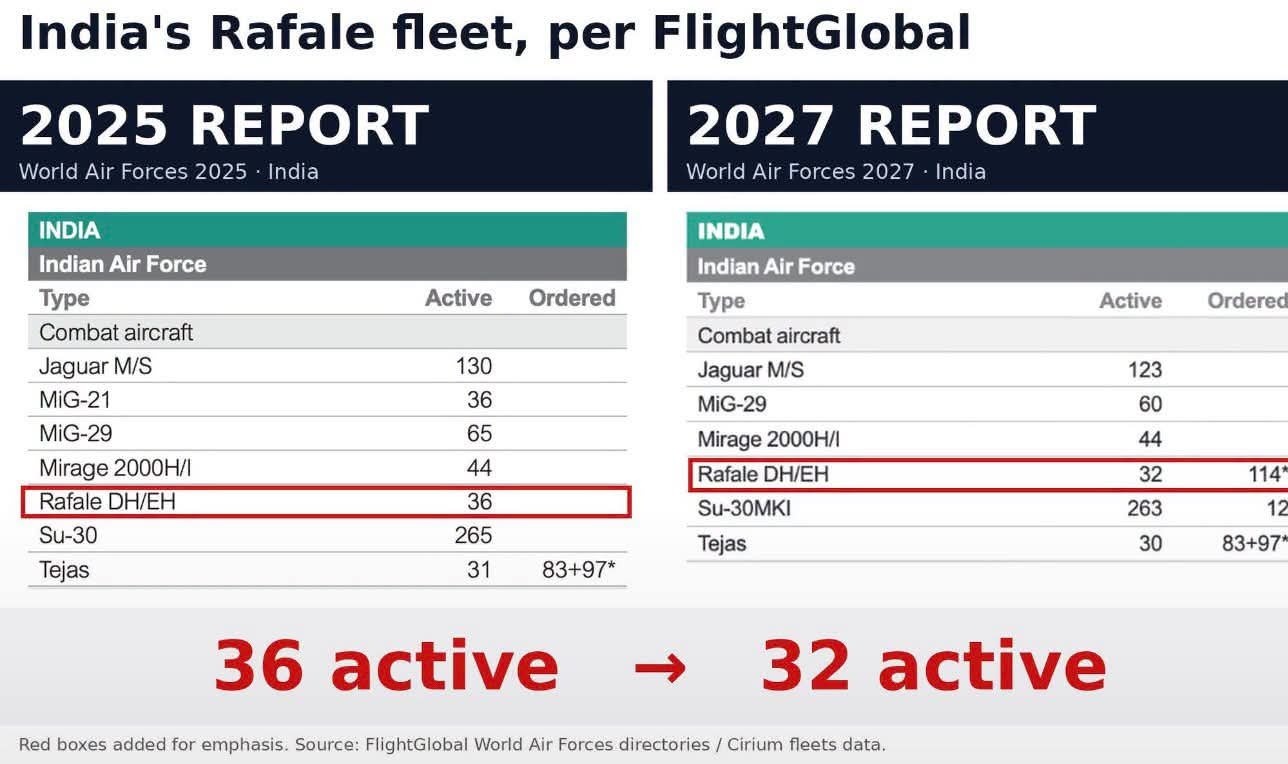
When a British aviation journal quietly trims the Indian Air Force’s (IAF) active Rafale roster from 35 to 32, the Indian Defence Ministry’s first reaction is to claim the numbers are not its own. The contradiction is stark, and the public price is anything but. FlightGlobal’s World Air Forces directory, a respected global inventory, listed 32 active Rafales in its latest edition – a drop of four aircraft from the previous count. Yet the Ministry publicly disavowed the source, saying the figures were not supplied by the IAF or the Ministry itself. This is not a bureaucratic footnote; it is a breach of accountability that ordinary citizens, pilots and taxpayers must feel.
The hard fact: FlightGlobal’s revision
FlightGlobal, the British publication that compiles the annual World Air Forces directory, revised India’s active Rafale count to 32, down from the 35 previously reported. The change appears in the directory’s 2026 edition and was echoed by multiple news wires on 20 November 2026. The directory is compiled from open‑source data, airline registrations, and official defence releases – none of which the Indian Ministry has contested as being inaccurate, only that the Ministry was not consulted for the update.
Ministry’s denial – a classic deflection
The same article from The Observer Post quoted senior Defence Ministry officials stating, “the published numbers were not based on information provided by the IAF.” No official press release, no parliamentary answer, just a vague denial that the Ministry “questioned the accuracy.” When a government refuses to confirm the very data that a reputable international source has published, the burden of proof shifts to the state – and the state has offered none.
Why the count matters to the common man
Four Rafales represent more than metal; each aircraft costs roughly $90 million, plus a lifetime of maintenance, training and infrastructure. The Indian government is currently negotiating a follow‑on purchase of 114 Rafales – a multibillion‑dollar deal that will be funded, in part, by ordinary taxpayers. If four of the first 36 are already out of service, the nation is paying for aircraft it may never see. Moreover, the IAF issued a tender in June 2026 for “bridge support” for all 36 Rafales, implying the full fleet is still operational. The tender contradicts the FlightGlobal figure and suggests the Ministry is either unaware of the loss or deliberately ignoring it to keep the procurement pipeline unimpeded.
Public cost of opacity
Every rupee spent on a Rafale that is not flying is a rupee that could have been used for a school, a hospital, or a farmer’s irrigation pump. The lack of transparency also erodes trust in the armed forces. Pilots train for years on a platform that may be quietly retired or cannibalised without their knowledge. Families of aircrew deserve to know whether their loved ones are flying on a fully supported fleet or on aging airframes kept alive by spare parts.