








































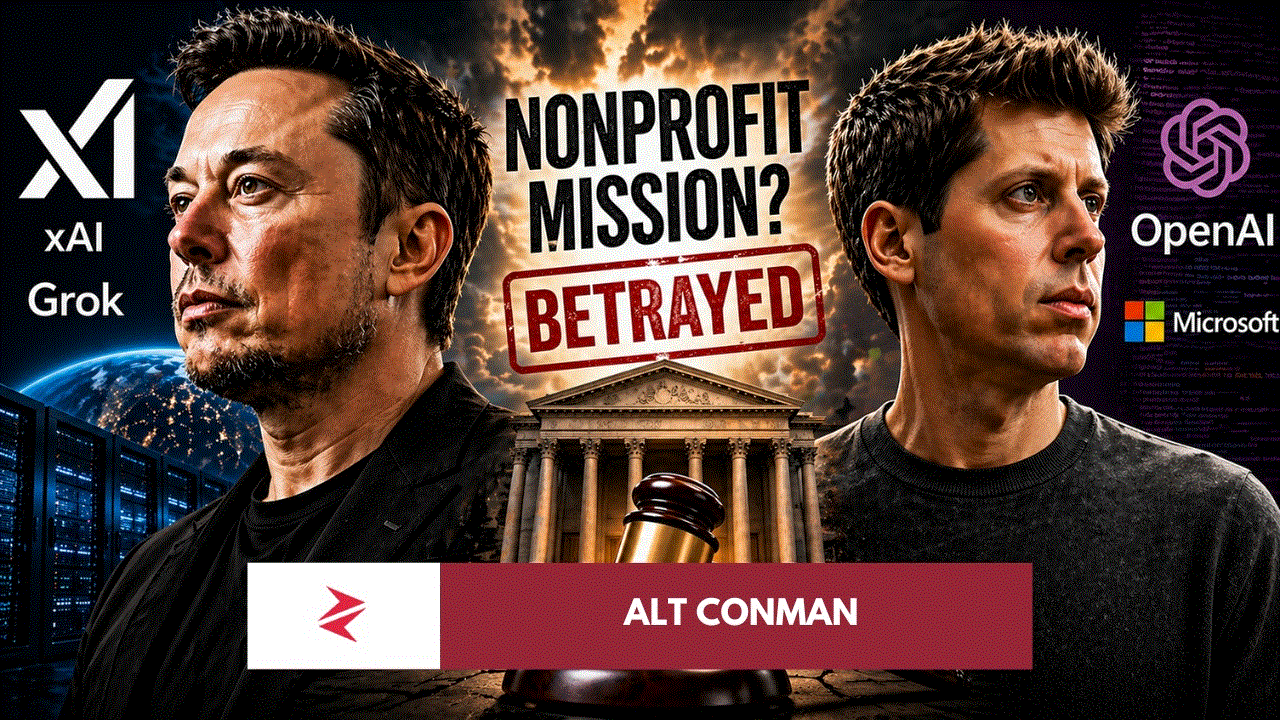
Share the post “Elon Musk Says OpenAI Betrayed Its Nonprofit Mission. So Does Grok Make Him a Hypocrite?”
The easiest mistake in the OpenAI–Elon Musk feud is pretending either side is morally pure. They are not. The real question is narrower and more important: if Elon left OpenAI because he objected to a nonprofit drifting toward closed, profit-driven control, does his own conduct with xAI and Grok undermine that argument?
The answer is uncomfortable for Musk supporters and Altman critics alike: partially, yes—but not in the simplistic way critics frame it.
Musk’s original grievance was not merely that OpenAI wanted revenue. It was that OpenAI, founded as a nonprofit with an openly stated mission to develop AGI for humanity rather than shareholder extraction, allegedly transformed into a commercially aggressive, closed ecosystem deeply intertwined with Microsoft while retaining the moral branding of its original mission. That is the heart of his complaint.
His own public explanation has been consistent: he says he backed OpenAI because he wanted a nonprofit counterweight to Google, refused equity because nonprofits were not supposed to enrich insiders, and believed “open” meant open source. The later shift toward capped-profit and then increasingly commercial structure is what he frames as betrayal.
That argument is not inherently invalidated simply because Musk later built a for-profit AI company.
The more serious critique is this: if Musk truly believes frontier AI should not be developed under conventional profit incentives, then creating xAI/Grok inside an ecosystem monetized through subscriptions, APIs, enterprise licensing, advertising, and strategic deployment into Tesla/X creates a philosophical contradiction unless he can demonstrate materially different governance constraints.
And at present, he largely has not.
What Musk appears to be arguing is not that profit itself is immoral. His implied position is that OpenAI misrepresented itself—raising goodwill, talent, and strategic legitimacy under nonprofit rhetoric before evolving into something else. If that is his standard, then the accusation is about institutional bait-and-switch, not commercialization per se.
That distinction matters.
Because critics often flatten the issue into: “Musk runs a for-profit AI company, therefore his criticism is hypocritical.” That is too shallow. A more precise framing is:

Musk can consistently argue that OpenAI violated its founding covenant while still running a for-profit competitor—provided his complaint is about broken governance promises rather than profit itself.
However, where the hypocrisy critique gains force is in Musk’s broader rhetoric.
He routinely presents himself as motivated primarily by civilizational concern, existential AI safety, and anti-corporate concentration. Yet xAI is not structured as a neutral public-benefit research lab. It is integrated into his private empire, strengthens X platform retention, enhances Tesla/robotics autonomy capabilities, and builds strategic value across his holdings. That means Musk is not standing outside the system condemning commercialization. He is participating in it aggressively.
So the intellectually honest position is this:
Musk Is Not Automatically a Hypocrite—But He Is Not Above Contradiction Either
Musk’s case is coherent if his objection is: