









































I don’t evaluate internet service providers in Pakistan from a place of novelty or short-term frustration.
I come from the dial-up era—when getting online meant listening to modem tones, timing connections around phone calls, and praying the line wouldn’t drop midway.
I grew up using PakTel, Brain, and Cybernet, when an Instacall connection felt revolutionary. Since then, the internet hasn’t been optional for me; it has been core infrastructure—for work, business operations, publishing, coordination, and cloud-based systems.
Over the years, I have personally used PTCL (copper), PTCL EVO, PTCL CharJi, Wateen, WorldCall, Qubee, Nayatel, Optix, and Transworld—often not as short trials, but as long-term, daily-use connections.
The only major providers I have not personally used are StormFiber and PTCL GPON. When I reference them, I rely strictly on benchmark data and aggregated user feedback—not firsthand claims.
This history matters. And I have a history of scoring 100% in CCNET in my course at GIKI while perusing Electronic Engineering. Because my assessment of Optix Pakistan is not based on a bad week, a single outage, or social-media noise. It’s based on decades of comparative exposure to how ISPs in Pakistan behave—when things work, and more importantly, when they don’t.
Optix Pakistan and the Promise of Fiber
When Optix entered the market, it arrived with a strong proposition: fiber-to-the-home (FTTH) at a time when many users were still trapped on aging copper or unreliable wireless solutions.
On paper, Optix promised:
-
High speeds
-
Low latency
-
Modern infrastructure
-
IPTV and bundled entertainment
In some areas, that promise was genuinely delivered.
Where Optix Actually Gets It Right
A fair review must acknowledge strengths.
1. Speed Consistency — When Conditions Are Right
In well-maintained pockets, long-term users report receiving full advertised speeds—50 Mbps and above—consistently for years. This confirms that Optix’s core fiber backbone is not inherently weak.


2. IPTV and Entertainment Bundles
Optix’s television channels, VOD libraries, and app-based streaming are often rated higher than legacy providers. For families prioritizing bundled entertainment, this has been a genuine advantage.
3. Technical Fixes Do Happen
In certain locations, fiber cuts and localized outages are resolved within hours. This shows that technical capability exists—even if it’s applied unevenly.
The Real Problem: Operational Inconsistency
Where Optix struggles is not technology—it’s execution at scale.
1. Customer Support as a Failure Point
Across user reviews from 2023–2025—on forums, app stores, and community discussions—the most repeated criticism is support behavior.
Users frequently report:
-
Calls going unanswered
-
WhatsApp support going silent
-
Tickets closed without resolution
-
Rude or dismissive interactions
In an ISP business, support is not a secondary function.
It is the service.
2. Location-Dependent Reliability
One of Optix’s biggest weaknesses is variance.
Some societies experience:
-
Daily or weekly disconnections
-
Night-time slowdowns
-
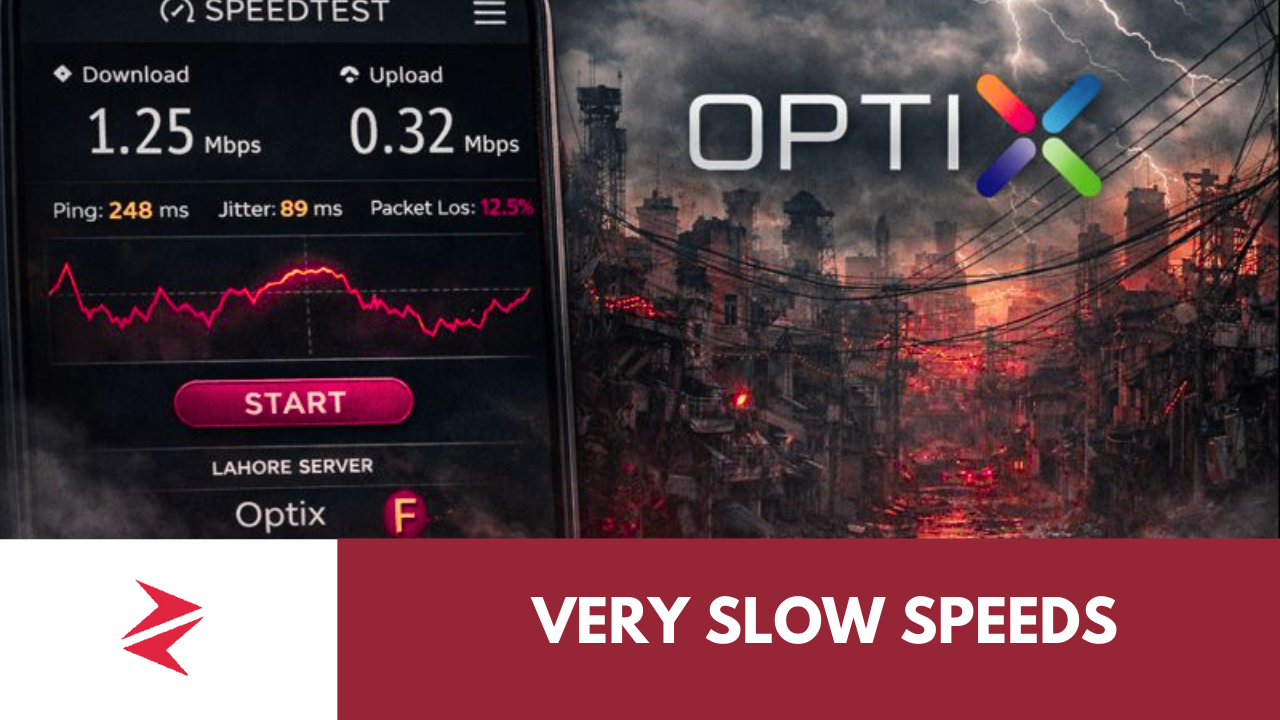
High ping and jitter (especially noticeable for gaming and video calls)
-
Area-wide outages lasting hours
Others remain stable for years.
This creates a lottery-style customer experience, which is unacceptable for professionals and businesses that depend on uptime.
3. Router Quality Quietly Undermines Performance
Optix’s stock Wi-Fi routers are widely criticized for:
-
Poor range
-
Unstable ping
-
Speed drops under load
A recurring pattern is that users who replace the default router with a higher-quality personal device report immediate performance improvement. This suggests that a meaningful portion of Optix dissatisfaction originates at the last-mile device level, not the fiber itself.
4. Monopoly Pressure in Gated Communities
In many DHA, Askari, and private societies, Optix is the only permitted provider.
This changes everything:
-
Customers cannot switch
-
Incentives to improve weaken
-
Frustration escalates faster
History shows that monopolies don’t fail because of bad technology.
They fail because accountability erodes.
5. Migration, Pricing, and Transparency Complaints
Users also report:
-
Confusion around speed upgrades
-
Delays after trial offers
-
Charges for migrations despite existing infrastructure
-
IPTV or app access issues due to missing credentials
Even solvable issues become major pain points when communication breaks down.
How Optix Stacks Up Nationally (2025–2026 Context)
Independent benchmarks and large-scale user feedback consistently place providers like PTCL Flash Fiber, Nayatel, StormFiber, and Transworld ahead in:
-
Reliability
-
Latency consistency
-
Support responsiveness
Optix rarely appears in national top-tier rankings, reinforcing its position as a regional, inconsistent performer rather than a market leader.
Final Verdict: Not the Worst—But Not Dependable Enough
Is Optix the most pathetic ISP in Pakistan?
No.
Is it reliable enough to recommend without hesitation?
Also no.
A fair conclusion is this:
-
Optix can be good if your area is well-maintained
-
Optix fails operationally too often to be trusted blindly
-
The experience varies far too much for comfort
If alternatives exist, most recent feedback suggests switching.
If you’re stuck due to society restrictions, investing in your own router and documenting complaints carefully can reduce—but not eliminate—the friction.
Practical Advice for Users
-
Check recent, area-specific reviews, not brand reputation
-
Use your own high-quality router
-
Keep written records of complaints and tickets
-
Avoid long lock-ins where possible
Closing Thought
In 2025, internet access is no longer a luxury. It is utility infrastructure.
ISPs that succeed long-term won’t be the ones with the loudest marketing—but the ones that respect uptime, transparency, and customer dignity.
Optix still has the technical foundation to improve.
Whether it chooses to fix its operational and human layers will define its future.
As I am trying to update the drafts, the Optix internet goes to the haaaa…ltt. I have a 25 Mbps three in one connection at home in DHA Phase V with a one year double up offer and 15 Mbps three in one connection at office in DHA Phase VI.
Retrospect: I have used 16 Mbps dedicated Nayatel fiber optic connection in I-8 Islamabad in 2014-2015. Same days, I got offered a job there too. Before that we have used Wateen DSL connection with its tower type devices. 8 Mbps PTCL connection was a mistake too. Tried to get their GPont in DHA and created quite a scene with the “higher ups”. No avail.
Related: Not saying that Nayatel would have monitored the by-passed proxies