


















Saudi Arabia & Pakistan: Converting Debt into Defence
The more consequential development lies westward.
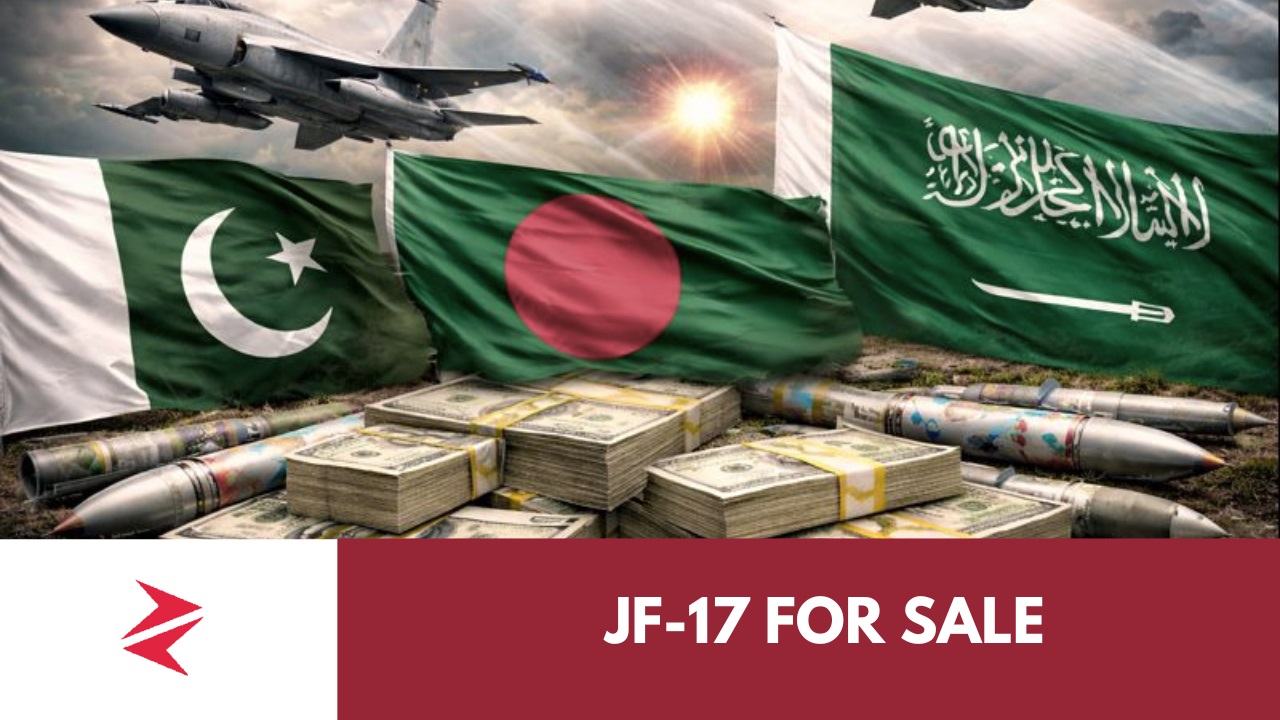
According to reporting cited by Reuters, Pakistan and Saudi Arabia are in talks to convert $2 billion in Saudi loans into a JF-17 fighter jet deal, with the total package potentially reaching $4 billion, including additional equipment.
This is not just arms trading—it is financial engineering.
Why This Matters
- Pakistan eases external debt pressure
- Saudi Arabia diversifies suppliers beyond the US/EU
- Defence trade replaces cash repayment
- Long-term training, MRO, and upgrades lock in partnership
In effect, jets become debt instruments.
Why the JF-17 Is Central to This Strategy

The JF-17 Thunder has matured into a modular platform:
- Block II & Block III with AESA radar, modern avionics, and BVR capability
- Compatibility with Chinese, Pakistani, and select Western systems
- Ideal for countries balancing budgets and geopolitics
Pakistan Aeronautical Complex already supports exports, training, and sustainment—making the jet viable for debt-swap diplomacy.
Trainers Matter Too: The Mushshak Angle
The Super Mushshak often flies under the radar, but it’s critical:
- Primary trainer for new pilots
- Pipeline aircraft feeding future fighter squadrons
- Low-cost entry point into Pakistan’s defence ecosystem
For countries like Bangladesh, trainers are often the first step before combat aircraft.
Strategic Geography: China, Bases, and Balance
References to China, Bangladesh, and facilities like Munir Base point to a wider pattern:
- China anchors the JF-17 supply chain
- Pakistan leverages manufacturing sovereignty
- Buyers avoid over-dependence on Western sanctions regimes
This triangular alignment—China (technology), Pakistan (production), Global South buyers—is becoming a repeatable model. Recent disclosures further reinforce the export-led success of the JF-17 Thunder as a cost-effective multirole platform. As of January 2026, confirmed deliveries include 5 aircraft to Azerbaijan (with 35 more on order), 13 to Myanmar (with 3 additional units pending), and 3 to Nigeria. The Pakistan Air Force itself operates 161 aircraft, providing scale, sustainment confidence, and continuous upgrade feedback.
Future operator pipelines remain active. Libya has 16 aircraft on order, while Indonesia is considering 40 units, pending final approval. In parallel, defense-industry reporting indicates exploratory discussions with Saudi Arabia and Bangladesh, underscoring continued market appetite for affordable fighter solutions amid tightening defense budgets globally.
The program’s export traction contrasts sharply with India’s HAL Tejas, which—despite technological maturity—has experienced slower foreign uptake due to higher unit costs, production constraints, and dependency on Western-origin subsystems. This competitive divergence explains the recurring rhetorical framing seen in regional commentary: JF-17’s success is not accidental; it is a function of pricing discipline, delivery certainty, and fewer geopolitical encumbrances.
Positioned below China’s heavier Chengdu J-10 in cost and complexity, the JF-17 occupies a distinct export niche—one increasingly relevant as mid-income air forces seek credible deterrence without fourth-plus-generation lifecycle burdens. For Pakistan, this translates not only into strategic depth but also into sustained industrial and economic dividends from a mature China–Pakistan co-development model.

