






























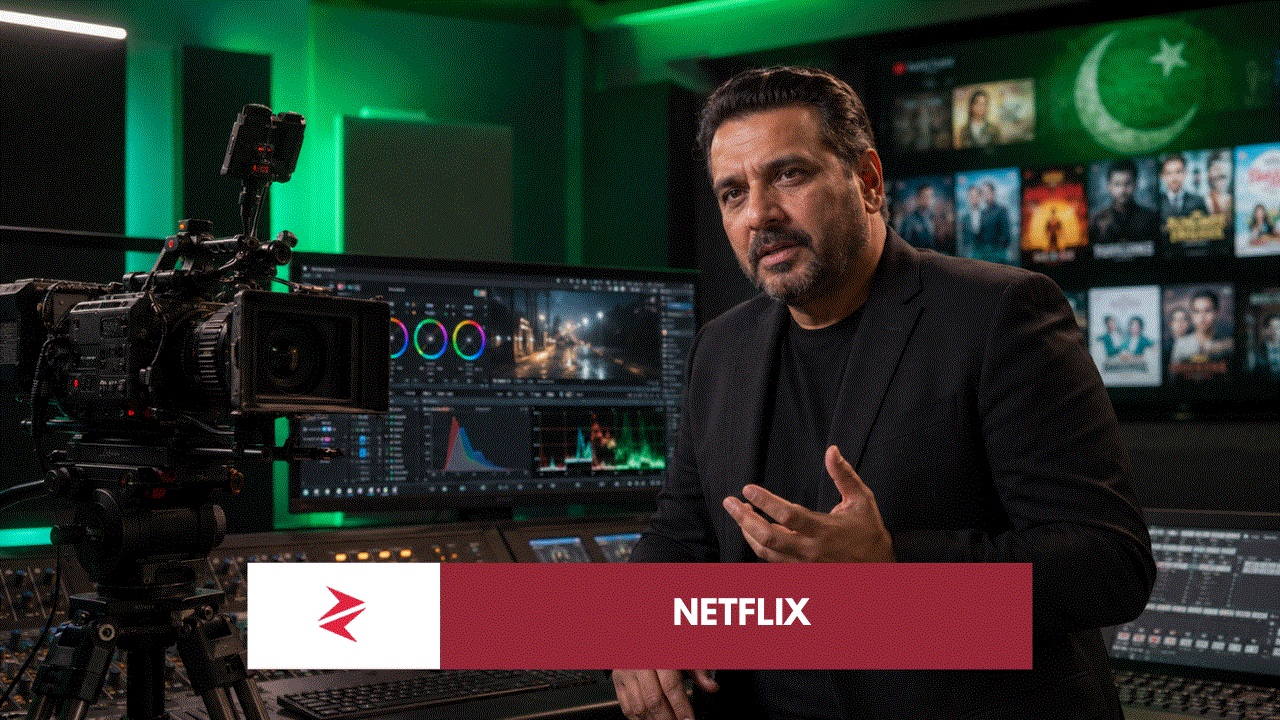
Share the post “Netflix Hamara Content Nahi Leta? The Myth Is Comfortable, but the Truth Is Brutal”
Pakistan Does Not Have a Story Shortage—It Has a Story-Development Crisis
The comment section repeatedly declared that Pakistan has no stories. That is nonsense. A country of more than 240 million people, carrying Partition, migration, terrorism, political upheaval, class conflict, urban violence, climate disasters, spiritual traditions, feudal power, industrial ambition, mountain communities, coastal cultures, espionage, sport, music, crime, folklore and one of the world’s largest diasporas cannot honestly claim to have run out of stories.
What Pakistan has run out of is institutional courage to develop them.
Television economics encourage producers to repeat formulas already accepted by advertisers and broadcasters. A wealthy angry man, a supposedly helpless middle-class woman, family intrigue, marriage, divorce, inheritance and domestic humiliation are rearranged because the commercial system recognises those components. The problem is not that marriage or family stories are inherently inferior. Some of the greatest works in world literature are about families, betrayal, intimacy and inheritance. The problem begins when a subject becomes an assembly line and every character exists only to extend episode count.
The Associated Press reported that Pakistan produces roughly 80 to 120 television shows annually and documented why the dramas travel: realistic settings, natural dialogue, emotional depth and relatable family experiences have attracted viewers beyond Pakistan, particularly in India. This is evidence that Pakistani cultural specificity is not automatically a barrier. It is already an export asset.
The “global story” argument is frequently misunderstood. A global story does not need to erase Urdu, Karachi, Lahore, Peshawar, Quetta, Gilgit-Baltistan or rural Punjab and dress every actor as though they live in Los Angeles. Global storytelling means that a culturally specific world is made emotionally and narratively legible to someone who has never entered it. The setting remains local. The human stakes travel.
Slow storytelling is also not the enemy. A series can be restrained, patient and psychologically layered. What cannot survive is repetition disguised as depth: the same revelation delayed for eight episodes, identical confrontations replayed in different drawing rooms, flashbacks used to fill runtime and characters refusing to communicate simply because the production needs another commercial break.
Pakistan’s finest drama tradition was built on writing. The industry does not need to abandon that inheritance for synthetic spectacle. It needs to protect the writing from commercial stretching, build proper writers’ rooms, pay for research, use professional script editors, test structure before shooting and allow new voices to enter a system dominated by familiar circles.
What Nobody Is Telling New Writers
Many commenters offered scripts, samples and stories directly to Abbasi. Their frustration exposed another broken layer. Pakistan repeatedly tells young people that talent will find its way, while the industry provides no transparent submission channels, no standard option agreements, few reputable development labs, weak intellectual-property protection and almost no reliable path from screenplay to financed production.
Netflix will not solve that Pakistani problem for us. An international buyer is not a national arts council, film school or talent-discovery charity. It purchases projects that arrive through credible commercial relationships. Pakistan must build the institutions that sit between the aspiring writer and the global platform.
A functioning ecosystem would contain screenwriting fellowships, pitch markets, showrunner training, legal templates, talent agencies, completion guarantors, international sales representation, post-production supervisors and annual showcases where carefully developed Pakistani projects are presented to buyers. Until these exist, the same insiders will keep circulating, outsiders will continue posting scripts in Facebook comments, and the country will keep calling its exclusion a mystery.

The India Question Cannot Be Dismissed—or Used as an Excuse
Some viewers insist that Netflix’s regional structure and Indian market interests create a bias against Pakistan. Others argue that invoking India is merely an excuse for poor Pakistani quality. The truth is harsher because both forces can operate at once.
In May 2025, India’s Ministry of Information and Broadcasting directed OTT platforms and digital intermediaries operating in India to discontinue content originating from Pakistan, citing national security and public-order concerns. The direction covered films, web series, songs, podcasts and other streaming media. Whatever language New Delhi uses to justify such measures, a restriction of that scale plainly complicates the regional licensing value of Pakistani content in one of South Asia’s largest commercial markets.
Pretending politics is irrelevant would therefore be dishonest. Pakistani artists have repeatedly faced boycotts, restrictions and sudden market closures despite the popularity of their work among ordinary Indian viewers. Yet turning this fact into a complete explanation would be equally irresponsible. Netflix is a global platform, Pakistani content reaches a substantial diaspora, and markets exist outside India. Pakistan cannot demand international recognition while delivering weak rights documentation, inconsistent technical masters and projects designed exclusively around domestic advertising incentives.
There is also no reliable public evidence supporting the simplistic claim that one Indian executive personally vetoes all Pakistani content or that every Urdu-language decision is controlled in Mumbai while Pakistan is merely “analysed in Singapore.” Regional offices, executives, market data, rights territories and commercial priorities certainly shape decisions, but a single-person conspiracy should not be published as fact without documentation.
Pakistan should confront discriminatory gatekeeping where evidence exists and simultaneously eliminate every self-inflicted excuse that allows a buyer to reject our work on commercial, technical or legal grounds.
Netflix Does Not Require Every Pakistani Story to Become Morally Alien
The comment section repeatedly claimed that Netflix requires explicit sexuality, an LGBTQ character or moral degradation in every series. No universal condition of that kind appears in the company’s published pitching, camera, sound or branded-delivery documents reviewed for this article. Those documents discuss representation, access routes, capture formats, colour pipelines, audio, subtitles, localisation, assets and technical delivery—not a mandatory sexual or ideological checklist.
Netflix carries content from many societies, languages and moral frameworks because its commercial purpose is to attract and retain viewers. Pakistani creators are not required to imitate the most provocative Western series in order to produce international work. Nor should “our values” become a slogan used to defend weak writing, artificial performances, careless lighting or zero investment in sound.
A morally grounded Pakistani crime drama, historical series, family epic, investigative thriller, children’s animation or science-fiction production can remain unmistakably Pakistani. The challenge is not to surrender identity. It is to convert identity into disciplined screen language.








AI Music Generator
July 17, 2026 at 5:00 pm
The title makes an important point because it’s often easier to blame platforms than to examine whether our stories are being developed, packaged, and marketed in a way that fits global audiences. I also think this conversation should include the role of consistent investment in writing, production quality, and long-term intellectual property, since those are just as important as getting a meeting with a streaming platform.