





























Share the post "Rumors of Pakistan Economy Default until IMF Loans Return"
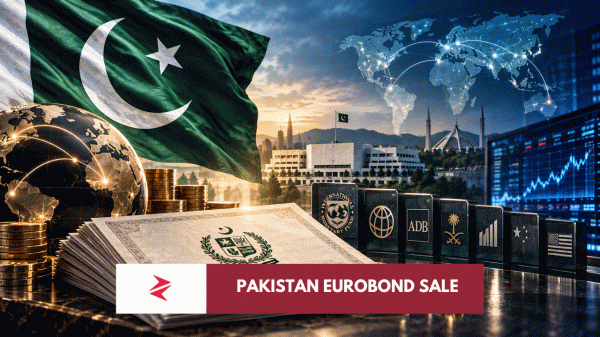
If Pakistan’s economy defaults, it would mean that the country is unable to meet its financial obligations and is unable to pay back its debts. This could have serious consequences, both for the Pakistani government and for the country’s citizens. It could lead to financial instability, a decline in the value of the Pakistani rupee, and difficulty obtaining loans in the future. It could also lead to social and political unrest, as people may become disillusioned with the government’s ability to manage the economy effectively. In the worst-case scenario, an economic default could lead to economic collapse, which could have far-reaching and devastating consequences for the country.
It is being said, that we always have collaterals like airports for their guarantee. The government should be responsible for providing necessary public services such as running courts, police stations, and air traffic control, but it is not necessary for the government to own and operate businesses in industries like oil and gas, transportation, and ports. Even if the lenders part take the stakes on defaults, it does not matter. Our airports already even earning us much.
I will cite the example of Sri Lanka, where people took things into their hands after huge inflation as they declared bankruptcy. Later on, Armed forces were deployed to take matters into their hands. Sri Lanka has faced economic challenges in the past, including a balance of payments crisis in 2018. This crisis was triggered by a number of factors, including high levels of debt, a large fiscal deficit, and a lack of foreign exchange reserves.
As a result of these challenges, the Sri Lankan government was forced to seek financial assistance from international organizations, including the International Monetary Fund (IMF). The IMF provided a $1.5 billion loan to Sri Lanka to help stabilize the country’s economy, but in return, the government had to implement a number of austerity measures, including cutting spending, raising taxes, and reducing subsidies. The measures were designed to help bring the country’s fiscal deficit under control and restore stability to the economy. While the Sri Lankan economy has improved since the crisis, it remains vulnerable to external shocks and will need to continue to implement responsible economic policies in order to sustain its recovery.
It is exactly what happened when Brazil defaulted. Brazil has faced financial challenges in the past, including a sovereign debt crisis in the 1980s and a balance of payments crisis in the late 1990s. In 2002, Brazil defaulted on its debt, which means that it was unable to make payments on its outstanding obligations. This default had serious consequences for the country, including a sharp depreciation of the Brazilian real, a decline in foreign investment, and a rise in borrowing costs. It also led to social and political unrest, as people were unhappy with the government’s handling of the economy.
In order to address the crisis, the Brazilian government implemented a number of measures, including a currency peg, a tightening of monetary policy, and structural reforms to improve the competitiveness of the economy. These measures helped stabilize the economy and restore confidence in the financial markets, but the recovery was slow and took several years.
Technical Default Vs. Global Default