























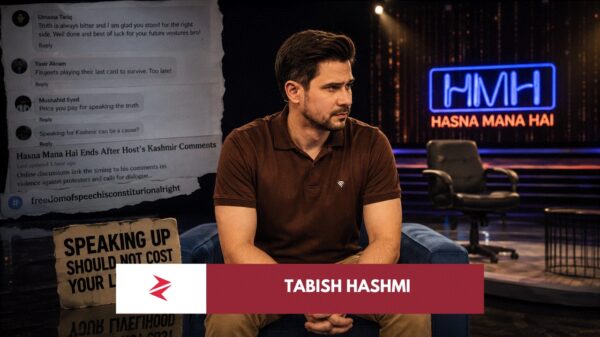



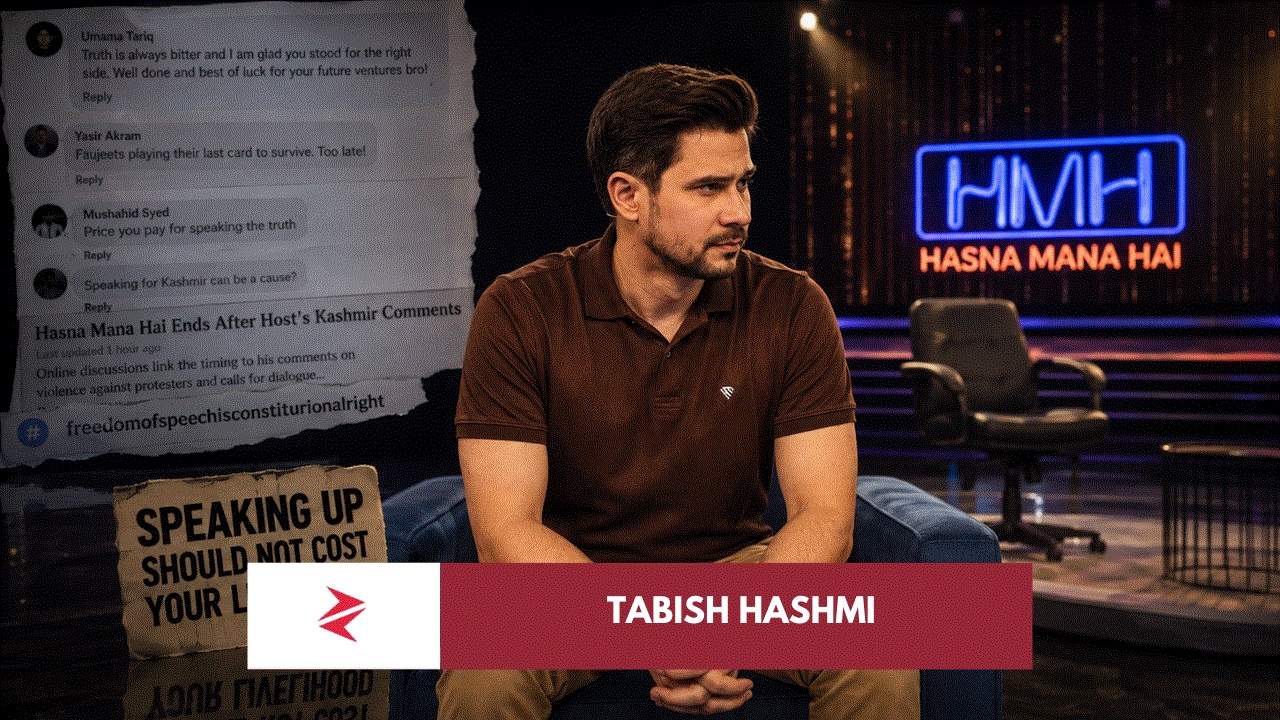
A bad comedy show does not become a civil-liberties monument merely because its host posts one politically sensitive video, and a comedian whose national-television identity was repeatedly built around double entendres, guest embarrassment and what I consider painfully low-grade vulgarity does not suddenly become Pakistan’s Nelson Mandela because he says a few unobjectionable sentences about dialogue in Kashmir.
I have never enjoyed Tabish Hashmi’s television persona. I do not find the endless innuendo intelligent, his forced reactions sophisticated or the recurring humiliation of guests particularly creative. His comedy frequently felt like material one had to watch with headphones because parents and children could not comfortably sit through it together. That criticism is not imaginary either: Geo’s own official YouTube operation promoted at least one segment with the title, “Plastic aur Rubber ki double meaning cheez!” When a programme’s own marketing openly advertises the double meaning, viewers cannot be accused of inventing its dependence upon cheap suggestiveness.
Wrong comedy remains wrong. Stale television remains stale. But turning dislike into misinformation would also be wrong.
The defensible position is therefore sharper than either fan worship or blind hatred: I loathe the comedy, but the publicly available evidence does not currently prove that Geo removed Tabish Hashmi from Hasna Mana Hai because he spoke about Kashmir.
What Actually Happened
Hashmi published a farewell message declaring that his journey with Hasna Mana Hai had concluded, writing, “It was great while it lasted, 2022–2026,” while thanking the programme’s audience and those who worked on it. The announcement confirmed his departure from the show; it did not publicly identify a dismissal order, a government instruction, a contractual dispute or a Kashmir-related ultimatum.
A few days earlier, Hashmi had released a video expressing distress over the situation in Azad Jammu and Kashmir. He said he was uncertain about the consequences of addressing the issue, appealed to the parties involved to resolve their differences through dialogue and described people on both sides as fellow Pakistanis. That video was reported on July 29, 2026.
The timing understandably generated suspicion. A politically sensitive video appeared, followed shortly afterwards by a farewell announcement. Social-media users then completed the story themselves: he spoke for Kashmir, somebody became insecure, Geo punished him, and the programme was terminated.
That sequence is emotionally persuasive. It is not yet documentary evidence.
| Public claim | What the record presently shows | Evidence-based conclusion |
|---|---|---|
| Tabish Hashmi left Hasna Mana Hai | Hashmi publicly announced the conclusion of his journey with the programme | Confirmed |
| His Kashmir statement came shortly before the farewell | The Kashmir appeal was reported on July 29; the farewell followed soon afterwards | Confirmed chronology |
| Geo removed him because of Kashmir | No publicly available Geo statement, termination letter, contractual disclosure or direct on-record confirmation establishes this connection | Unverified |
| Hasna Mana Hai itself was permanently cancelled | His announcement concerned his departure; Geo’s website continued carrying the programme and listed a July 31 episode | Not established |
| Geo completely severed relations with him | Hashmi was simultaneously appearing as a judge on Geo Entertainment’s Pakistan’s Got Talent | Not supported by the current record |
| The close timing raises legitimate questions | The proximity of the two events reasonably invites scrutiny | Fair question, not proven answer |
What Nobody Is Telling the Martyrdom Merchants
The most inconvenient fact for the instant-censorship narrative is that Tabish Hashmi was not disappearing from Geo’s universe. Pakistan’s Got Talent premiered on Geo Entertainment in July 2026 with Hashmi among its judges, alongside Mehwish Hayat and Ali Zafar. Geo and Har Pal Geo were publicly promoting his participation in the programme, while Geo’s own television listings continued to carry Hasna Mana Hai and displayed an episode dated July 31, 2026.
This does not conclusively prove that no disagreement occurred behind closed doors. Television programmes may be pre-recorded, separate contracts may operate simultaneously, executives may tolerate a personality in one format while removing him from another, and scheduled content can remain online after a professional rupture. Those are possible explanations.

But possibility must not be confused with evidence.
Anyone alleging an institutional punishment must answer an obvious question: why was the allegedly banished man still being marketed on another major show by the same network? Until somebody produces a credible explanation, the idea of a complete Geo purge remains substantially weaker than social-media posts suggest.
This is precisely why a documentation-first approach to public allegations matters. Pakistan’s digital ecosystem has become addicted to constructing the verdict before locating the evidence. A vague farewell becomes a firing, suspicious timing becomes confirmed causation, and repeated comments become “reports” even when all the reports ultimately trace themselves back to the same unverified assumption.
