









































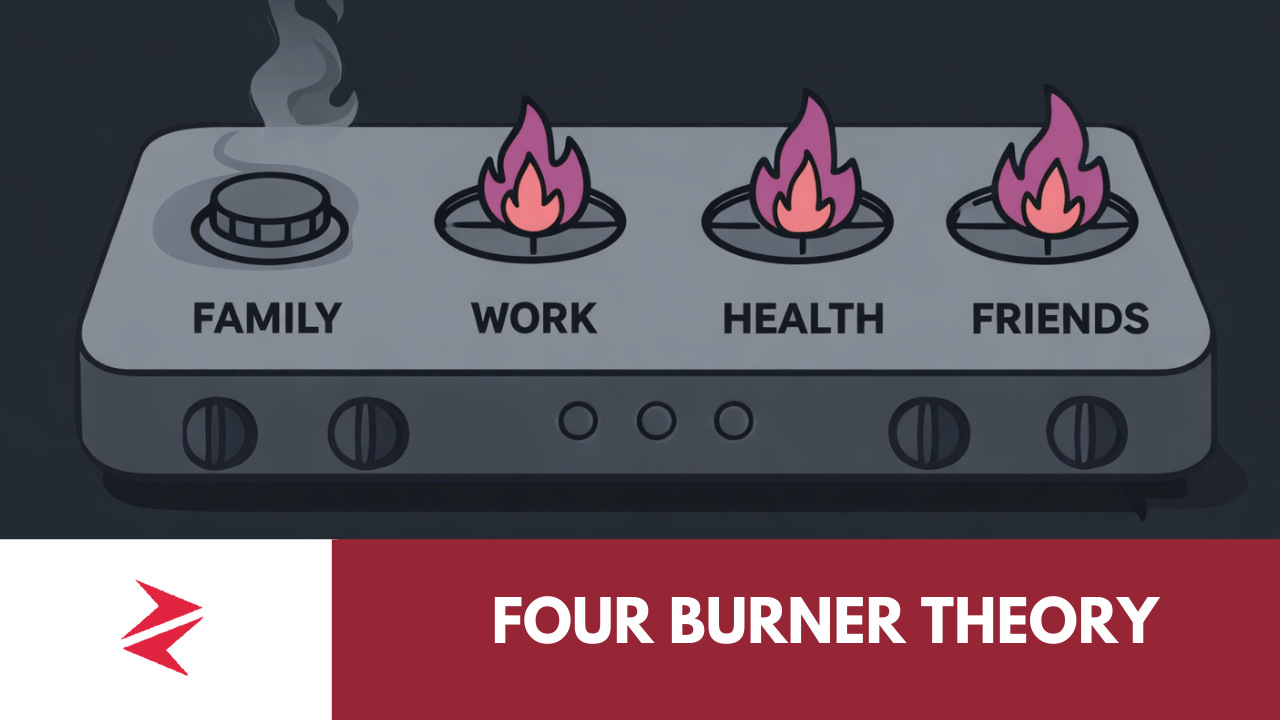
The Four Burner Theory is one of those deceptively simple concepts that lingers long after you hear it. Popularized through an anecdote attributed to humorist David Sedaris, it frames life as a stovetop with four burners: Family, Work, Health, and Friends. The claim is stark. To be successful, you must turn one off. To be extremely successful, you must turn off two.
It spreads because it feels uncomfortably accurate.
The metaphor is efficient. Each domain consumes fuel—time, cognitive bandwidth, emotional energy. You cannot run all four at maximum intensity indefinitely. The viral thread that revived this idea linked it to figures like Elon Musk, Jeff Bezos, and Mark Zuckerberg, suggesting that elite achievement often coincides with relational sacrifice. While such comparisons are reductionist, the underlying trade-off dynamic is empirically grounded.
