




























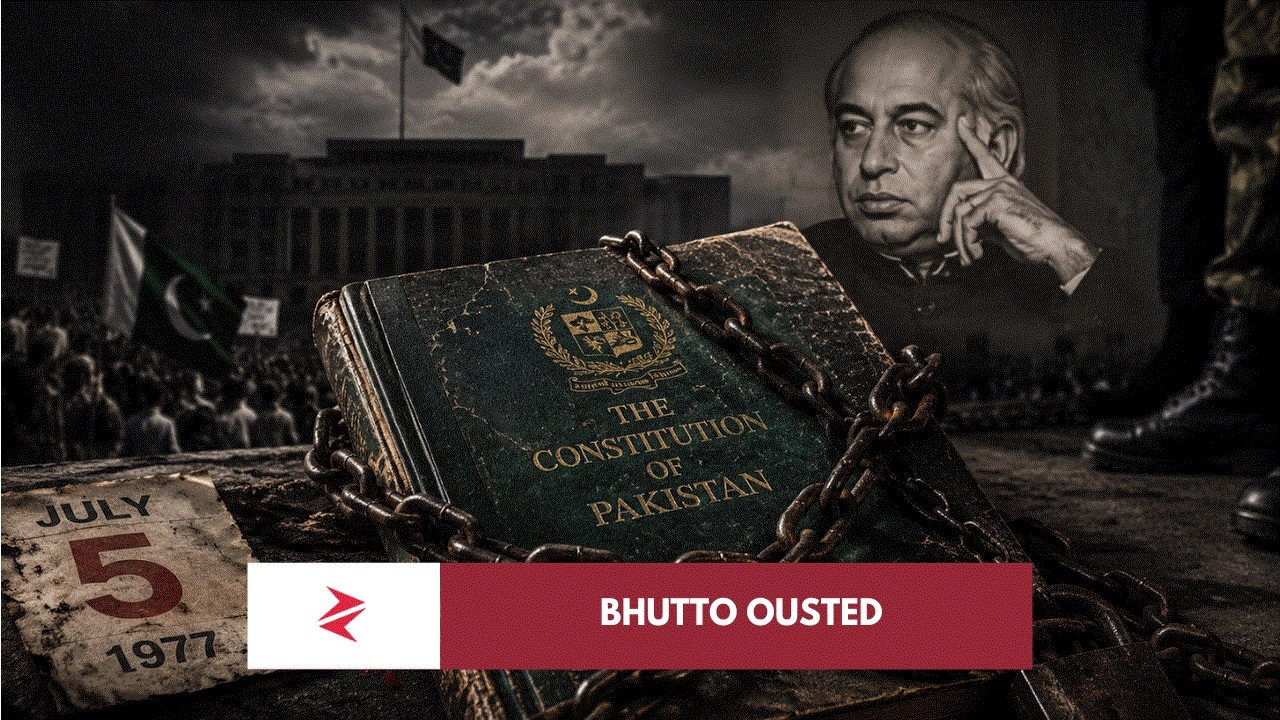
The easiest lie about 5 July 1977 is that it belongs only to 1977. It does not. That date did not merely remove one prime minister, imprison one political party, or place one general above one elected government; it taught Pakistan’s power structure that the ballot could be interrupted, the Constitution could be paused, the courts could be bent, and the people could be told, again and again, that their own mandate was too dangerous to be trusted.
What happened on 5 July was wrong. Full stop. But using that truth to turn Zulfikar Ali Bhutto into an untouchable saint is also wrong. Celebrating martial law because one dislikes Bhutto is wrong. Pretending that 1970 did not happen is wrong. Pretending that 1977 did not wound the Constitution is wrong. And pretending that today’s political actors can mourn dictatorship while benefiting from unelected engineering without public backlash is also wrong. This is why #5thJuly is still radioactive: it is not only history; it is a mirror.
The factual core is clear. Pakistan’s National Assembly records state that after the 7 March 1977 elections, the opposition accused the government of rigging, boycotted provincial assembly elections, and a severe political crisis followed; martial law was then imposed by Army Chief General Muhammad Zia-ul-Haq on 5 July 1977. EBSCO’s research summary describes the same event as a military coup that deposed Prime Minister Zulfikar Ali Bhutto, established martial law, suspended fundamental rights, and opened the door to large-scale repression of political opponents.
The impact was not one-dimensional. It damaged civilian supremacy, normalized constitutional suspension, distorted party politics, empowered unelected offices, weakened judicial independence, and injected coercion into national life. The 1977 coup did not arrive in a vacuum, either. It came after the deep wound of 1970–71, when Pakistan’s first direct general election exposed a fatal gap between voting and power transfer. The 1970 election, held on 7 December 1970, gave the Awami League an absolute majority, while the PPP emerged as the dominant party in West Pakistan; the refusal and delay in translating that mandate into constitutional power contributed to a national breakdown that ended with Bangladesh’s creation after war and Indian intervention.
That is why any honest Pakistan-first reading must hold two truths together. Zulfikar Ali Bhutto was a victim of a military regime after 1977, and he was also a deeply controversial actor in the crisis that preceded Pakistan’s breakup. One truth does not cancel the other. A nation that cannot hold complexity becomes a playground for slogans.
| Event | Immediate impact | Long-term damage |
|---|---|---|
| 7 December 1970 general election | First direct democratic mandate exposed East-West political division | Failure to honour the mandate helped destroy trust in federal democracy |
| 7 March 1977 general election crisis | Opposition rejected results and political confrontation escalated | Civilian dispute became the opening through which military rule entered |
| 5 July 1977 martial law | Zia removed Bhutto’s government and suspended democratic rule | The Constitution became conditional on power, not power conditional on the Constitution |
| Military courts and repression | Civilians and political prisoners were tried through summary military procedures | Fear entered politics; courts and due process were weakened |
| 1985 non-party elections and 8th Amendment | Controlled political activity resumed without full party democracy | Presidential dissolution powers later destabilized elected governments |
The most direct constitutional impact was that the 1973 Constitution lost its supremacy in practice. Amnesty International reported that after martial law, fundamental rights guaranteed by the 1973 Constitution were suspended, including freedom of movement, assembly, association, speech, safeguards against unlawful arrest and detention, and protections against torture. Amnesty also reported that more than one hundred military courts were established after the 1979 constitutional amendment and that civilians, including political prisoners, were tried through summary procedures, with hundreds sentenced to imprisonment and flogging for ordinary political activity banned under martial law.
Then came the judicial scar. Bhutto’s execution in 1979 became one of Pakistan’s most contested legal and political events, and decades later, in 2024, Pakistan’s Supreme Court ruled that he did not receive a fair trial before his execution. That ruling matters because it does not merely revisit one man’s death; it confirms that when constitutional order collapses, courts can become part of the machinery of fear rather than shields against it.
The second impact was political engineering. After martial law, real party politics was not restored cleanly. The National Assembly’s own parliamentary history notes that a nominated Federal Council, Majlis-e-Shoora, was constituted in 1981, and general elections were later held in 1985 on a non-party basis. This mattered because non-party elections weakened ideological politics and strengthened patronage politics. When parties are pushed out, electables, biradari networks, administrative pressure, and personal loyalties fill the vacuum. Pakistan is still paying for that distortion.
The third impact was Article 58(2)(b). The National Assembly record notes that the 8th Constitutional Amendment added Article 58(2)(b), giving the president discretionary power to dissolve the National Assembly. That single structural change haunted the post-Zia democratic period, because elected governments could be dismissed through presidential power rather than defeated through parliamentary accountability. In plain language, 5 July did not only topple Bhutto; it left behind tools for future controlled democracy.
The fourth impact was social and legal. The Zia years reshaped Pakistan’s legal and cultural environment through an Islamization project that still generates debate. Pakistan’s Legislative History archive notes that a body of law enacted largely during General Zia-ul-Haq’s regime sought to establish what supporters called an “Islamic” justice system, while attracting scrutiny over civil liberties, human rights, and equal treatment of citizens. Whatever one’s religious or ideological lens, the political reality is that Islam was used not merely as belief but as statecraft, legitimacy, and discipline.

The fifth impact was psychological. After 5 July, Pakistani politics became addicted to the “rescuer” myth: whenever civilian politics became messy, some class of commentators, power brokers, or beneficiaries began waiting for intervention. That is the deepest poison. Democracies make mistakes in public and correct them through elections. Authoritarian systems hide mistakes behind discipline, then hand the bill to the people.
This is where the social media backlash in the supplied reactions becomes politically important. PPP supporters frame 5 July as a Black Day for democracy, and historically they are right. But many critics respond by invoking 1970, the breakup of Pakistan, allegations of elite compromise, and today’s mandate disputes. Some of that reaction is legitimate political anger; some of it collapses into abuse, slurs, and inherited hatred. The analytical point is not the abuse. The analytical point is the distrust. Many Pakistanis no longer accept dynastic moral speeches at face value, especially when parties condemn past authoritarianism while appearing comfortable with present-day power arrangements.
The Pakistan Peoples Party (PPP) marked the 49th anniversary of the July 5, 1977, military coup, termed “Operation Fair Play,” as a “Black Day” to protest General Zia-ul-Haq’s overthrow of Prime Minister Zulfikar Ali Bhutto. PPP leaders reaffirmed their commitment to constitutional rule, condemning the era as a dark period that destroyed national institutions and led to Bhutto’s 1979 execution.
My opinion on the 7 December 1970 election is straightforward: it was Pakistan’s most important democratic test, and Pakistan failed after the vote, not during the vote. The Awami League’s mandate should have been accepted constitutionally, and the federation should have been renegotiated politically rather than broken through delay, arrogance, and force. That does not absolve India’s role in exploiting the crisis, but Pakistan must be mature enough to say that external exploitation became possible because internal legitimacy had already collapsed. A nation cannot defend itself externally while cheating its own constitutional logic internally.
So what was the impact of 5 July 1977? It converted a political crisis into a constitutional disease. It made unelected arbitration appear normal. It turned courts, laws, parties, media, religious rhetoric, and national security language into instruments of regime survival. It damaged PPP, but it also damaged Pakistan beyond PPP. It killed Bhutto politically and physically, but it also wounded the citizen’s belief that voting alone could decide power.
The real lesson is not “Bhutto was right” or “Bhutto was wrong.” The real lesson is that no politician, party, judge, general, bureaucrat, cleric, media owner, or foreign patron should ever be allowed to place himself above the Constitution. The Constitution is not a decoration for speeches. It is the contract that stops Pakistan from becoming a permanent negotiation between force and fear.