


































What Nobody Is Telling You: The Players Became Diplomatic Proxies
The Indian women played excellent cricket. They did not design the political conflict, elect the ACC president or determine India-Pakistan foreign policy. Yet they were placed at the visible edge of a decision made by administrators.
That is why praising the cricketers and criticising the BCCI are entirely compatible positions.
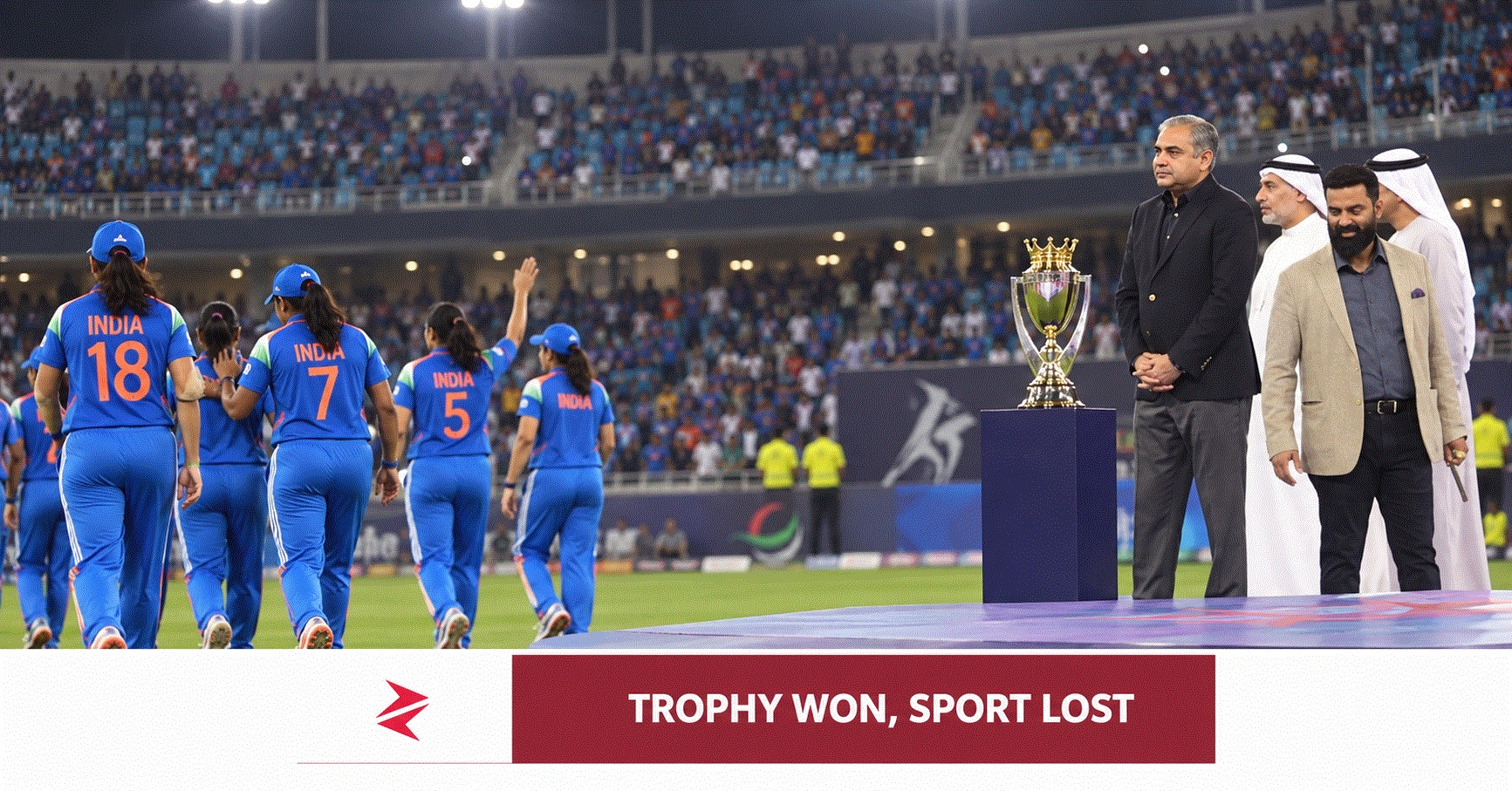
When a governing board tells athletes whom they may shake hands with, whom they may receive medals from and which recognised official they must publicly avoid, the board is using players as instruments of state signalling. The cricket ground becomes a diplomatic stage, while the athletes carry the reputational cost.
Indian leaders, including Prime Minister Narendra Modi and President Droupadi Murmu, praised the champions. Their congratulations were understandable. What deserves scrutiny is the political machinery around the team that ensured discussion of a magnificent 72-run victory immediately shifted from Verma, Mandhana and Charani to a Pakistani administrator standing beside an uncollected trophy.
The BCCI did not protect the women’s achievement from politics. Its directive guaranteed that politics would dominate it.
Yes, Mohsin Naqvi’s Multiple Offices Deserve Scrutiny
Pakistanis do not have to become uncritical defenders of Mohsin Naqvi to recognise the BCCI’s conduct as political.
Naqvi simultaneously serving as Pakistan’s interior minister, PCB chairman and ACC president creates a genuine governance question. Cricket administration should not be insulated from scrutiny merely because the administrator happens to be Pakistani. The ICC’s membership principles have historically required national boards to manage their affairs autonomously and resist government interference in cricket administration.
That issue deserves a serious, uniform debate, as explored more broadly in this analysis of the International Cricket Council’s influence and responsibilities.
However, criticism of Naqvi’s offices does not logically transform India’s trophy refusal into a non-political act. Both propositions can be true:
- Pakistan should examine whether one serving minister ought to hold so much political and cricketing authority.
- The BCCI deliberately used a sporting presentation to communicate a political position against Pakistan.
One contradiction does not cancel the other. Pakistan’s governance shortcomings cannot be used as an unlimited permission slip for India to convert every shared sporting ritual into hostile theatre.
The Double Standard Surrounding Political Influence
Indian commentary arguing that politics entered cricket only because Naqvi is a minister ignores the BCCI’s own long and well-documented proximity to political power. Indian politicians have occupied prominent cricketing positions for decades, while Jay Shah moved from BCCI secretary to ICC chairman after being elected unopposed in 2024. He is also the son of Indian Home Minister Amit Shah.

That family relationship alone does not prove improper interference, just as holding public office does not automatically prove that every administrative decision is illegitimate. It does, however, make the claim that Indian cricket exists in some untouched, politically sterile universe particularly difficult to sustain.
The wider power relationship is examined in how Jay Shah’s rise altered cricket governance and in the documented controversies surrounding the BCCI’s treatment of Pakistan during international cricket events.
India cannot plausibly celebrate political access when it strengthens the BCCI and condemn political identity only when a Pakistani occupies regional office.
BCCI’s Diplomatic Strategy
The trophy refusal appears to serve four connected objectives.
First, it produces a dramatic image for India’s domestic audience without requiring withdrawal from a commercially valuable tournament. Second, it isolates Pakistan symbolically while allowing India to retain points, broadcast exposure and the championship. Third, it places the burden of resolving the confrontation upon the ACC rather than the BCCI. Fourth, it tests whether cricket’s governing institutions will tolerate unilateral protocol changes from their most commercially powerful member.
This is strategically clever but institutionally corrosive.
A full tournament boycott would have carried financial and competitive costs. A trophy refusal generated comparable nationalist messaging at a fraction of that cost. India could compete, win, celebrate and still present itself as having maintained political distance.
That is not the separation of sport and politics. It is the optimisation of politics through sport.
Why the ACC and ICC Cannot Remain Spectators
The ACC should establish written presentation protocols before every final, including an alternative mechanism when a participating board raises a documented objection. That process must be private, time-bound and equally available to every member—not improvised after a match depending upon the commercial power of the winner.
The ICC should also clarify the difference between government interference in board administration and political gestures imposed upon players during international competitions. Existing autonomy principles mean little if they are invoked selectively against weaker boards while powerful members freely transform ceremonies into diplomatic demonstrations.
A workable reform agenda would include:













Carla Zhao
November 14, 2026 at 9:50 pm
The focus on BCCI’s politicised trophy ceremony is important because it risks overshadowing the women’s team’s hard-earned Asia Cup victory. The players’ achievement should remain central, not the politics around the presentation.
Zorays
November 14, 2026 at 9:58 pm
I completely agree that the players’ incredible achievement deserves to be the sole focus. It is disappointing when administrative decisions distract from the hard work and talent that led to this victory.
— Zorays
For continued reading: Opening Ceremony Cricket World Cup 2023 · Global Cricket Politics · Afghanistan Cricket Politics