





























Share the post “India Won the Women’s Asia Cup, but BCCI Politicised the Trophy Ceremony Once Again”
The Double Standard Surrounding Political Influence
Indian commentary arguing that politics entered cricket only because Naqvi is a minister ignores the BCCI’s own long and well-documented proximity to political power. Indian politicians have occupied prominent cricketing positions for decades, while Jay Shah moved from BCCI secretary to ICC chairman after being elected unopposed in 2024. He is also the son of Indian Home Minister Amit Shah.
That family relationship alone does not prove improper interference, just as holding public office does not automatically prove that every administrative decision is illegitimate. It does, however, make the claim that Indian cricket exists in some untouched, politically sterile universe particularly difficult to sustain.
The wider power relationship is examined in how Jay Shah’s rise altered cricket governance and in the documented controversies surrounding the BCCI’s treatment of Pakistan during international cricket events.
India cannot plausibly celebrate political access when it strengthens the BCCI and condemn political identity only when a Pakistani occupies regional office.
BCCI’s Diplomatic Strategy
The trophy refusal appears to serve four connected objectives.
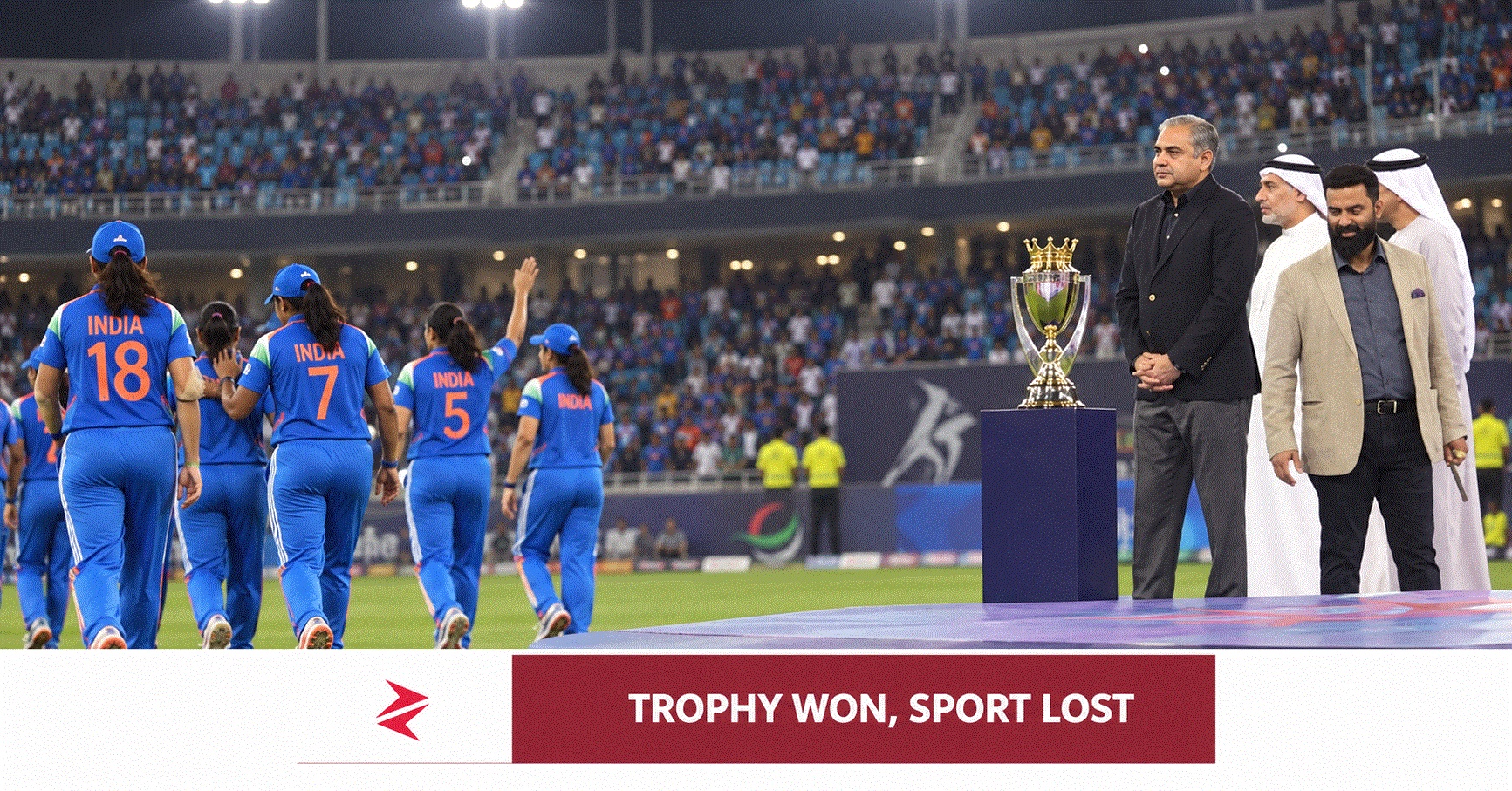
First, it produces a dramatic image for India’s domestic audience without requiring withdrawal from a commercially valuable tournament. Second, it isolates Pakistan symbolically while allowing India to retain points, broadcast exposure and the championship. Third, it places the burden of resolving the confrontation upon the ACC rather than the BCCI. Fourth, it tests whether cricket’s governing institutions will tolerate unilateral protocol changes from their most commercially powerful member.
This is strategically clever but institutionally corrosive.
A full tournament boycott would have carried financial and competitive costs. A trophy refusal generated comparable nationalist messaging at a fraction of that cost. India could compete, win, celebrate and still present itself as having maintained political distance.
That is not the separation of sport and politics. It is the optimisation of politics through sport.
Why the ACC and ICC Cannot Remain Spectators
The ACC should establish written presentation protocols before every final, including an alternative mechanism when a participating board raises a documented objection. That process must be private, time-bound and equally available to every member—not improvised after a match depending upon the commercial power of the winner.

The ICC should also clarify the difference between government interference in board administration and political gestures imposed upon players during international competitions. Existing autonomy principles mean little if they are invoked selectively against weaker boards while powerful members freely transform ceremonies into diplomatic demonstrations.
A workable reform agenda would include: