



















Spain: Lamine Yamal And The Muslim-Heritage Breakthrough
Spain’s Muslim-heritage story runs through Lamine Yamal. His Moroccan family background and visible Muslim identity have been widely reported, with Al Jazeera describing his World Cup goal celebration as sujoud, a public Muslim act of prostration, after his maiden World Cup goal.
Yamal’s importance is not limited to representation. Spain reached the quarter-finals after beating Portugal, and Reuters’ pre-quarter-final reporting described Yamal as one of the key figures in Spain’s attack while noting that Spain had reached the stage without conceding a goal. His role is tactical as much as cultural: he pulls defenders toward him, changes the opponent’s shape, stretches defensive lines, and gives Spain a constant threat even when his direct goal numbers do not tell the whole story.
Belgium: Amadou Onana And The Immigrant-Muslim Story
Belgium’s clearest Muslim-player connection is Amadou Onana. This is not a speculative label. In a first-person Players’ Tribune article, Onana wrote about arriving in Belgium from Senegal and described himself as “a Black, Muslim immigrant.”
That line gives his presence in Belgium’s top-eight campaign real narrative weight. Onana’s story is not just about a midfielder wearing a European shirt. It is about migration, family sacrifice, African roots, Muslim identity and elite football all converging inside a non-Muslim-majority national team. In the wider Muslim-heritage World Cup series, he belongs in the conversation because Belgium’s progress kept that story alive at the top-eight stage.
Switzerland: Granit Xhaka And The Kosovo-Albanian Muslim Line
Switzerland’s Muslim-heritage connection is strongest through Granit Xhaka. Muslim Network’s World Cup 2026 feature described Xhaka as coming from Kosovo’s Albanian Muslim community and placed him inside Switzerland’s Muslim-football profile.
Xhaka’s role is different from Yamal’s and Dembélé’s. He is not the teenage winger or the explosive forward. He is the veteran midfielder, the emotional conductor, the player who gives Switzerland authority in the middle of the pitch. Reuters has previously described him as Switzerland’s captain and most-capped player, highlighting his leadership and composure. That makes him relevant not because he fits a convenient identity label, but because he remains a serious football figure inside a top-eight team.
What Nobody Should Overstate
This is where accuracy matters. Norway had Mohamed Elyounoussi as a Morocco-born heritage-relevant player, but Norway’s top-eight progression should not be rewritten as a Muslim-player-led campaign without stronger match-specific evidence. England and Argentina, based on available top-eight progression reporting, should not be forced into the Muslim-player discussion without clearly documented decisive Muslim-background contributors. Weak claims damage the whole series.
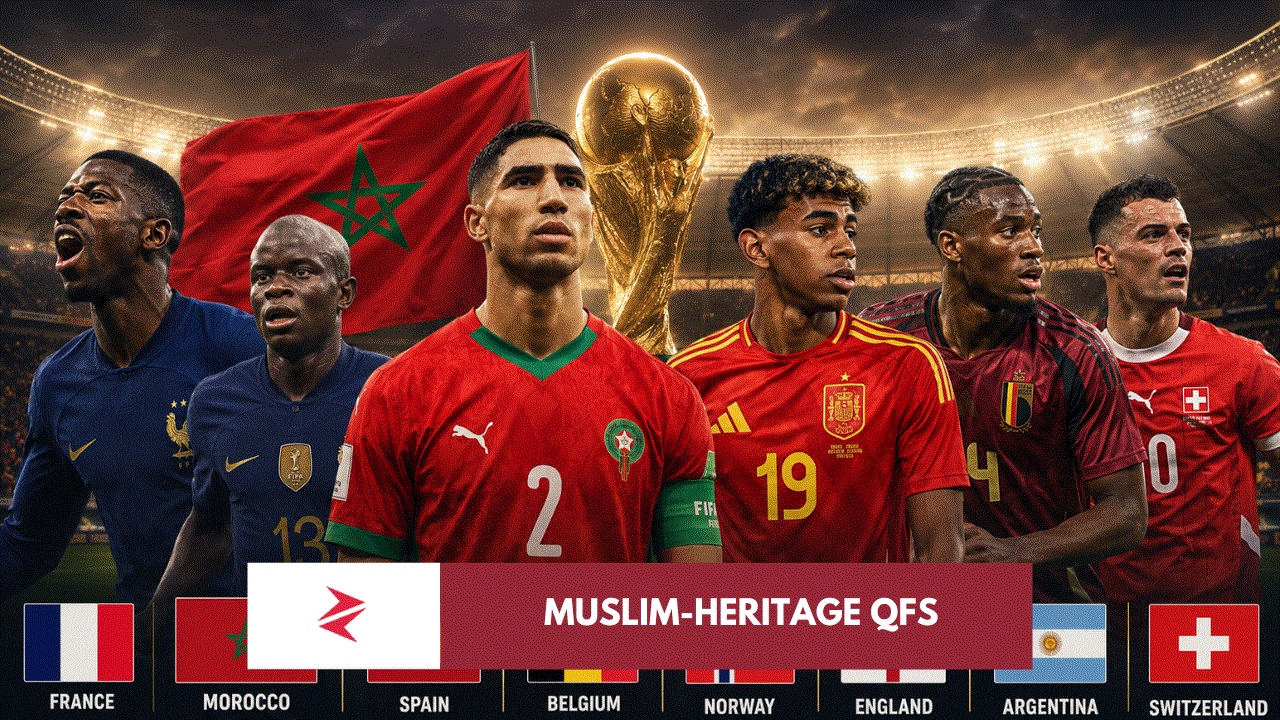
The stronger line is narrower, cleaner and more defensible: Morocco were the only Muslim-majority nation in the top eight, while France, Spain, Belgium and Switzerland carried the clearest Muslim or Muslim-heritage player relevance among non-Muslim-majority quarter-finalists.
Ranking Muslim-World Relevance At The Top-Eight Stage
| Rank | Nation / Player | Why It Matters |
|---|---|---|
| 1 | Morocco | Only strict Muslim-majority nation to reach the World Cup 2026 top eight |
| 2 | Lamine Yamal, Spain | Muslim-heritage attacking force with Moroccan background and major tactical gravity |
| 3 | Ousmane Dembélé, France | Publicly identified Muslim player in one of the strongest remaining teams |
| 4 | N’Golo Kanté, France | Muslim midfielder associated with France’s elite tournament structure |
| 5 | Amadou Onana, Belgium | Publicly self-described Black Muslim immigrant in Belgium’s top-eight squad |
| 6 | Granit Xhaka, Switzerland | Kosovo-Albanian Muslim-community heritage and veteran Swiss leadership |
| 7 | Mohamed Elyounoussi, Norway | Morocco-born heritage relevance, but not the central evidence-based story of Norway’s progression |
Final Verdict
Morocco carried the Muslim-majority flag into the top eight of the FIFA World Cup 2026. That is the central headline, and it should not be diluted.
But the wider Muslim-football footprint did not stop at Morocco. It continued through France’s Muslim-player pool, Spain’s Lamine Yamal, Belgium’s Amadou Onana and Switzerland’s Granit Xhaka. That is the real map modern football keeps showing us: Muslim football influence is no longer contained only inside Muslim-majority countries. It is spread through Europe’s elite systems, African migration routes, North African identity, Balkan memory, and the children of families who moved across borders before football made their names global.

The top-eight stage therefore delivered two truths at once. Morocco stood alone as the only Muslim-majority nation. Muslim-heritage football, however, remained present across several of the tournament’s strongest teams.