







































Why atomic timekeeping matters
Everyday clocks appear simple because the scientific machinery behind them is hidden. Modern telecommunications, broadcasting, satellite systems, navigation, scientific laboratories, power networks and digital transactions depend upon precise synchronization.
A small timing discrepancy means little to someone checking a wristwatch, but at the level of electronic systems it can interfere with data transmission, frequency control and measurement reliability. Atomic timekeeping makes it possible to preserve stability far beyond the capability of ordinary mechanical or electronic clocks.
Khalid Islam did not merely bring back a machine. He brought back the ability to operate, maintain and apply highly specialized knowledge inside Pakistan.
That is what genuine technology transfer looks like. It is not a foreign delegation giving a presentation, signing a photograph-friendly memorandum and leaving. It happens when a Pakistani scientist learns an advanced system, returns home, installs it, trains people and embeds the capability inside a national institution.
Keith Berry, NPL and the relationship with Pakistan
During Khalid Islam’s tenure as Director, NPSL actively cultivated relationships with measurement institutions in other countries. Delegations from the United Kingdom were invited to Pakistan, giving their scientists an opportunity to see the laboratories, technical services and institutional ambition being developed in Islamabad.
Among those visitors was Keith Berry, a research scientist associated with the National Physical Laboratory in Teddington. Berry visited Pakistan three times between 2004 and 2006 and was deeply impressed by the enthusiasm, technical direction and progress demonstrated under Khalid Islam’s leadership.
The relationship developed into a meaningful connection between NPSL and NPL. In reciprocation, Berry invited Khalid Islam to visit NPL and Bushy House, allowing him to return to an institution where he had previously conducted demanding scientific work.
This was scientific diplomacy built through professional respect. Pakistan was not begging for ceremonial recognition. Its scientist had created an institutional relationship by demonstrating competence.
How the Newton apple tree came to Pakistan
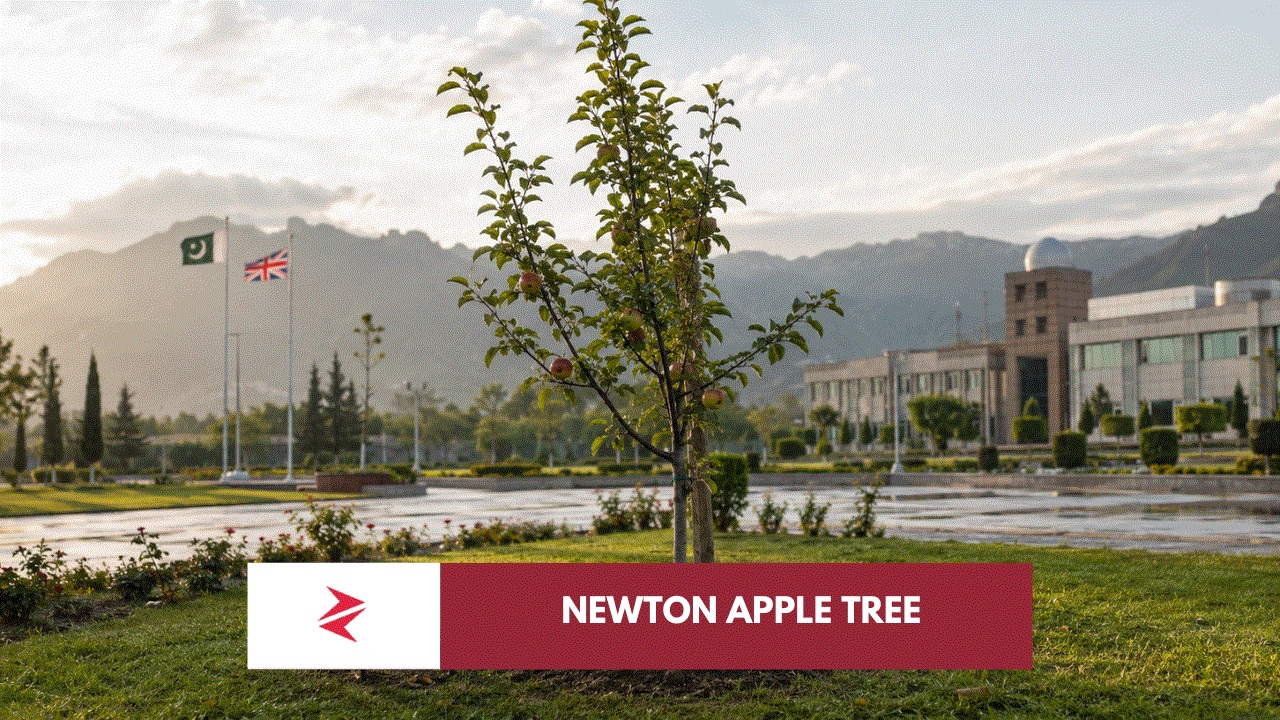
The Newton apple-tree sapling emerged from this Pakistan–United Kingdom scientific relationship. In acknowledgement of Khalid Islam’s work developing NPSL’s primary laboratories and creating a strong linkage with Britain’s National Physical Laboratory, Her Majesty Queen Elizabeth II awarded NPSL a sapling descended from the original Newton apple tree.
The sapling was planted within the premises of NPSL in Islamabad.


Its symbolism was extraordinary. The original apple tree at Woolsthorpe Manor is associated with Sir Isaac Newton’s thinking about gravity—one of history’s most recognizable moments of scientific curiosity. A descendant of that tree reaching Pakistan represented the movement of scientific knowledge across generations, institutions and national borders.
It also represented something more personal. A Pakistani scientist who had once worked inside Britain’s national laboratory had returned home, developed Pakistan’s own institution and built a relationship strong enough for one of science’s most famous living symbols to be presented to NPSL.
That credit belongs to Khalid Islam.
The truth behind Newton’s apple
The popular story claims that an apple fell on Newton’s head and gravity was suddenly discovered. The real intellectual achievement was deeper. Newton observed—or later recalled contemplating—an apple falling toward the ground and began considering whether the same force drawing it toward Earth might extend farther outward and influence the Moon.
The Royal Society’s account of Newton’s apple tree connects the story with William Stukeley, who personally knew Newton and recorded their conversation. The apple therefore belongs to a documented scientific tradition, although popular culture simplified years of thought and mathematics into one dramatic moment.