







































| Popular retelling | Scientific meaning |
|---|---|
| An apple hit Newton’s head | Newton contemplated why an apple fell toward Earth |
| Gravity was discovered instantly | The observation contributed to years of mathematical development |
| Gravity only explains falling objects | Newton connected terrestrial motion with celestial motion |
| The apple was the discovery | The apple represented the question that opened a universal explanation |
| Every Newton tree is the original | Trees outside Woolsthorpe are descendants propagated through seeds or grafting |
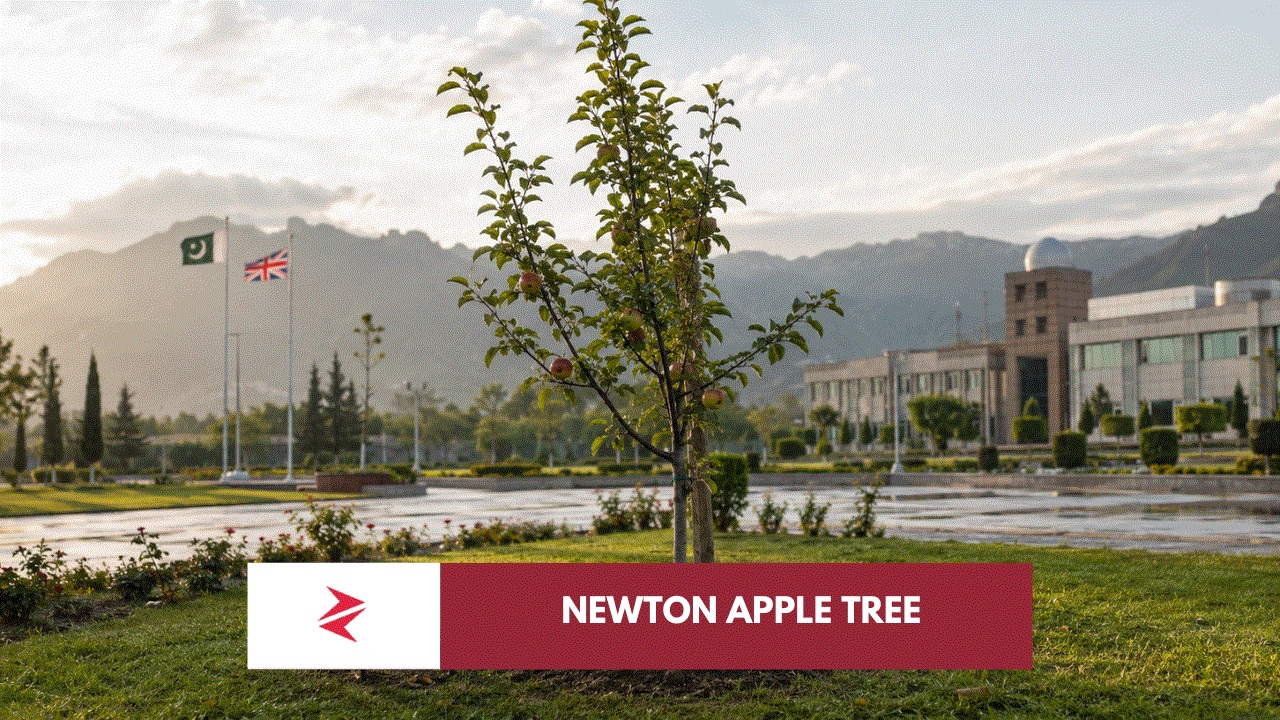
A Newton tree at NPSL was therefore the perfect symbol. Metrology is also about looking beyond ordinary appearances and asking whether the number produced by an instrument can be trusted universally.
What nobody tells Pakistan about its scientific heroes
Pakistan has developed a dangerous habit of remembering positions while forgetting contributors. An institution may retain its name, a laboratory may continue functioning and a machine may remain in service, yet the scientist who created the capability gradually disappears from the official story.
This is how nations lose confidence in themselves.
When young Pakistanis are never told that one of their scientists won an internationally competitive scholarship, worked on atomic timekeeping at NPL, declined a British career, returned home, strengthened Pakistan’s standard-time infrastructure, led the national measurement laboratory and brought a descendant of Newton’s tree to Islamabad, they naturally begin assuming that scientific history happens only in Europe or America.
It does not.
Pakistani scientists have repeatedly built strategic, industrial and research capabilities under conditions far more difficult than those faced by counterparts working in wealthier countries. Their work deserves the same attention given to political personalities, celebrity disputes and temporary social-media spectacles.
Our broader accounts of Pakistani technical figures, including Sultan Bashiruddin Mahmood and Pakistan’s overlooked scientific history, demonstrate why these stories must be preserved before institutional amnesia erases them. The debate surrounding Pakistan’s talent, opportunity and generational future also becomes meaningless if we never honour those who already chose to return and build.
Even today’s expanding world of artificial-intelligence tools depends upon the same foundations Khalid Islam helped strengthen: reliable data, precise timing, reproducible measurement and institutions capable of defining what accuracy actually means.
Why this legacy must be preserved
The Newton apple tree at NPSL should be treated as a national scientific heritage object. Its condition should be documented, its plaque preserved and the story of its arrival presented publicly. The correspondence, photographs and institutional records associated with Khalid Islam’s NPL work and NPSL directorship should also be digitized.
A permanent display could explain Pakistan’s metrology system, atomic timekeeping, Newton’s theory of gravitation and the history of cooperation between NPSL and NPL. Students visiting the laboratory should learn not only why Newton’s tree matters, but why a Pakistani scientist was responsible for bringing its descendant to Islamabad.


The tree could become the centre of an annual Khalid Islam lecture on metrology, scientific diplomacy or precision engineering. Such an initiative would convert a forgotten ceremonial gift into a continuing source of technical education.
Pakistan needs fewer empty tributes and more permanent records.
Frequently Asked Questions
Who is Khalid Islam?
Khalid Islam is a Pakistani scientist, founding contributor to NPSL and its Director from 2003 to 2008. He worked on advanced atomic timekeeping at Britain’s National Physical Laboratory and later strengthened Pakistan’s measurement, calibration, time-frequency and standardization capabilities.