






























Share the post “Pakistan–Kuwait Defence Pact: A Strategic Opportunity Pakistan Cannot Afford to Mishandle”
The Viral Screenshot Is Emotionally Powerful—but It Is Not a Verified Intelligence Brief
The circulating social-media image frames the crisis as a betrayal of Yemen and Iran by Muslim governments. It attributes to Al Mayadeen a claim that Israeli Gulfstream intelligence aircraft assisted Saudi fighter jets, places beside it the Reuters-based assertion that Pakistan warned Iran against attacking Saudi Arabia, and then contrasts Iranian and Yemeni flags with those of Pakistan and Saudi Arabia.
Visually, it is designed to collapse several separate questions into one moral accusation: alleged Israeli-Saudi intelligence coordination, Pakistan’s treaty commitments to Saudi Arabia, Iran’s regional retaliation and the emotional idea of a united Muslim Ummah. The Pakistan-related warning has support in Reuters reporting surrounding the Iran-aligned Houthi attacks on Saudi territory. The allegation concerning Israeli Gulfstream surveillance aircraft, however, appears to originate from partisan reporting attributed to an unnamed Yemeni source and was not independently corroborated by Reuters or Associated Press in the material reviewed. It should therefore be identified as an allegation, not promoted as established operational fact.
This matters because Pakistan cannot build foreign policy from viral collages. States operate amid overlapping arrangements that often offend ideological simplicity: Gulf governments cooperate militarily with Washington while maintaining economic relationships with China; Iran confronts American installations while calibrating where and when it attacks; Pakistan mediates between Washington and Tehran while remaining formally committed to Saudi defence; and regional states publicly invoke Islamic solidarity while privately pursuing national survival.
Hypocrisy exists, but exposing hypocrisy is not a substitute for developing a Pakistani strategy.
What the Kuwait Talks Actually Mean for Pakistan
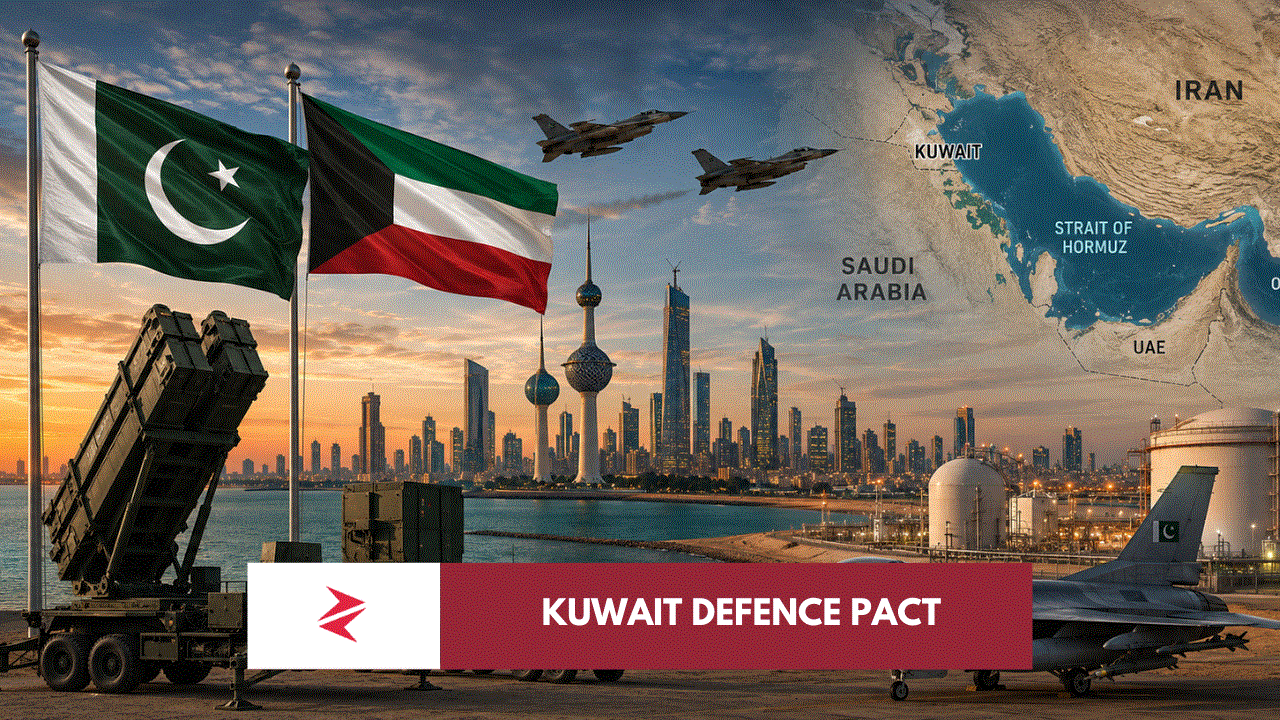
The Kuwait negotiations confirm that Pakistan’s military value is no longer confined to South Asia. Gulf states are looking beyond total dependence on Washington and seeking partners that can provide trained manpower, combat aviation, drone operations, integrated air defence, infrastructure protection and rapid mobilisation without imposing the same political conditions associated with Western deployments. Reuters’ reporting on Pakistan’s military capabilities and its existing Gulf relationships shows why Islamabad is being approached: Pakistan possesses a large, operationally experienced military, a mature aviation ecosystem and increasingly credible air-defence capabilities.
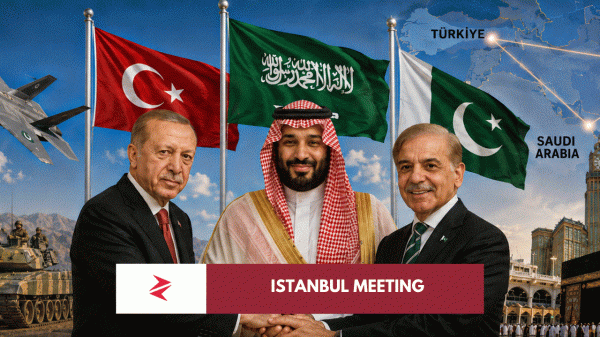
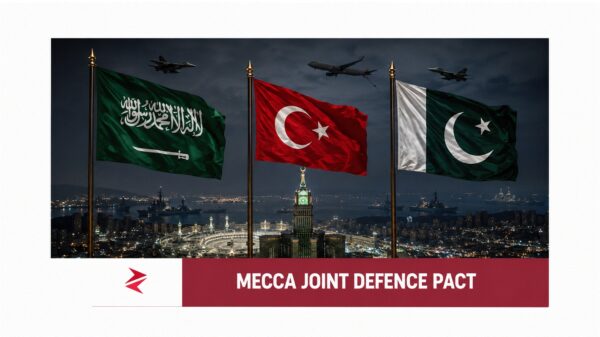
Pakistan’s 2025 Strategic Mutual Defence Agreement with Saudi Arabia established that aggression against either country would be treated as aggression against both. Pakistan subsequently deployed thousands of personnel, JF-17 aircraft, drones and an HQ-9 air-defence system to Saudi Arabia during the Iran conflict, according to Reuters. Kuwait is now examining whether a comparable Pakistani security presence could reduce its exposure to missiles, drones and attacks against critical infrastructure.
This is not a minor diplomatic development. It suggests that Pakistan could become one of the central security providers in an emerging Muslim and Global South order, a possibility that connects directly with the wider argument explored in Donald Trump, the New World Order and the Muslim World. Yet becoming central does not automatically mean becoming sovereign. A state can sit at the centre of everyone else’s war and still be merely used as manpower if it fails to price its participation properly.
Pakistan must therefore reject the psychology of gratitude. Kuwait is not doing Pakistan a favour by requesting Pakistani protection. It is approaching Pakistan because American protection has become politically uncertain, geographically overstretched or insufficient against the scale and speed of contemporary missile and drone warfare. Pakistan is bringing the scarce commodity to the table.
The Energy Deal Must Be Physical, Measurable and Enforceable
Pakistan should not accept vague promises of “investment” in exchange for concrete military exposure. If Pakistani personnel, aircraft, intelligence systems or air-defence units are expected to protect Kuwaiti territory, then the economic component must consist of legally enforceable assets rather than press-release language.
Reuters reported that Islamabad is seeking expanded fuel supplies, investment and a bonded fuel-storage arrangement. This could be valuable because Pakistan remains acutely vulnerable to international oil-price shocks, maritime disruption and instability around the Strait of Hormuz. The weakness of relying upon headline reserve numbers without effective pricing protection has already been examined in Pakistan’s petrol-price shock and its limited oil reserve.


A credible agreement should therefore include guaranteed minimum fuel volumes, Pakistani ownership or legally protected access to strategic stocks, storage facilities physically located in Pakistan, transparent pricing formulas, emergency shipping priority, long-term investment in refining and petrochemical capacity, and penalties for unilateral suspension. Training exercises can be suspended overnight; aircraft can be recalled; political assurances can evaporate after a palace reshuffle. Storage tanks, pipelines, refinery equity and contracted fuel volumes are harder to pretend away.
Pakistan must also demand labour reciprocity. Kuwait lifted what Islamabad described as a 19-year restriction on Pakistani visas in 2025 and resumed categories including work, family, business, tourist and visit visas. That history cannot simply disappear now that Kuwait requires Pakistani strategic protection. A defence agreement should include protected employment pathways for Pakistani engineers, doctors, technicians, cybersecurity specialists, aviation professionals and skilled workers, along with enforceable standards against discriminatory recruitment practices.
Security cannot flow in one direction while dignity, employment and mobility remain conditional in the other.








Wan AI
July 19, 2026 at 6:28 pm
The idea that a Pakistan–Kuwait defence partnership should be viewed as a long-term strategic relationship rather than a symbolic agreement is an important distinction. It would also be interesting to explore what practical steps—such as joint training, defence technology cooperation, or intelligence sharing—would make the partnership sustainable instead of just another headline.