






































Share the post “Pakistan–Kuwait Defence Pact: A Strategic Opportunity Pakistan Cannot Afford to Mishandle”
Pakistan Must Not Become a Front-Line State Against Iran
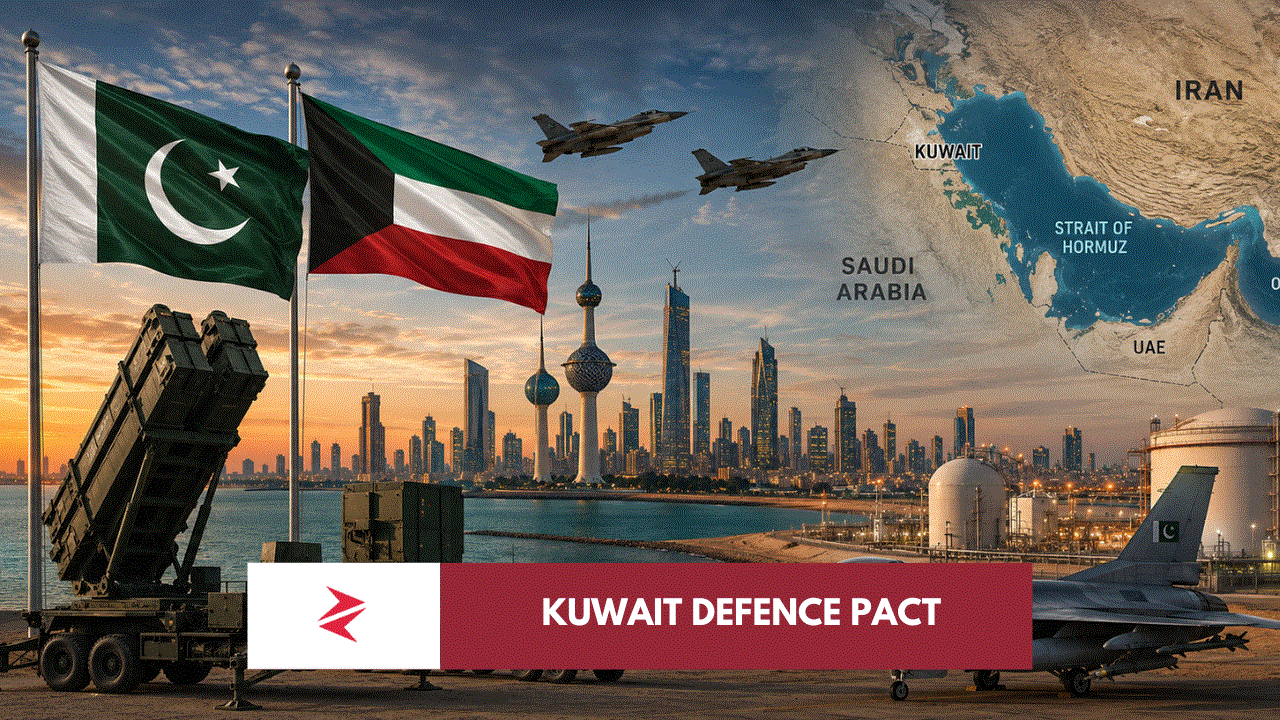
Pakistan has legitimate obligations toward Saudi Arabia and legitimate reasons to cooperate with Kuwait, but geography refuses to disappear merely because Gulf financing looks attractive. Iran is Pakistan’s direct neighbour. The two countries share a long border, interconnected communities, trade routes and security problems that neither can permanently solve through intimidation.
Islamabad must make one red line unmistakable: Pakistani territory, bases, aircraft and personnel cannot be used for offensive operations against Iran unless Pakistan itself is directly attacked or a formally defined collective-defence threshold is crossed. Protecting Kuwaiti desalination facilities from incoming missiles is defensive. Flying offensive sorties deep into Iranian territory is an entirely different commitment. Intercepting drones aimed at civilians is defensive. Participating in an American or Israeli campaign for regime change would be strategic recklessness.
Pakistan should retain national command over all deployed forces, require written rules of engagement, prohibit unilateral tasking by foreign commanders and establish automatic parliamentary and cabinet review if a defensive deployment moves toward offensive combat. The country’s air-defence capabilities are a premium strategic service, not an open-ended subscription that foreign capitals may activate whenever their own decisions produce retaliation.
The country must also preserve its ability to mediate. Pakistan and China have continued calling for de-escalation and renewed negotiations between Washington and Tehran, even as Pakistan’s Saudi commitments pull it closer to the Gulf security architecture. That balancing position is difficult but valuable. It would be destroyed the moment Pakistan becomes publicly identified as an operational participant in attacks on Iranian territory.
What Nobody Is Telling Pakistanis
The most important hidden reality is that Gulf security and Pakistani energy security are becoming negotiable parts of the same transaction. Kuwait possesses capital, fuel and strategic storage opportunities but lacks the demographic and military depth required for a prolonged regional confrontation. Pakistan possesses manpower, defence-industrial capacity, combat experience and geographic reach but remains vulnerable to fuel disruption, external financing pressure and weak strategic reserves.
That complementarity can produce a genuine partnership, but only if Pakistan avoids repeating the old formula in which it provides hard security while receiving temporary deposits, delayed investments and verbal brotherhood.
The second hidden reality is that a regional defence role will impose opportunity costs. Fighter squadrons stationed abroad are not available for every domestic contingency. Air-defence batteries deployed around Kuwaiti power stations cannot simultaneously protect Pakistani infrastructure. Thousands of soldiers committed overseas require logistics, rotation, insurance, medical support and political accountability. Pakistan’s defence resources are substantial, but they are not infinite; the relationship between military ambition and economic capacity remains central to the country’s defence-budget dilemma.
The third hidden reality is that energy security cannot be reduced to imported petroleum. Even a perfectly negotiated Kuwaiti fuel arrangement would leave Pakistani industry exposed to shipping disruption, currency depreciation and international price spikes. Pakistan must convert this moment into accelerated investment in domestic solar generation, battery storage, energy-efficiency retrofits and industrial microgrids. Oil storage protects weeks or months; distributed generation protects factories and households every day.
For Pakistani businesses, the practical response is to calculate how much production would be lost during a Gulf-driven fuel or grid emergency and then build an onsite resilience plan through solar, battery storage, load management and professional energy auditing. Companies seeking that transition can use the Solar Trade platform for equipment sourcing and approach Zorays Solar for system design, commercial energy audits and project consultation. Waiting for the next Hormuz closure before calculating backup requirements is not caution; it is negligence.
The Nuclear Argument Is a Distraction from the Real Strategic Question
The parallel online debate over whether Iran, Pakistan, Israel or any other state morally “deserves” nuclear weapons begins from a flawed premise. Nuclear capability has never been awarded as a certificate of good behaviour. It is acquired through scientific capacity, political will, economic sacrifice, intelligence protection and the ability to survive external pressure.


Pakistan’s deterrent exists because the country concluded that conventional assurances were insufficient for national survival. Iran’s calculations arise from its own threat environment. Israel’s undeclared arsenal exists under a separate system of Western protection and strategic ambiguity. Arguing endlessly about which government is morally pure enough to possess such weapons may produce compelling podcasts, but it does not explain how states actually behave.
The correct Pakistani question is narrower: does a Kuwait agreement strengthen Pakistan’s sovereignty, economic resilience and deterrence, or does it create new vulnerabilities that other capitals can activate?
Anything that does not answer that question is noise.









Wan AI
July 19, 2026 at 6:28 pm
The idea that a Pakistan–Kuwait defence partnership should be viewed as a long-term strategic relationship rather than a symbolic agreement is an important distinction. It would also be interesting to explore what practical steps—such as joint training, defence technology cooperation, or intelligence sharing—would make the partnership sustainable instead of just another headline.