






























This Is Where the Oil-Shock Investment Thesis Becomes Important
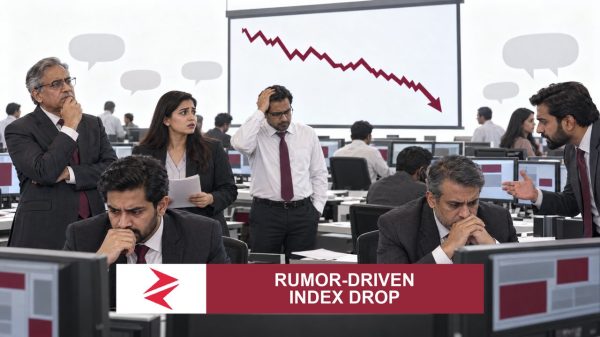
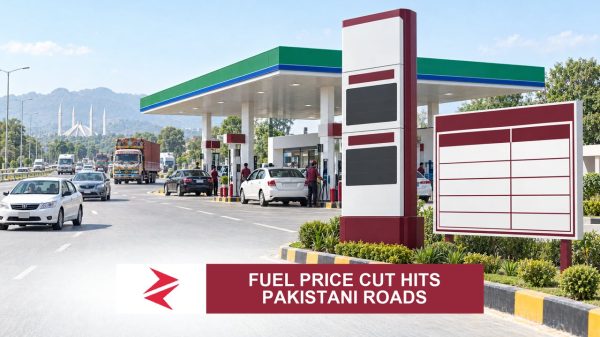
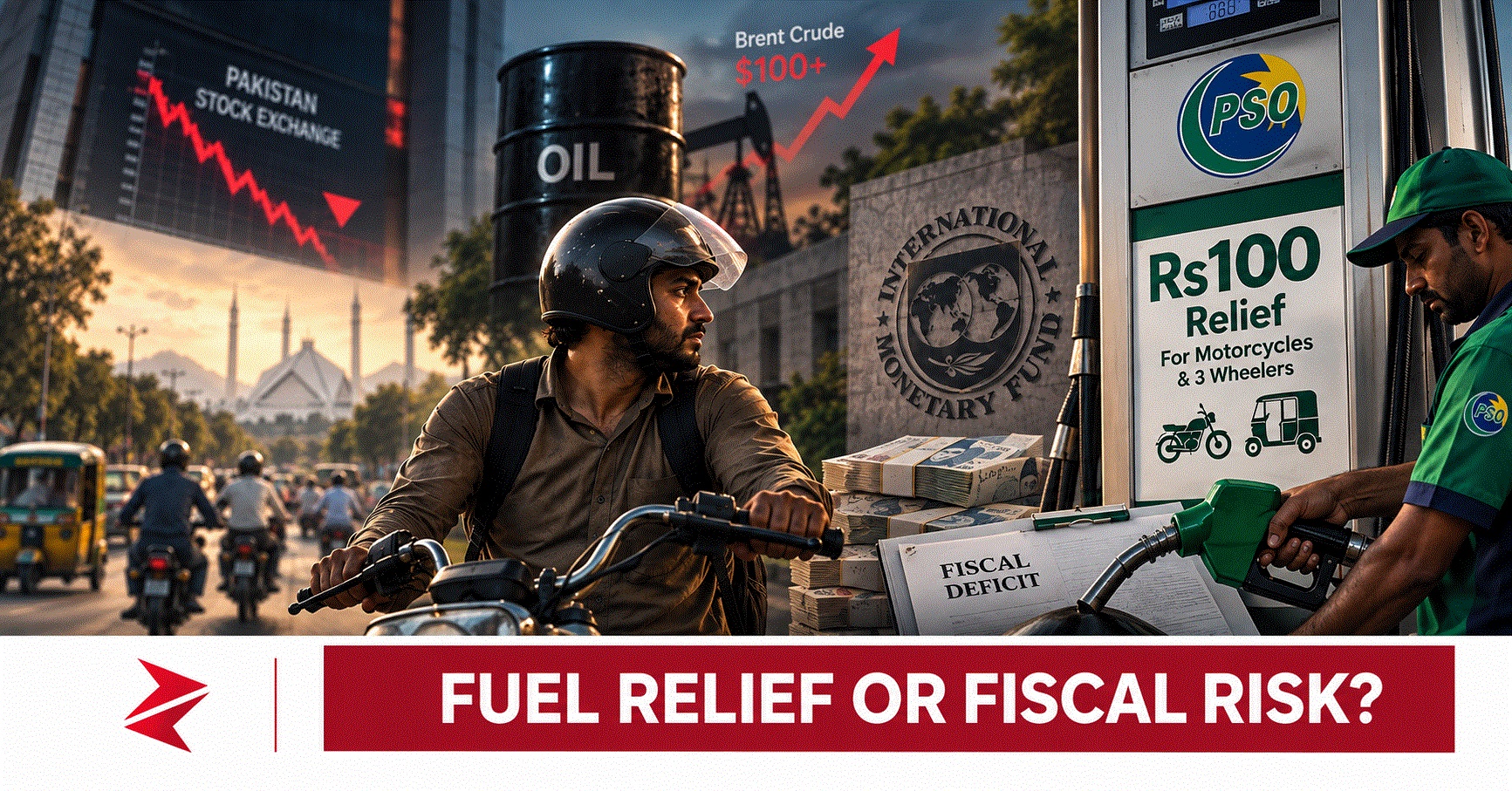
This is also where the petrol-relief debate connects directly with a broader investment thesis I have been examining: what happens to Pakistan and the Pakistan Stock Exchange if international oil remains expensive?
The transmission mechanism is uncomfortable.
Expensive international oil raises Pakistan’s import bill. A larger import bill increases demand for foreign exchange. That can put pressure on the rupee. A weaker rupee makes imported energy still more expensive in Pakistani currency. Fuel feeds transportation costs; transportation feeds practically every supply chain in the country; inflation becomes harder to extinguish; monetary easing becomes more difficult; corporate financing remains expensive; disposable household income declines; and equity valuations can consequently come under pressure.
The petrol subsidy interrupts one tiny section of that chain for selected consumers.
It does not break the chain.
Indeed, if the subsidy itself produces an unfunded fiscal cost, Pakistan can find itself simultaneously absorbing the external cost of expensive crude and the domestic fiscal cost of shielding selected consumers from it.
That is why a policy designed to fight inflation today can, if poorly financed, contribute to inflationary pressure tomorrow.
But Isn’t Targeting Motorcycles Better Than Subsidising Everyone?
Absolutely.
This is where criticism needs to remain intellectually consistent.
A capped, digitally verified benefit for motorcycles is unquestionably more targeted than freezing petrol prices for Pakistan’s entire population. The ECC’s one-owner/one-vehicle restriction and Fuel Pass System are specifically designed to prevent an unrestricted subsidy.

The government therefore deserves credit for not simply cutting the pump price by Rs100 for everybody.
But targeted by vehicle ownership is not the same thing as targeted by economic need.
A motorcycle registration certificate does not tell the government how poor somebody is.
A household can own several motorcycles. A genuinely destitute household may own none. A student from a wealthy family can ride a motorcycle. A widow dependent on public transport may receive nothing. A low-income worker may still be using an old motorcycle whose registration data are incomplete or outdated.
That last issue is already appearing in public reaction to the programme. Social-media users have questioned eligibility rules, including claims that older registrations may be excluded, while others have questioned how fuel allocation and verification will actually work. Those comments should be treated as public observations rather than confirmed policy rules until the government publishes definitive eligibility documentation.
That distinction is important because criticism of the scheme should be based on what government has actually approved, not whatever happens to be circulating on X.
The Fuel Pass Solves One Problem and Creates Another
The digital Fuel Pass System makes this scheme considerably more sophisticated than a traditional blanket subsidy.
But digitisation does not abolish arbitrage.
Petrol is fungible.
If one litre is available to Person A for Rs100 less than Person B is willing to pay for exactly the same litre, an economic incentive to transfer that benefit immediately exists. The larger the price differential, the stronger that incentive becomes.
That does not mean every motorcyclist will become a black-market petrol dealer. It means the system has to be designed on the assumption that somebody will try.
Pakistan’s history of commodity interventions gives us little reason to treat leakage as an imaginary risk. Whenever subsidised and market-priced versions of effectively identical commodities coexist, administrators must police identity fraud, duplicate registrations, false claims, diversion, resale and collusion at distribution points.
A token verifies an entitlement.
It does not necessarily verify what happens to the economic value of that entitlement afterwards.
Pakistan Has Already Run This Experiment in Another Form
There is an especially important historical precedent.
During the 2022 energy and inflation crisis, Pakistan created Sasta Fuel Sasta Diesel, but the relief was delivered through cash transfers rather than maintaining cheap fuel for everybody. IMF records show that approximately Rs16.8 billion was used for a one-off Rs2,000 transfer covering 7.6 million Kafalat families and another one million non-Kafalat families selected using poverty-means testing.
The IMF subsequently noted that the scheme was extended to lower-middle-income households, while Pakistan continued expanding the BISP safety net.
There is an even more revealing passage in Pakistan’s 2023 IMF programme documentation. Authorities ultimately decided against executing another budgeted Sasta Fuel Sasta Diesel programme and described BISP as the country’s prime programme for supporting the most vulnerable.
That history provides a serious alternative to today’s Fuel Pass.
Instead of asking:
“Which vehicle does this Pakistani own?”
Government can ask:
“How economically vulnerable is this Pakistani household?”
Pakistan already possesses the National Socio-Economic Registry and BISP infrastructure for precisely this purpose. IMF programme documents have repeatedly supported targeted transfers through that system, including expansion of Kafaalat to millions of households.
If the government wants to spend Rs2,000 helping somebody survive an oil shock, I would rather see that Rs2,000 follow the person’s economic condition than the cubic capacity or registration certificate of the machine parked outside his house.
The Forgotten Victim Is the Pakistani Who Owns Nothing
This is perhaps the strongest moral and economic argument against using vehicle ownership as the primary poverty filter.
Consider two Pakistanis.
One household owns three motorcycles. Another household cannot afford one and relies on buses, vans, walking and borrowed transport.
Under a vehicle-based programme, the first household may qualify while the second receives nothing directly.
Yet the second household is hardly protected from expensive oil.
The bus carrying its children becomes more expensive. Vegetables arriving from another district become more expensive. The van carrying workers becomes more expensive. The truck transporting wheat becomes more expensive. The generator powering a shop becomes more expensive.
Oil inflation reaches people who never personally purchase a litre of petrol.
That is precisely why income-based social protection is economically different from subsidising possession of a particular asset.