


















Share the post “BRICS or Buffet? How India’s Summit Optics Ate Its Diplomatic Message”
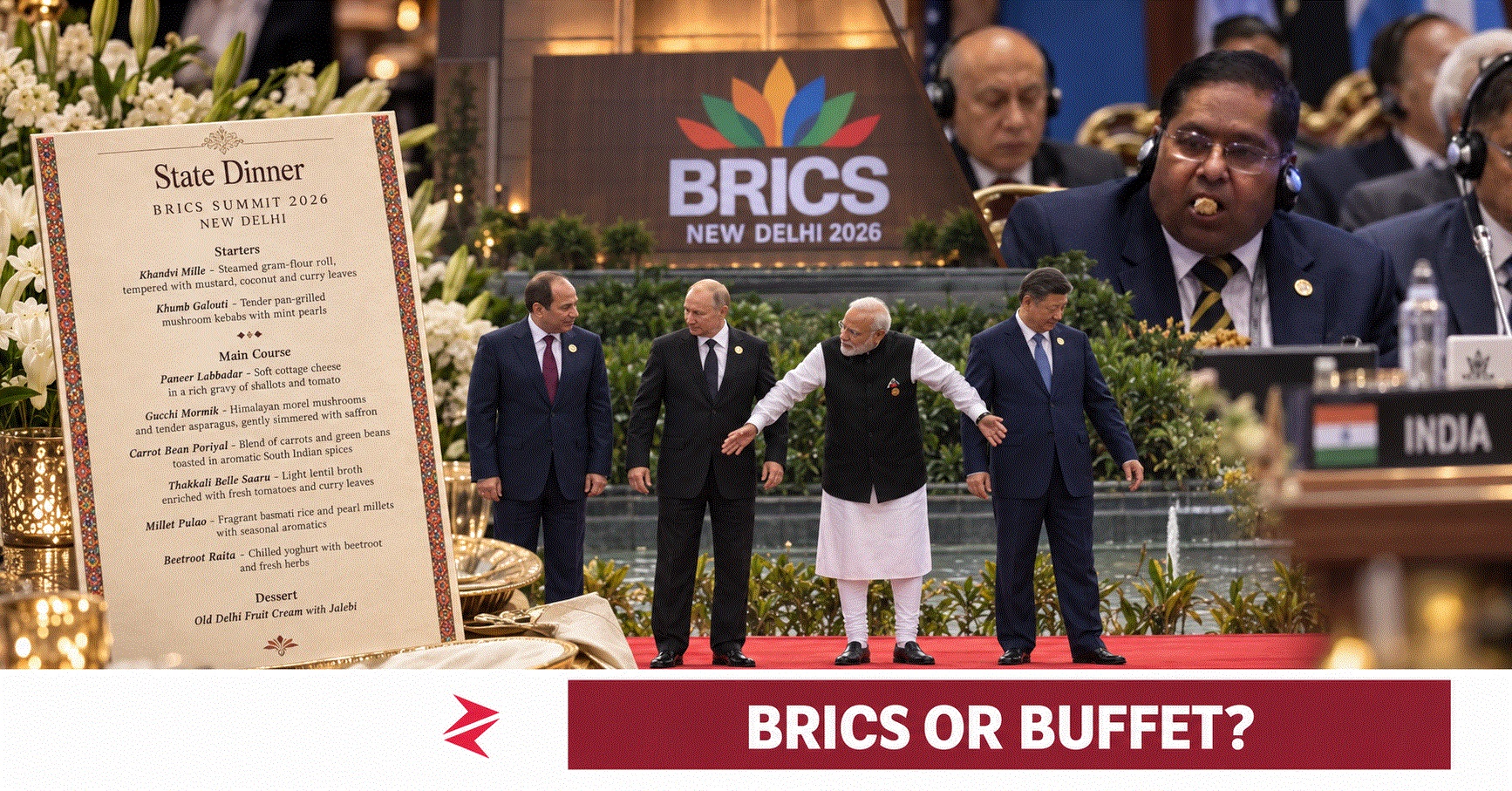
India gathered some of the world’s most consequential leaders in New Delhi to discuss wars, sanctions, payment systems, artificial intelligence, supply chains and the future of the Global South—and somehow ended up defending mushrooms, managing an awkward photograph and explaining why its diplomatic spokesperson was licking his fingers behind a speaking president.
That is not merely an internet joke. It is a brutal lesson in political communication: when a host government choreographs every visible detail as a projection of national power, every visible failure becomes part of the diplomatic record too.
The 18th BRICS Summit, held at Bharat Mandapam on September 12–13, 2026, was not an empty gathering. Its leaders adopted the New Delhi Declaration, backed greater use of local currencies, called for reform of international institutions and reached consensus on contentious global conflicts. The expanded bloc now represents approximately half of humanity, giving the summit genuine strategic weight rather than ceremonial importance. Associated Press
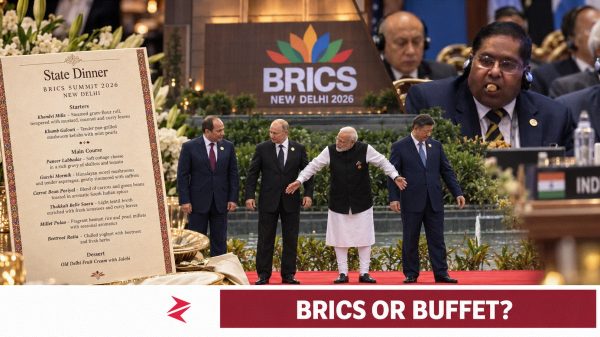
Yet India’s carefully manufactured visual narrative repeatedly escaped its handlers. First came the entirely vegetarian gala menu and the debate over whether Hindutva-era hospitality was presenting India’s diversity or sanitising it. Then came Narendra Modi’s highly animated effort to arrange—and physically connect—Vladimir Putin and Xi Jinping during a photo opportunity. Finally, a camera trained on Iranian President Masoud Pezeshkian caught Ministry of External Affairs spokesperson Randhir Jaiswal repeatedly reaching for dry fruits and apparently licking his fingers while the address continued.
Each episode can be dismissed individually. Together, however, they reveal the weakness of diplomacy conducted as spectacle: the camera eventually captures something the script did not anticipate.
The vegetarian dinner was not offensive—but it was politically revealing
The BRICS gala dinner reportedly opened with khandvi mille-feuille and khumb galouti, followed by paneer lababdar, gucchi mushrooms, carrot-bean poriyal, lentil broth, millet pulao, beetroot raita and Indian breads. Desserts included Old Delhi fruit cream with jalebi and shahtoot phirni. It was elaborate, regionally inspired and unquestionably Indian. It was also entirely vegetarian. The Indian Express
Serving vegetarian food is not inherently inhospitable. It simplifies religious and dietary considerations, including halal, jhatka and other restrictions, while allowing every guest to eat from a common table. Delegations also possess their own catering arrangements, chefs and hotel facilities. Nobody sensible believes Putin, Xi or Pezeshkian travelled to Delhi because they had been promised a plate of biryani.
But that defence avoids the actual criticism. The controversy was never truly about whether paneer tastes good. It was about which India the Modi government chose to exhibit.
Delhi’s culinary identity is inseparable from kebabs, qorma, nihari, butter chicken, tandoori dishes and biryani. These are not foreign contaminants hiding inside Indian history. They are products of the subcontinent’s shared Indo-Muslim civilisation, shaped across Delhi, Lucknow, Hyderabad, Lahore and other cultural centres. Presenting Delhi while erasing this inheritance does not broaden Indian culture; it edits it.
Congress leader Rahul Gandhi reacted by writing that “80% of Indians are non-vegetarian,” while the Pew Research Center’s widely cited survey found that 39% of Indian adults described themselves as vegetarian and 81% observed at least some restriction on meat consumption. Those findings are compatible: India contains many meat-eaters who nevertheless avoid particular meats or abstain on certain days. It is precisely that complexity which a single ideologically immaculate menu could not represent.

| Summit optic | Verified factual basis | Legitimate criticism | What should not be claimed |
|---|---|---|---|
| Entirely vegetarian dinner | The published menu contained vegetarian starters, mains and desserts | It presented a selective version of India’s vast culinary identity | Vegetarian food itself was disrespectful to delegates |
| Xi Jinping’s absence | Indian reporting said Xi skipped the gala dinner | His absence weakened the intended symbolism of the banquet | The menu caused his absence, without supporting evidence |
| Modi’s group-photo direction | Video showed Modi gesturing while leaders arranged themselves | The interaction appeared over-managed and invited ridicule | Putin or Xi was demonstrably “insulted” without their statements |
| Officials eating during an address | Viral footage showed Indian officials taking dry fruits during the session | Finger-licking and persistent eating produced poor host-country optics | Ordinary hunger or eating provided refreshments is inherently misconduct |
| AI-generated summit photograph | Fact-checkers identified impossible participants in an image circulated by political figures | It demonstrated careless digital propaganda around a major diplomatic event | The fabricated image was an official BRICS photograph |
Note: “Embarrassing” describes the observable public optics and subsequent reaction; it does not prove diplomatic damage unless participating governments say relations were affected.
Chinese President Xi Jinping reportedly skipped the gala dinner. That absence was newsworthy, but its cause must not be invented merely because the menu became controversial. There is no credible evidence that Xi rejected the dinner because it lacked meat, because he wanted food from Karim’s or because he considered the banquet insulting. The viral image showing Xi and Putin dining at Karim’s was satire, not a leaked photograph.
The joke nevertheless travelled because it captured a cultural truth: a plate overflowing with Delhi’s famous Mughlai food looked more recognisably connected to the city than the government’s precision-curated hospitality statement.
Pakistanis understand this contrast instinctively. Much of the culinary culture that contemporary Hindutva appears uncomfortable owning survived Partition openly and unapologetically in Pakistan. Nihari, seekh kebab, qorma, pulao, biryani and tandoori meat require no defensive footnote in Lahore, Karachi or Rawalpindi. The claim that “Muslim Hindustani culture migrated to Pakistan with the Muhajirs” is too sweeping as literal history, but it expresses why the banquet controversy resonated across the border: India wants civilisational prestige while increasingly becoming selective about the Muslim civilisation that helped produce it.